Boost Your Shopify Conversion Rate by Ditching Discounts for Store Credit
Mar 4, 2026
|
Published
Let's be honest, that conversion rate you obsessively track in your Shopify dashboard is hiding a painful truth. You see the number, maybe even a decent one, and feel a momentary sense of relief. But behind that single metric, a silent killer is eating away at your store’s profitability: discount culture.
Your Shopify Conversion Rate Is Costing You Money
We've all been there. You get a little nervous about sales, so you blast out a coupon code. The orders roll in, the conversion rate spikes, and it feels like a win. But is it?
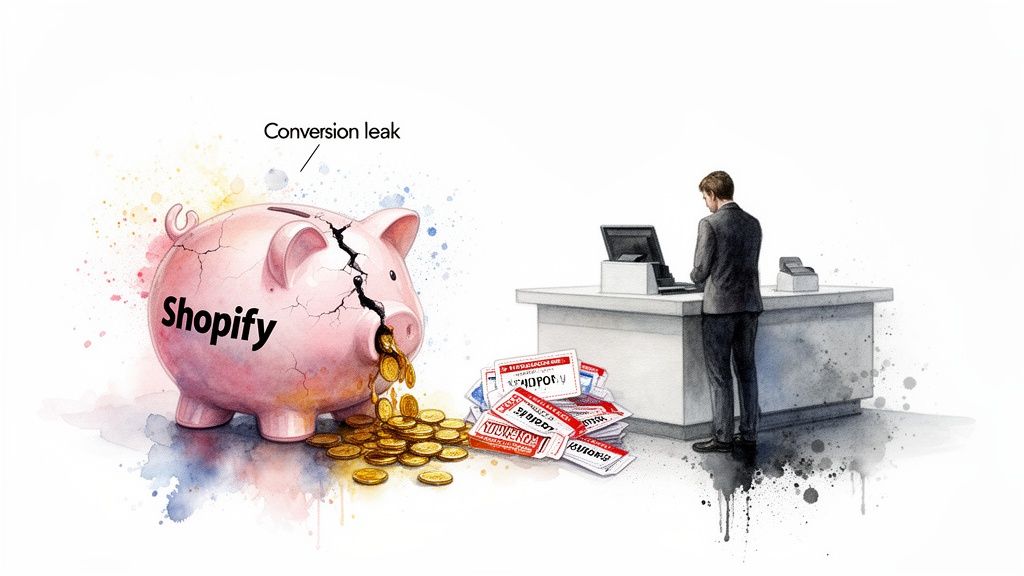
This endless cycle of coupon codes, flash sales, and confusing point systems has trained our customers to become professional bargain hunters. They’ve learned to wait for the next "20% OFF" email before they even think about buying. This behavior directly tanks your margins and, over time, systematically devalues your brand. You’re teaching them your products aren’t worth full price.
The Real Problem Hiding Behind Your Conversion Rate
The issue isn't just about getting one sale across the finish line. The real problem is the collateral damage to your customer lifetime value (LTV) and your average order value (AOV). These are the twin pillars of sustainable e-commerce growth, and a discount-first strategy actively sabotages both.
Low AOV: When a customer knows a discount is waiting, they have zero incentive to add more to their cart. They grab what they came for, slap the code on it, and check out. You just left potential revenue sitting on the table.
Low LTV: By training shoppers to buy only during sales, you make it nearly impossible to cultivate loyal, full-price customers. Their relationship with your brand becomes purely transactional, built on getting the lowest possible price.
Let's put some hard numbers to this. Industry data shows the average Shopify conversion rate hovers between 1.4% and 1.8%. If you’re hitting 3.2%, you’re in the top 20% of stores. The elite—the top 10%—are converting at 4.7% or higher.
These numbers prove that even tiny improvements can create massive revenue swings, but only if those improvements are profitable.
The goal isn't just converting traffic; it's converting traffic profitably. A 5% conversion rate fueled by 40% discounts is a race to the bottom. A 2% conversion rate from full-price, repeat customers is how you build an unbreakable brand.
It's Time to Shift From Discounts to Value
To break the cycle, you need a fundamental shift in how you think about incentives. Stop asking, "How can I get more conversions?" Start asking, "How can I get more profitable, repeat conversions?"
The answer isn’t a bigger discount or a more complex loyalty program. It’s about changing the game entirely.
Instead of slashing your prices with coupons, what if you rewarded customers in a way that actually encourages them to spend more and come back sooner? This is where a native Shopify store credit system becomes your secret weapon. It reframes "loyalty" from a cheap gimmick into a genuine asset for the customer and a profit driver for you.
To get there, you first need a solid foundation. A comprehensive understanding of Conversion Rate Optimization for Shopify provides the practical strategies you need to turn more visitors into customers without giving away the farm.
This guide will show you exactly why old-school discounts and points systems are failing modern DTC brands. More importantly, we'll walk you through a powerful, margin-safe solution that uses native Shopify store credit to boost both AOV and LTV. It’s time to turn those one-time bargain hunters into your most valuable, loyal customers.
Why Store Credit Outperforms Every Discount
Let's be honest. The constant cycle of discounting is a race to the bottom, and it’s a game you can't win. Slashing prices might give you a temporary sales bump, but it slowly bleeds your margins and trains your customers to wait for the next sale.
To truly improve your conversion rate on Shopify for the long haul, you don't need a bigger discount—you need a smarter incentive. This is where native Shopify store credit, when done right, completely flips the script.
Unlike a 20% off coupon that feels transactional and, frankly, a bit cheap, store credit feels like ‘found money’ to your customers. It's a real balance waiting in their account, giving them a powerful, built-in reason to come back. That small psychological shift is what drives two of the most important metrics for your store's growth: Average Order Value (AOV) and Lifetime Value (LTV).
Boost Average Order Value Instantly
The first thing you'll notice is a healthier Average Order Value (AOV). Think about it: a discount code actually encourages customers to spend less. They find their item, slap the code on, and get out. Store credit does the exact opposite.
Picture this: a shopper has $85 worth of products in their cart. A small, dynamic message appears: “Spend just $15 more to get $10 in store credit.”
This isn’t a discount; it’s an investment. All of a sudden, adding that extra item doesn't feel like overspending. It feels like a savvy move to unlock a future reward.
You've changed the entire conversation. Instead of begging for a sale with a cheap coupon, you're inviting them to earn real value. You make the initial sale more profitable while funding their next purchase at the same time.
This works because you're tapping into a powerful motivator. You’re essentially gamifying the shopping cart.
It creates a challenge: Customers are prompted to hit a specific goal, turning a simple purchase into a mini-game where they win.
It protects your margins: You aren't giving away a 20% chunk of your revenue on this order. The reward is only realized on a future purchase—one that might never have happened otherwise.
It shifts the focus to value: The conversation moves from "How much am I saving?" to "How much am I earning?", which makes the whole experience feel more premium.
Using a native Shopify store credit app like Redeemly, you can put these kinds of prompts right on your product pages and in the cart. It makes it dead simple for shoppers to see how close they are to their next reward.
Skyrocket Lifetime Value for Predictable Growth
AOV is a great immediate win, but the real magic of store credit is its impact on Customer Lifetime Value (LTV). This is how you stop chasing one-time buyers and start building a predictable, loyal customer base.
A discount is a one-and-done deal. A loyalty points system? Most of the time, it's just confusing. Customers have no idea how many points they have or what they're actually worth.
Store credit is beautifully simple. It’s cash.
When a customer makes a purchase and earns $10 in credit, that balance sits in their account as a constant, gentle reminder of your brand. A few weeks later, an automated email can pop into their inbox: “Hey, just a reminder you have $10 waiting for you.” This isn't a pushy sales pitch; it's a helpful notification about money they already own.
This kicks off a powerful retention loop:
Customer Shops: They make their first purchase and are encouraged to spend a little more to hit a store credit threshold.
Customer Earns: They instantly get real, cash-value credit in their account.
Customer Returns: That credit balance acts like a magnet, pulling them back for a second, third, and fourth purchase.
This cycle is your escape from the exhausting customer acquisition treadmill. Instead of constantly paying to bring in new people, you’re investing in the customers you already have. The data doesn't lie: increasing customer retention by just 5% can boost profits by 25% to 95%.
Store credit is the most direct path to getting there. It gives your customers a rock-solid financial reason to choose you over a competitor, every single time.
How To Launch Your Store Credit Loyalty Program
Alright, let's move from theory to action. Getting a store credit program off the ground is a lot simpler than most merchants think. This isn't some massive, month-long project. With the right approach, you can swap out your margin-killing discount strategy for a profit-first loyalty program in just a few minutes.
The secret is to use a native Shopify app like Redeemly. It’s built on top of Shopify's own store credit functionality, which means no heavy scripts to slow down your site and no clunky external platforms to manage. The result is a clean, fast, and totally seamless experience for you and your customers, directly helping your conversion rate on Shopify because it makes loyalty feel effortless.
This simple flow shows you exactly how powerful that customer journey can be.
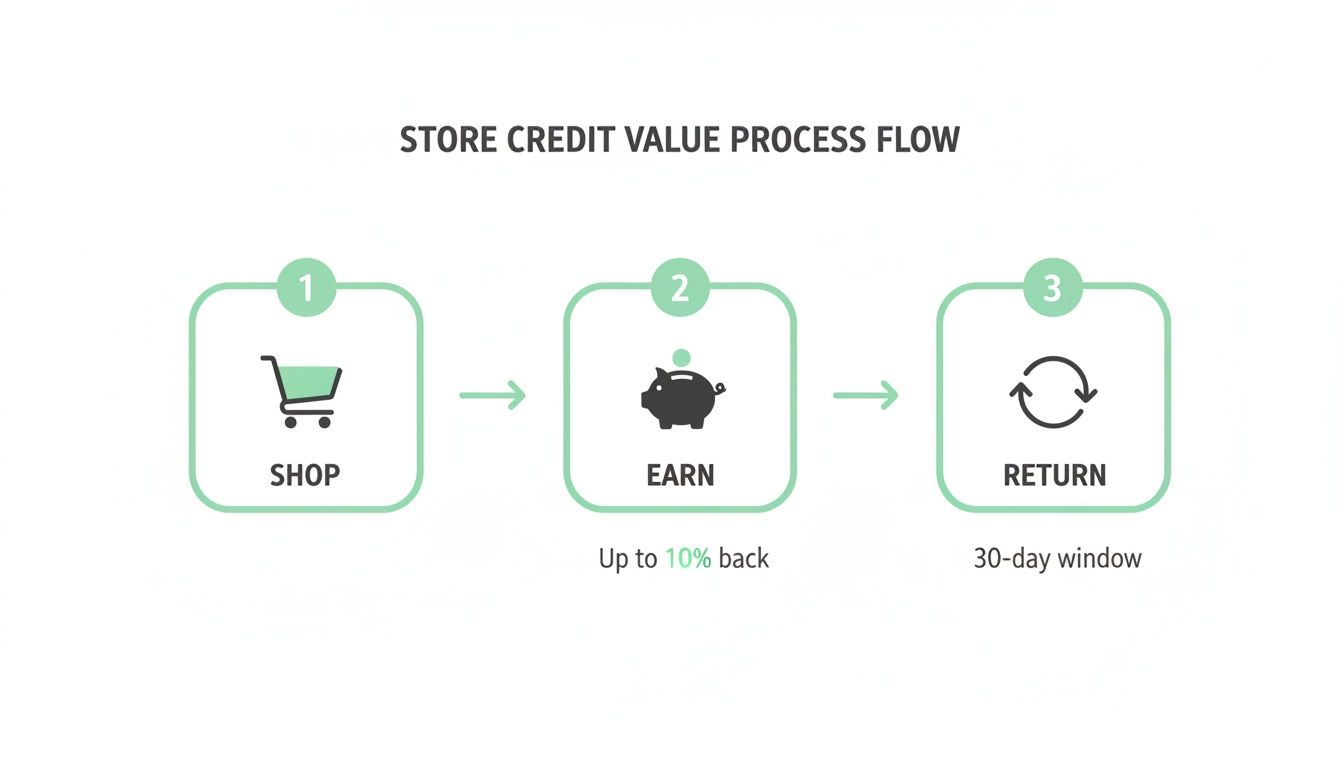
It’s a beautiful, profitable cycle: customers shop, earn a real reward they value, and get a compelling reason to come back and spend that credit. This is what drives sustainable retention.
Setting Up Your First High-Impact Reward
The best way to start is with a reward rule designed to immediately lift your Average Order Value (AOV). A simple spending threshold is a classic for a reason—it just works.
I always recommend starting with the “Spend $100, Get $10 in Store Credit” model.
Here’s why it’s so incredibly effective:
It’s Crystal Clear: Customers get it instantly. No confusing points math, no complicated tiers. It's just simple, tangible value.
It Drives Up-Sells: Think about the shopper with $70 or $80 in their cart. This offer gives them the perfect nudge to add one more item and unlock that reward. That one small decision is a direct line to a higher AOV.
It Protects Your Margin: This is the big one. Unlike a 10% off coupon, you aren't giving up revenue on this initial sale. The cost is deferred until a future purchase—a purchase you are actively encouraging.
Using an app like Redeemly, you can launch this in just a few clicks. You just head to the rewards section, create a new rule, set the spend and credit amounts, and flip it on. No code, no headaches.
Your goal is to make earning a reward feel like a natural, even exciting, part of shopping. A simple spending threshold does this perfectly, turning a standard checkout into a rewarding little win for the customer.
Making the Customer Experience Seamless
A loyalty program is useless if your customers forget it exists. This is the Achilles' heel of most points-based systems—the rewards are out of sight, out of mind. A native store credit system completely flips the script by making a customer’s balance visible and incredibly easy to use.
The best programs put the customer’s balance front and center, making it feel less like a "reward" and more like cash in their pocket.
Here’s how you can create that frictionless experience:
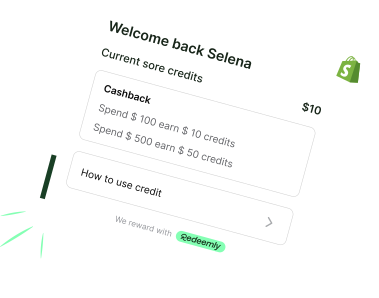
Display a Store Credit Wallet: Add a floating wallet icon or a link in the customer account area. When they click it, it should show their available balance in plain dollars, not abstract points. This reinforces the real-money value of their credit.
Make Redemption Effortless: The system should plug directly into Shopify’s checkout. Customers see their available credit right there and can apply it with a single click, just like a gift card. The days of hunting for promo codes are over.
If you want to dive deeper into the nuts and bolts, our guide on how to give store credit on Shopify breaks down the entire process.
This effortless redemption is crucial for your conversion rate. When a customer comes back and sees they have $10 waiting for them, the decision to buy again becomes almost automatic.
Turning Loyalty Into an Automated Retention Machine
Once your reward rule is live and the customer experience is smooth, the final piece of the puzzle is automation. You shouldn't have to manually chase customers to spend their credit. A smart store credit system handles this for you.
Set up automated email reminders that trigger when a customer has an unused credit balance. I've seen these emails deliver some of the highest engagement rates of any marketing message.
Picture this scenario:
A customer spends over $100 and earns $15 in store credit.
Three weeks go by. They get a friendly, automated email: "Hey, just a reminder that you have $15 in store credit waiting for you!"
That simple nudge brings your brand top-of-mind and reminds them of the "found money" they have. It pulls them back to your store when they might have otherwise forgotten.
These aren't pushy sales emails; they're valuable, helpful notifications. This is how you transform your loyalty program from a passive perk into a proactive retention engine that’s always working to boost your repeat purchase rate and customer lifetime value.
Store Credit Rewards vs Traditional Discounts
When you stack store credit up against traditional discount codes, the long-term winner becomes obvious. While discounts can spike short-term sales, they often come at the expense of your brand value and profit margins. Store credit, on the other hand, builds a foundation for profitable, long-term growth.
Metric | Discount Codes | Native Store Credit Rewards |
|---|---|---|
Profit Margin | Erodes margin on the initial sale. | Protects initial margin; cost is deferred to a second, guaranteed purchase. |
Customer Behavior | Encourages one-off, transactional purchases. | Incentivizes a second purchase, building a habit of repeat buying. |
Brand Perception | Can devalue your brand and train customers to wait for sales. | Positions your brand as premium and rewarding, building true loyalty. |
Average Order Value | Often has no impact or can even lower it if thresholds aren't used. | Directly encourages customers to add more items to their cart to hit a threshold. |
Customer Lifetime Value | Low impact; doesn't create a strong reason to return. | High impact; creates a powerful, built-in incentive for the next purchase. |
The takeaway is clear. By automating the store credit process, you create a sustainable growth loop that consistently drives profitable revenue without needing your daily attention. It’s about building a loyal customer base that chooses to come back, not one that’s just waiting for the next 20% off sale.
Squeeze More Profit from Every Sale with Advanced Store Credit Tactics
So, you've launched your store credit program and officially stepped away from the race to the bottom with margin-killing discounts. That’s a massive win. But don't stop there. Now it's time to really dial things in and turn that program into a serious engine for growth.
These aren't just minor tweaks; they're advanced strategies that fully weave store credit into the fabric of your business. Let's look at how to supercharge your conversion rate on Shopify, boosting both average order value (AOV) and lifetime value (LTV) in the process.
Gamify Spending with Tiered Rewards
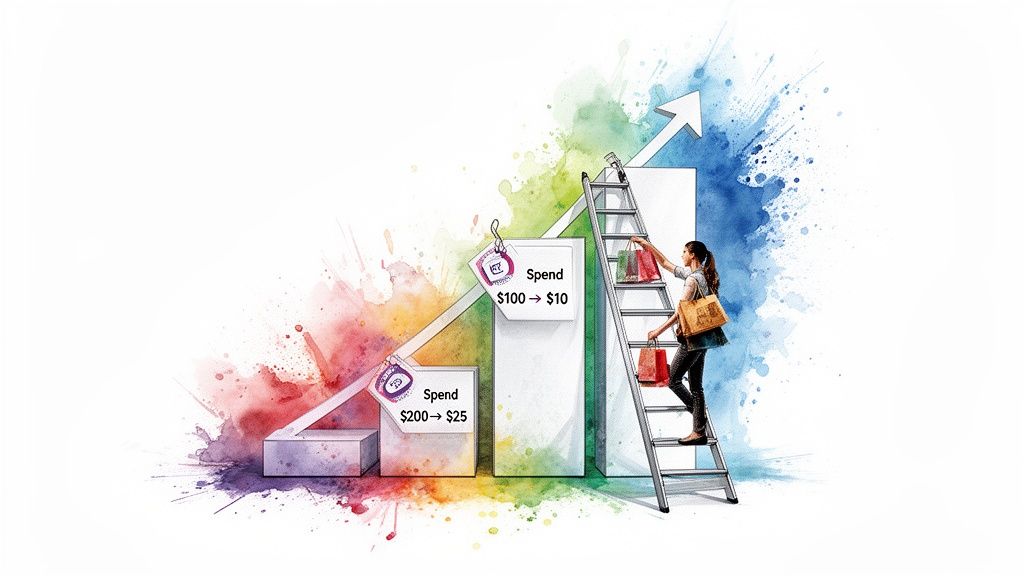
A single spending goal is a great start, but to really move the needle with your best customers, you need to gamify the experience. Tiered rewards are perfect for this, giving your high-value shoppers a compelling reason to push their cart value even higher.
Instead of a flat "Spend $100, get $10" offer, build out a multi-level structure that rewards bigger spending with even bigger kickbacks.
Tier 1: Spend $100, get $10 in credit.
Tier 2: Spend $200, get $25 in credit.
See what happens there? A customer sitting at $160 in their cart suddenly has a very clear incentive to find one more item. They aren't just spending more—they're unlocking a disproportionately better reward. It's a simple psychological nudge that can turn a good order into a fantastic one.
This is how you boost AOV without ever touching a discount code. You're simply rewarding loyalty and protecting your margins at the same time.
Turn Store Credit into Your Customer Service Superpower
Let's be honest: things go wrong. A package gets delayed, an item shows up damaged, or a product just isn't what the customer expected. How you handle these moments is what separates good brands from great ones.
This is where store credit becomes an absolute game-changer for your support team.
Instead of just issuing a refund or offering a generic coupon for a future purchase, empower your team to issue instant store credit as a "we're sorry" gesture.
A customer who has a problem solved with a 15% off coupon feels placated. A customer who has a problem solved with $20 of instant, no-strings-attached store credit feels valued.
Suddenly, a negative experience transforms into a moment that builds serious loyalty. The customer gets immediate value they can use whenever they want. Most importantly, it gives them a real reason to come back and give you a second chance, locking in a future sale you would have otherwise lost for good.
Automate the Return Journey to Create a Retention Loop
The real magic of a well-run store credit program is its ability to create a hands-off retention loop. The customer journey doesn't end when someone earns credit; it's actually just beginning. With smart, automated reminders, you can pull customers back to your store right when the time is right.
Think about how this plays out:
A customer spends $120 and earns $10 in store credit. They feel good about their purchase and the little bonus they just received. A few weeks go by, life gets busy, and they might forget about you.
Then, an automated email from your store credit app, like Redeemly, hits their inbox with a simple subject: "You have $10 waiting for you."
That email reminds them of what feels like found money. It’s a powerful motivator that pulls them back to your site to browse, apply their credit at checkout, and make another purchase—all without you lifting a finger.
Knowing your numbers is crucial here. Industry benchmarks show just how much Shopify conversion rates can vary, from 1.5-4% in food & beverage to 3.0-3.5% in health & wellness. Even during massive sales events like BFCM, where Shopify sales grew to $11.5 billion by 2024, the average rates remained stubbornly low. This proves that simple optimization—like a floating wallet that prompts customers with "spend $20 more for $10 credit"—is what separates the stores that just survive from the ones that truly thrive. You can explore more about these industry statistics and see how your store stacks up.
How To Measure Your Store Credit Program's ROI
So, you've launched a store credit program. The real test isn't just getting it live; it's proving its worth with cold, hard data. This is where you connect the dots between your new strategy and your store's financial health, giving you the confidence to finally ditch those profit-killing discount codes.
Let's dig into how you can track the real-world impact and prove that store credit is a money-maker, not just another expense.
Instead of getting lost in a sea of dozens of metrics, you need to zero in on the handful of key performance indicators (KPIs) that truly show you what's working.
Focus on the Metrics That Actually Move the Needle
Your Shopify Analytics dashboard is packed with information, but you have to know where to look. The following KPIs will tell you the real story of your store credit program's success.
Average Order Value (AOV): Are customers spending more per transaction now that they have a spending goal or store credit to redeem? This is often the first and fastest sign that your program is working to increase basket size.
Customer Lifetime Value (LTV): This is the long-term prize. Is the total revenue you generate from a single customer growing over time? A rising LTV is the ultimate measure of loyalty and proves store credit is building lasting relationships.
Repeat Purchase Rate: Are first-time buyers coming back for a second, third, and fourth purchase more often? This metric proves you're building a sustainable retention loop, not just a one-time gimmick.
Time Between Purchases: Is the gap between a customer's first and second purchase getting shorter? This is a powerful signal that store credit is a compelling reason for them to come back sooner.
Just tracking these numbers isn't enough, though. The real "aha!" moment comes when you start comparing them after you’ve implemented your store credit system.
Putting the Numbers to the Test: Credit vs. Coupons
You can't just look at these numbers in a vacuum. The key is to run a simple comparison to see a clear cause-and-effect relationship.
Here's a practical experiment: create two customer segments in Shopify. The first group includes every customer who has redeemed store credit in the last 90 days. The second group includes everyone who used a traditional discount code during that same period.
Now, compare their behavior. What you’ll almost certainly find is that the AOV of customers redeeming store credit is significantly higher. It makes perfect sense—they see the credit as "found money" and are more willing to use it toward a larger purchase. The discount user, on the other hand, is usually just hunting for the lowest possible price on a specific item.
Proving the ROI of store credit isn't about vague feelings; it's about clear, undeniable data. When you can show that store credit customers have a 25% higher AOV and a 40% higher repeat purchase rate than discount users, the decision to abandon coupons becomes incredibly easy.
This side-by-side analysis is your most powerful tool. It provides a clear framework to prove that store credit isn't a cost—it's a profit driver.
If you want to get even more granular with your analysis, you can dive deeper into different methods for how to calculate customer LTV to add another layer of proof. This data empowers you to double down on what’s working and ensure every part of your loyalty program directly contributes to a healthier bottom line.
Common Questions About Using Store Credit On Shopify
Thinking about ditching discount codes for store credit? It's a smart move, but I get it—it feels like a big shift. You're probably wondering if it will actually work.
Let’s walk through the exact questions I hear from Shopify merchants all the time. My goal is to help you see why this isn't just a small tweak, but a fundamental upgrade to how you build profitable, long-term customer relationships.
Will Customers Prefer Store Credit Over A Discount?
Absolutely. The key is understanding the psychology at play. A discount code feels temporary and cheap. Store credit feels like real money sitting in their personal wallet, ready to be spent. It has a tangible, perceived value that a fleeting promo code just can't match.
Imagine a customer logging into their account and seeing $15 waiting for them. It’s no longer a question of if they'll buy again, but what they'll buy. It removes the friction of hunting for a coupon at checkout and makes the next purchase feel like a foregone conclusion. This simple shift in perception is a powerhouse for improving your conversion rate on Shopify.
How Does Store Credit Impact My Margins Vs. Discounts?
This is where store credit really shines. It's infinitely better for your bottom line. When you offer a 20% off discount, you're taking a guaranteed 20% hit on your revenue for that sale, right then and there. The profit is just gone.
With store credit, the "cost" is only paid out when a customer comes back to make another purchase—a purchase you might never have gotten otherwise. You protect the full margin on the initial sale and use a portion of it to directly fund retention.
You're essentially pre-paying for a second sale instead of just giving away profit on the first. It completely changes the financial dynamic of your loyalty efforts and directly fuels a higher customer lifetime value.
Is It Hard To Switch From A Points-Based Loyalty App?
Not in the slightest. In fact, it's usually a huge relief. Moving to a native Shopify store credit app is designed to be dead simple. Because it’s built directly on Shopify’s own framework, it's incredibly lightweight. You get to shed the heavy, external scripts that so many points-based apps use to slow your site down.
The setup is quick and intuitive. You can get your first reward rules—like a "Spend $100, get $10" campaign—live in a matter of minutes. The whole point is to move to a cleaner, more powerful system that's refreshingly easy for both you and your customers to use.
Ready to replace confusing points and margin-killing discounts with a loyalty program that actually grows your bottom line? Redeemly makes it simple to launch a native store credit program that boosts AOV and LTV. See how it works at redeemly.ai.


Join 7000+ brands using our apps