Cost of Customer Acquisition vs Retention: A Shopify Guide
Feb 24, 2026
|
Published
When you boil it down, the real difference between customer acquisition and retention is all about cost and profitability. It's a well-known secret among seasoned e-commerce pros: it costs 5-10 times more to land a new customer than to keep an existing one happy. That massive gap makes retention the only truly efficient engine for sustainable growth.
This stark contrast puts every Shopify merchant at a crossroads—do you chase expensive, short-term wins or invest in profitable, long-term loyalty? The answer lies in focusing on two key metrics: Lifetime Value (LTV) and Average Order Value (AOV).
The True Cost of Shopify's Leaky Bucket
Every merchant feels that constant pressure to keep pouring money into ads just to keep the sales coming. But what happens when all that expensive traffic you paid for makes a single purchase and then disappears forever? This is the classic "leaky bucket" problem that plagues modern e-commerce—a vicious cycle of high spending for temporary results.

The old "growth at all costs" mindset is a surefire way to kill your margins. Think about it: you pour your marketing budget into Facebook and Google ads, only to see your customer acquisition costs (CAC) soar while those new shoppers become ghosts. The numbers don't lie. Research has shown time and again that acquiring a new customer is 5 to 10 times more expensive than retaining one, with some estimates hitting 25x depending on your industry.
In fact, brands now lose an average of $29 for every new customer they acquire, a number that has tripled since 2013. That trend simply isn't sustainable. This financial drain makes focusing on retention a matter of survival, not just another strategy to consider. Once you've seen how a leaky bucket can sink your store, you can learn how to reduce customer churn with proven tactics.
Acquisition vs Retention The Core Differences
To really understand the financial impact, it helps to put these two strategies side-by-side. The table below breaks down the fundamental economic differences between chasing new sales and nurturing the customers you already have.
Metric | Customer Acquisition | Customer Retention |
|---|---|---|
Primary Goal | Generate the first sale from a new prospect. | Encourage repeat purchases from existing customers. |
Typical Cost | High, involving significant ad spend and marketing resources. | Low, focused on engagement and loyalty initiatives. |
Conversion Rate | Low, often 1-3% for new prospects. | High, with a 60-70% probability of selling to an existing customer. |
Impact on LTV | Minimal, as it only initiates the customer relationship. | Substantial, as each repeat purchase directly increases Lifetime Value. |
Profitability | Often results in a net loss on the first order. | Highly profitable due to lower costs and higher average spending. |
Seeing the numbers laid out like this makes the core conflict for store owners crystal clear. Continuing to overspend on acquiring customers who don't stick around is like trying to fill a bucket riddled with holes. The only way to win is to plug those leaks by building a retention strategy that grows customer lifetime value and fiercely protects your margins.
Using CAC and LTV to See if You're Actually Making Money
Forget vanity metrics. Real growth comes down to profitability, not just top-line revenue. If you want to know if your store is financially healthy, you have to get comfortable with two numbers: Customer Acquisition Cost (CAC) and Customer Lifetime Value (LTV).
These two metrics cut through the noise and tell you the real story behind the customer acquisition vs. retention debate.
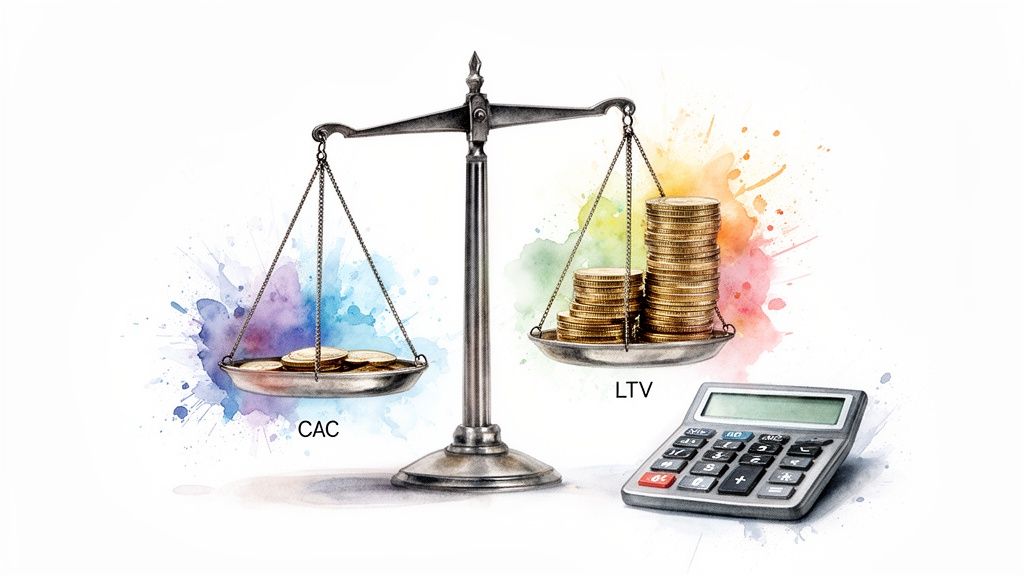
Honestly, they're the difference between building a sustainable business and just buying revenue at a loss. Once you know how to calculate and compare them, you can start making decisions that actually pad your bottom line by focusing on your LTV.
How to Calculate Your Customer Acquisition Cost
Your CAC is simply the total price you pay to turn a prospect into a customer. It’s a gut-check on how efficiently your marketing dollars are working. If you see your CAC creeping up, it's often a red flag that your go-to ad channels are getting saturated or just aren't as effective as they used to be.
To figure it out, just add up all your sales and marketing expenses over a set period and divide that by the number of new customers you brought in during that same time.
The Formula: CAC = (Total Sales & Marketing Costs) / (Number of New Customers Acquired)
Let’s say your Shopify store spent this much last quarter:
Ad Spend (Google & Social): $15,000
Marketing Team Salaries: $10,000
Software & Tool Subscriptions: $1,000
Total Acquisition Costs: $26,000
If you landed 1,000 new customers in that quarter, your CAC would be $26. It's that simple. Now you know it costs you exactly $26 to get someone new to hit "buy."
Understanding Customer Lifetime Value
While CAC tells you what you spend, LTV tells you what you get back. It’s the total revenue you can reasonably expect from a single customer over their entire relationship with you. This is where retention strategies really pay off, because LTV is the ultimate measure of customer loyalty and satisfaction.
LTV gives your acquisition spending crucial context. A high LTV means you can afford to spend more to get the right kind of customers—the ones who will stick around and make you profitable for years to come.
A simplified LTV calculation multiplies your average order value, how often customers buy, and how long they stay with you. For a much deeper dive, check out our complete guide on how to calculate customer LTV.
The Formula: LTV = (Average Order Value) x (Average Purchase Frequency) x (Average Customer Lifespan)
Let's stick with our example store. If your Average Order Value (AOV) is $50, your customers typically buy twice a year, and they stick around for about three years, the math looks like this:
LTV = $50 (AOV) x 2 (Purchases) x 3 (Years) = $300
That means, on average, a customer is worth $300 to your business. Every single thing you do to improve retention directly boosts this number.
The LTV to CAC Ratio: Your Golden Metric
Okay, this is where it all comes together. The LTV to CAC ratio is your business's report card. It shows you exactly how much value each customer brings in compared to what it cost you to get them.
The Goal: You should be aiming for a ratio of 3:1 or higher. That's the industry benchmark for a healthy, scalable business.
Using our numbers, the ratio is $300 (LTV) to $26 (CAC), which works out to about 11.5:1. This is an incredible ratio. It means for every dollar spent getting a new customer, the business makes back $11.50 over that customer's lifetime.
A 1:1 ratio means you're breaking even at best—and likely losing money once you factor in the cost of your products. A 3:1 ratio proves you have a solid business model. Anything higher than that suggests you've built a powerful growth engine centered on high LTV customers.
Why Traditional Retention Tactics Erode Your Margins
Once you see the numbers behind customer acquisition vs. retention, the lightbulb goes on. The smart move is to invest in keeping the customers you’ve already won. But this is exactly where so many Shopify stores stumble, making a critical, profit-draining mistake. They reach for the most obvious retention tools—discount codes and points-based loyalty programs—without seeing the hidden damage they cause.
On the surface, these old-school tactics look like a quick win. The problem is, instead of building real loyalty, they end up training your customers to expect a handout. They slowly, quietly chip away at your bottom line with every single purchase. It’s time to take a hard look at why these popular methods are a direct threat to your profitability and your ability to grow lifetime value.
The Problem with Perpetual Discounting
Discount codes are the knee-jerk reaction for many brands, but they're a blunt instrument in a game that demands surgical precision. Slapping a "15% OFF" coupon on everything might nudge a customer toward a second purchase, but it also teaches them to always wait for the next sale. This kicks off a dangerous cycle where your brand becomes synonymous with discounts, not value.
This "race to the bottom" has a few nasty side effects:
Margin Erosion: Every discount is a direct hit to your profit on that sale. That loss adds up fast, making it nearly impossible to hit a healthy LTV:CAC ratio.
Attracting the Wrong Customers: Heavy discounting is a magnet for deal-seekers, not brand evangelists. These shoppers have zero allegiance and will bolt the second a competitor dangles a slightly better offer.
Brand Devaluation: When your products are constantly on sale, customers start to see the discounted price as the real price. Good luck ever getting them to pay full price again.
The real issue with a discount-first strategy is that it buys transactions, not loyalty. You're just renting customer attention, and the moment you stop paying up with a discount, that attention is gone. True retention is about building an asset, not just forcing a temporary sale.
Why Complex Points Systems Fail
Tired of the discount grind, many stores pivot to points-based loyalty programs. The thinking is sound—reward customers for coming back—but the execution is often a clunky, confusing mess. Shoppers are forced to do mental gymnastics with abstract points—"Earn 10 points for every $1 spent, redeem 1000 points for a $5 reward"—which just creates friction.
All that complexity kills engagement. Customers either don't get how the system works or just can't be bothered to figure out what their points are actually worth. The reward feels distant and flimsy, failing to inspire the very behavior it was meant to create. A simpler, more direct approach is one of the best ways to improve your store's profit margins because it encourages genuine repeat business.
The backend is a headache, too. These programs often rely on bloated third-party apps that can slow down your site, create a disjointed customer experience, and tack on yet another monthly subscription fee. You're left with a system that confuses customers and complicates your tech stack, all while barely moving the needle on your lifetime value or average order value.
So, we’ve established that old-school retention tactics can quietly eat away at your profits. What if there was a smarter way? Imagine a system that not only brings customers back but also gets them to spend more, all without you having to slash prices upfront.
This is exactly what Shopify-native store credit does. It flips the entire customer acquisition vs. retention debate on its head. Forget about confusing points or a race to the bottom with discounts. We're talking about giving your customers something that feels like real cash they've earned—a powerful psychological nudge that pulls them right back to your store.
The Psychology of Store Credit as Earned Money
Store credit just works. Why? Because it feels tangible and valuable. A "15% OFF" coupon is applied and instantly forgotten, but a store credit balance sits in a customer's account, feeling like their own money just waiting to be spent. This creates a strong sense of ownership and loss aversion. Trust me, customers are far more motivated to use a $10 credit they've already earned than they are to go hunting for another discount code.
This psychological hook is what turns store credit into a predictable and efficient engine for profitable growth. It’s an asset the customer has earned, giving them a concrete reason to return and engage with your brand again.
Store credit bridges the gap between a one-time transaction and a long-term relationship. It transforms a discount into an investment, motivating customers to return and spend more, which directly boosts lifetime value and strengthens your unit economics.
This is especially critical when you look at the steep drop-off after a customer’s first purchase. Keeping customers isn't just cheaper—it's a massive profit multiplier. A tiny 5% increase in retention can blow up your profits by 25-95%. It makes sense when you consider that loyal shoppers spend 67% more than newcomers.
But here’s the reality check: only 27% of customers return after their first purchase. That number jumps to 49% for a second purchase and 62% for a third, which shows just how brutal that initial drop-off is without a smart retention strategy. This is a huge missed opportunity, especially when you see that CAC has climbed over 220% in the last eight years. If you want to dig deeper, you can find more on how retention drives profitability by reviewing the underlying data.
Boosting AOV and Repeat Purchases Seamlessly
A well-designed store credit program is a double-whammy, hitting two of your most important metrics at once: Average Order Value (AOV) and repeat purchase rate. By setting up simple spending thresholds—like "Spend $100, Get $10 in Credit"—you give customers a clear incentive to add more to their cart right now.
This simple mechanic does a few key things for your business:
It immediately lifts AOV: Shoppers are naturally wired to hit that next reward tier, bumping up the value of their current order.
It creates a reason for a second purchase: The earned credit acts like a powerful magnet, pulling them back to redeem their balance.
It protects your margins: Unlike an upfront discount, store credit only becomes a "cost" when it's redeemed, and that requires a second, often larger, purchase.
This infographic shows just how easily common retention tactics like discounts and points can tank your margins, which is exactly why store credit is a better model.
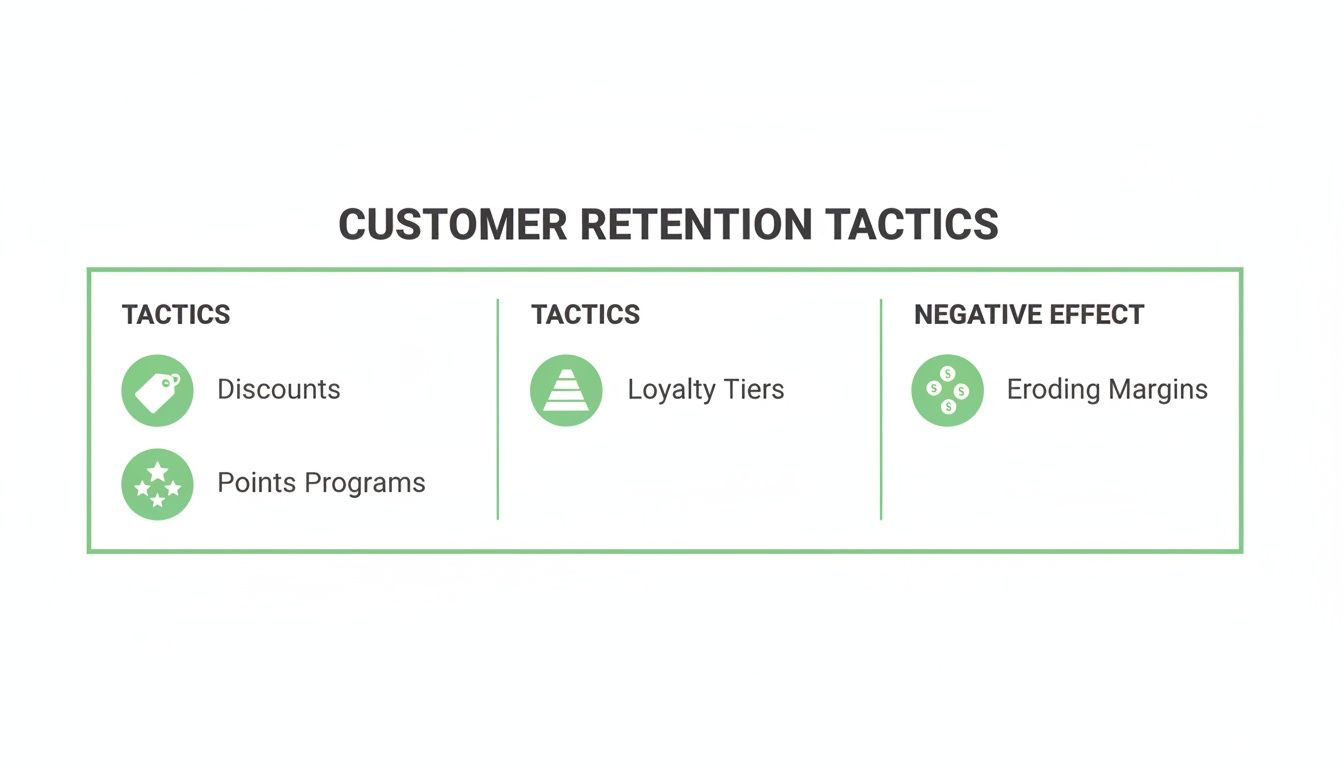
As you can see, traditional methods often lead to a slow bleed of your profits. Shopify native store credit systems fix this by linking the reward to a future purchase, keeping your margins intact on the first sale and boosting LTV.
Comparing Retention Models: Store Credit vs. Discounts vs. Points
To really understand the difference, let’s put these retention models head-to-head. Each has its place, but for building sustainable, profitable growth, the differences become pretty clear.
Feature | Native Store Credit | Discount Codes | Points Programs |
|---|---|---|---|
Margin Impact | Protects margins on the initial sale. Cost is deferred until a second purchase is made. | Immediate margin erosion. Discounts are applied upfront, reducing revenue instantly. | Can be complex to model. Points often devalue over time, creating unpredictable costs. |
Customer Psychology | Feels like earned cash, creating a strong pull to return and spend a balance they "own." | Transactional and forgettable. Encourages deal-hunting rather than brand loyalty. | Abstract and often confusing. Customers may not understand the cash value of their points. |
AOV Impact | Excellent. Threshold-based rewards ("Spend $100, get $10") directly incentivize adding more to the cart. | Minimal to none. Can sometimes encourage smaller purchases just to use the discount. | Moderate. Customers may add items to reach a point threshold, but the incentive is less direct. |
Tech Simplicity | Excellent (if native). Integrates with Shopify's core functions for a fast, seamless experience. | Good. Simple to create and distribute but can be messy to manage and track. | Poor to fair. Often requires heavy, third-party apps that can slow down your site. |
Brand Perception | Premium. Rewards value and repeat business without appearing "cheap." | Can devalue the brand. Constant sales train customers to wait for the next markdown. | Varies. Can feel like a generic loyalty scheme if not executed perfectly. |
Ultimately, store credit stands out because it aligns perfectly with the goal of long-term profitability. It's a system built to reward loyalty in a way that benefits both the customer and your bottom line.
Why Native Shopify Integration Matters
The magic of store credit is amplified when it works flawlessly within the Shopify ecosystem. A native solution like Redeemly is built on Shopify's own store credit system, which means it’s lightweight, fast, and completely reliable for both you and your customers. You avoid the clunky external widgets and heavy scripts that kill site speed—a known conversion killer.
By replacing confusing points and margin-killing discounts with a clear, cash-like reward, you can finally build a retention strategy that actually fuels profitable growth and turns first-time buyers into high-LTV advocates.
How to Actually Use Store Credit to Boost Your Bottom Line
It's one thing to talk about the economics of customer acquisition vs. retention, but it's another thing to put a system in place that actively shifts the balance in your favor. Launching a store credit program isn't about bolting on another app. It’s about creating a simple, powerful engine to drive up both lifetime value and average order value from the get-go.
The whole point is to make it feel completely natural for your customers, like it’s just part of the experience of shopping with you. By using a native Shopify app, you sidestep the clunky, site-slowing scripts that often come with third-party tools. It just works, letting you focus on the strategy instead of wrestling with technical glitches.
Designing Your Reward Tiers
The engine of any good store credit program is its reward structure. It needs to be dead simple for customers to grasp and compelling enough to make them actually change how they shop. Ditch the confusing point systems and stick to what people understand: cash-like value.
A threshold-based model is a fantastic place to start. Think along these lines:
Spend $75, Get $5 in Store Credit
Spend $150, Get $15 in Store Credit
This approach accomplishes two critical things. First, it sets a clear target, nudging shoppers to add just one more item to their cart to unlock the next reward—an instant boost to your average order value. Second, it gives them a very real reason to come back, since they now have a balance just waiting to be spent. For more advanced ideas, check out our guide on how to give store credit on Shopify.
Making Sure Your Customers Actually Care
A brilliant rewards program is useless if nobody knows about it. You need to weave communication about the program directly into the shopping journey so the benefits are always visible without being annoying.
Start with a clean, simple widget on your site. This little element can show customers their current balance or how much more they need to spend to earn their next reward. It’s a constant, gentle reminder of the value they get by shopping with you.
Then, lean on automated emails to keep the conversation going after they buy.
The "You Earned It" Email: Right after a qualifying purchase, send an email celebrating the credit they just unlocked. Position it as a genuine thank-you gift for their business.
The "Hey, You Have Cash" Reminder: If a customer hasn't been back in a while, a friendly nudge reminding them of their balance can be incredibly effective at sparking a return visit.
When you make store credit a visible and celebrated part of the customer journey, it stops being a marketing tactic and becomes a core feature of your brand. It’s a tangible way to show customers you appreciate their loyalty.
Measuring What Matters
The best part of a native store credit system is how quickly you can see its impact on your finances. In a world of skyrocketing ad costs, keeping a customer costs just 1/5th of acquiring a new one. For DTC brands on Shopify, this is a game-changer. So many brands get trapped in a cycle of margin-killing discounts, with 77% admitting they overspend on acquisitions that don't pay off. A smart store credit program is the perfect antidote, driving real profit from the customers you already have. For more data on this, Optimove.com has some great insights.
To prove it to yourself, just track these three metrics before and after you launch:
Average Order Value (AOV): Are people spending more to hit those reward tiers?
Repeat Purchase Rate: Are more customers coming back for a second or third time?
Customer Lifetime Value (LTV): Is the total revenue you get from the average customer going up over time?
When you focus on these numbers, you draw a straight line from your store credit program to real profit growth. It becomes obvious why this is a much smarter play than just throwing another discount code out there.
Shift Your Focus from Acquisition to Lifetime Value
The endless chase for new customers is exhausting. It's also completely unsustainable. For too long, the default growth playbook has been to just pump more money into ads, get a quick sales spike, and hope for the best. But with acquisition costs climbing relentlessly, that old strategy is now a surefire way to kill your margins.
It's time for a fundamental shift in thinking. The Shopify brands that are truly crushing it aren't just winning the acquisition game—they're mastering retention. They're obsessed with the one metric that actually predicts long-term success: customer lifetime value (LTV).
The New Mindset for Profitable Growth
Relying only on acquisition is like trying to fill a leaky bucket. Sure, you can keep pouring water in, but you'll never actually fill it up until you plug the holes. That’s precisely what retention does. You stop buying one-off transactions and start investing in profitable, long-term relationships.
But let's be clear: not all retention tactics are created equal. As we've seen, old-school methods like constant discount codes or clunky point systems often cause more problems than they solve. They teach your customers to wait for a sale, devaluing your products and creating a cheap, transactional vibe. You end up attracting deal-hunters, not the loyal fans who drive predictable growth.
This is where a Shopify-native store credit program changes the game. It turns your retention efforts into a growth engine that actually protects your margins.
The core difference is simple: discounts are an upfront cost that erodes your profit on the first sale. Store credit is an investment that only pays out when a customer returns to make a second purchase, driving up both LTV and average order value.
This model lets you reward loyalty without gutting your bottom line. It aligns your success with your customers' by giving them a real, cash-like incentive to come back. To effectively shift focus from acquisition to lifetime value and ensure long-term growth, it's vital to implement actionable customer retention strategies.
The choice is yours. You can keep fighting the losing battle of cost of customer acquisition vs retention, or you can build a more resilient business around the customers you've already earned. By prioritizing lifetime value, you're creating a healthier, more predictable, and far more profitable Shopify store that's built to last.
Got Questions? We've Got Answers.
Here are a few common questions we hear from Shopify merchants who are thinking about moving from a discount-heavy acquisition model to a more profitable, retention-focused strategy using Shopify native store credit.
How Much Store Credit Should I Actually Give Out?
The sweet spot for most brands is a reward rate between 5% and 10%. Think of it as, "Spend $100, get $10 in your account for next time." You want the offer to feel substantial enough to be a real incentive, but not so generous that it eats into your margins.
The best approach is to experiment. Start with a baseline and test different tiers to see what actually gets your customers to bump up their average order value. With a native app, you can tweak these rules in a few clicks—no coding needed—which makes finding that perfect balance for your store much easier.
Won't Store Credit Just Eat Into My Full-Price Sales?
That's a fair question, but store credit is actually built to protect your margins. Unlike a straight 10% off discount that devalues the initial purchase, store credit only becomes a "cost" when a customer comes back to spend it.
This setup is smart because it drives a second sale that might never have happened. Better yet, we see it all the time: customers redeeming their credit almost always spend more than the credit's value, lifting the AOV on that second purchase and significantly boosting their lifetime value.
The whole point of store credit isn't just to hand out a reward. It's to engineer a profitable second transaction. You get the first sale at full price, and the credit becomes a powerful, built-in reason for them to shop with you again.
Is It a Pain to Switch from a Points App to Store Credit?
It’s surprisingly straightforward, especially if you choose a native Shopify solution. Apps that use Shopify’s own store credit system integrate right into your store without the clunky, site-slowing scripts that many complex points platforms rely on.
Plus, the customer experience is a huge upgrade. "$10 in credit" is instantly understood. "1,000 points" often just leads to confusion and support emails. The migration is usually as simple as turning off your old app and setting up your new reward rules, which you can knock out in a few minutes.
Ready to stop giving away your margins with endless discounts and start building a truly loyal customer base? Redeemly lets you launch a native Shopify store credit program that drives up AOV and LTV, without all the usual complexity.
Discover how Redeemly can transform your retention strategy today.


Join 7000+ brands using our apps