Shopify Customer Acquisition and Customer Retention Strategies
Feb 27, 2026
|
Published
When it comes to growing a Shopify brand, everything boils down to two core activities: bringing in new customers and keeping the ones you already have. We call this customer acquisition and customer retention. Think of acquisition as the art of attracting first-time buyers, while retention is the science of getting them to come back for a second, third, and fourth purchase. Nailing the balance between these two is the secret sauce for any profitable, long-lasting brand.
Your Shopify Store Has a Leaky Bucket
Let’s use an analogy. Picture your Shopify store as a big bucket, and the water you're pouring into it is your revenue. Every new customer you win over—that’s another cup of water added to the bucket. This is the acquisition side of things: running ads, posting on social, getting your name out there. It feels great, right? You can see the water level rising.
But what if your bucket is riddled with holes?
That’s the harsh reality for so many merchants who get tunnel vision on acquisition. The holes are the customers who buy once and vanish forever. This is called customer churn. With ad costs constantly climbing, you’re paying more and more for every single cup of water, all while your hard-earned revenue is steadily draining out of the bottom. It’s a frantic, expensive race you can never quite win.
The Problem with Traditional Fixes
To stop the leak, most stores reach for the same old tools: discount codes and complex loyalty point systems. They think a quick "20% off" coupon will patch the hole. But in reality, these tactics often just make the leaks bigger.
When you constantly offer discounts, you're training your customers to wait for a sale. You're not building loyalty; you're building a list of bargain hunters who will only buy when you slash your prices. This kills your profit margins and shrinks your Average Order Value (AOV) over time.
Complicated point systems aren’t much better. Customers get lost trying to figure out what "5 points per dollar" even means, and the reward feels so far away that it doesn't motivate them to come back and shop. These are flimsy patches for a serious problem. You can dive deeper into how to reduce customer churn with strategies that actually work.
Shifting Focus to What Truly Matters
We need a smarter approach—one that balances filling the bucket with actually plugging the holes. This means we have to stop obsessing over one-time transactions and start looking at metrics that tell the real story of your brand's health and profitability. Instead of just celebrating a new sale, we need to focus on growing the total value each customer brings to your business over their entire journey with you.
This is where two game-changing metrics come into play:
Customer Lifetime Value (LTV): This is the total profit you can expect from a single customer throughout their relationship with your brand. Plugging the leaks in your bucket directly grows this number.
Average Order Value (AOV): This is the average amount a customer spends each time they check out. The right incentives can boost this on their first purchase and every one after.
By making LTV and AOV your north stars, you graduate from the short-term acquisition hamster wheel to a long-term strategy built for sustainable growth. In the next sections, we’ll break down exactly how to find this balance, ditch the margin-killing discounts, and embrace a modern solution designed for Shopify merchants.
The Two Sides of Your Shopify Growth Coin
Every successful Shopify store has mastered the delicate dance between two critical forces: customer acquisition and customer retention. Think of them as two sides of the same coin. You simply can't build a sustainable business with just one. One side brings new people through the door, and the other convinces them to stick around and become profitable, long-term fans.
To really get this right, you have to get comfortable with two core metrics, but let's skip the jargon. First, there's Customer Acquisition Cost (CAC)—that’s everything you spend to get a brand new customer to finally click 'buy' for the very first time. On the flip side, you have Customer Lifetime Value (LTV), which is the total profit you'll make from a customer over their entire relationship with your store.
Understanding the Leaky Bucket in Action
The "leaky bucket" analogy is perfect for showing why a pure acquisition-at-all-costs mindset is a losing game. Imagine you’re pouring new customers (and revenue) into a bucket. If you’re not actively plugging the holes, they’ll leak out just as fast as you pour them in. You end up spending a ton of money just to stay in the same place.
This concept map brings the idea to life, showing new customers pouring in while churn lets that hard-earned money drain away.
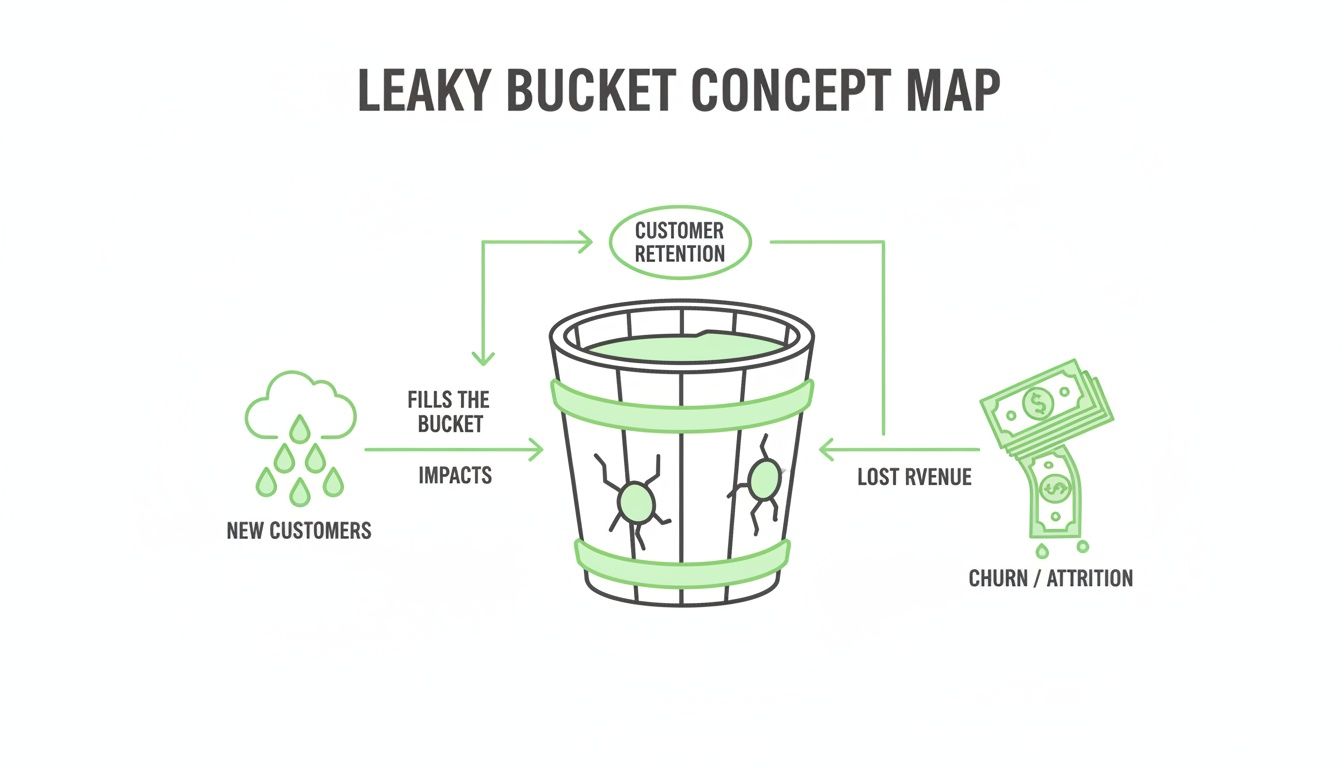
What this really drives home is that without a solid retention strategy to patch those leaks, even the most aggressive acquisition campaigns lead to wasted marketing spend and growth that just sputters out.
Acquisition vs Retention Key Differences at a Glance
It helps to see these two strategies side-by-side to understand their distinct roles in your growth plan. Each one has a different goal, relies on different metrics, and uses a unique set of tactics.
Aspect | Customer Acquisition | Customer Retention |
|---|---|---|
Primary Goal | Attract and convert brand-new customers who have never purchased before. | Nurture existing customers to encourage repeat purchases and build loyalty. |
Key Metrics | CAC, Conversion Rate, Click-Through Rate (CTR) | LTV, Repeat Purchase Rate, Churn Rate, AOV |
Common Tactics | Paid ads (Meta, Google), SEO, influencer marketing, content marketing. | Email & SMS marketing, Shopify store credit programs, excellent customer service. |
While they are different, they aren't in competition. Instead, they work together. A great retention strategy actually makes your acquisition efforts more profitable by ensuring the customers you spend so much to acquire actually become valuable over time.
The Magic Ratio That Defines Success
The real magic happens when you understand the relationship between these two numbers, specifically the LTV to CAC ratio. This is your business's ultimate report card. It tells you, clear as day, how much value you’re getting back for every single dollar you spend to bring in a new customer.
A healthy ratio is your North Star. You’re aiming for 3:1 or better, meaning a customer generates at least three times their acquisition cost in lifetime value. Hitting that number is one of the clearest signs you’re building a truly thriving brand, not just buying one-off sales.
Chasing a low CAC above all else is a shortsighted strategy. In today's crowded market, it often leads to a race to the bottom, attracting bargain-hunters with low LTV instead of loyal fans who drive real growth.
This is where retention becomes your secret weapon. With global acquisition costs climbing 40% since 2023, the math is undeniable: a single retained customer can deliver 5-10x the value of a newly acquired one. The top-performing brands consistently maintain that 3:1 LTV to CAC ratio, while others get stuck spending more for less. It’s proof that an effective retention strategy makes every acquisition dollar work harder. You can dig into the data behind these rising costs in these CAC trends for growth companies.
Why Retention Is Your Growth Multiplier
Focusing on retention isn't just about plugging leaks; it's about fundamentally transforming your unit economics. Here's how it works: retained customers don't just buy again—they tend to spend more over time, boosting your Average Order Value (AOV) with each purchase. They already trust you, so they’re more willing to try new products and are far less sensitive to price.
This creates a powerful growth loop for your store:
Higher LTV: Every customer you keep becomes more valuable.
Improved Margins: You spend less on marketing to generate the same (or more) revenue.
Predictable Revenue: Your business is built on a stable foundation of repeat buyers, not a constant scramble for new ones.
By shifting from a pure acquisition mindset to a balanced strategy, you stop trading dollars for one-off sales and start building a truly valuable asset: a loyal customer base. And one of the best ways to do this is to ditch the margin-killing discounts and embrace smart incentives like Shopify-native store credit that actually reward loyalty and drive future purchases.
Why It Costs a Fortune to Get New Customers (And What to Do About It)
The old ecommerce playbook was simple: throw money at ads, get new customers, repeat. But that playbook is officially broken. For most Shopify merchants today, relying solely on a constant flow of first-time buyers isn't just unsustainable—it's a fast track to bleeding cash.
The hard truth? Finding new customers has become brutally expensive. The digital ad space, which once felt like a gold rush, is now a crowded, cutthroat battlefield. This isn't just a hunch; the data shows a clear and painful trend of rising costs that are eating into your profits.
The Ad Cost Tidal Wave
For most of us, customer acquisition runs through platforms like Meta (Facebook and Instagram) and Google. A decade ago, these were like magic—hyper-efficient channels for reaching your perfect audience. Today, they're saturated. You're now competing with millions of other brands for the exact same eyeballs, driving up the price of every single click and impression.
This fierce competition means you have to bid more and more just to get your products in front of people. As a Shopify merchant, that translates directly into a higher Customer Acquisition Cost (CAC), squeezing your margins on that crucial first sale before you even think about the cost of your products.
Privacy Changes Are Making It Even Harder
Just to make things more interesting, massive privacy updates from companies like Apple have completely upended the advertising world. These changes severely limit how platforms like Meta can track what people do across different apps and websites.
So, what does this actually mean for your store?
Your targeting is getting fuzzier. The laser-focused ability to pinpoint your ideal customer with specific ads? It’s been seriously dialed back.
Retargeting is weaker. Reaching people who visited your site but didn’t buy has become much less effective.
You're flying a bit blind. It's harder to prove which ads are actually driving sales, making it a nightmare to know where to spend your money.
All this forces you to cast a wider, more expensive net to find new customers, which only pushes your CAC higher. You can't just throw more money at the problem; you have to get smarter. If you're looking for new ways to adapt, you might find these persuasive advertising techniques helpful in this new post-privacy era.
The new reality for ecommerce is that you're paying more money for less certain results. Relying solely on paid acquisition feels like trying to fill a bucket with a very expensive, very leaky hose.
This creates immense pressure to find the "next big thing" in marketing, but the real solution isn't about finding a new, cheaper channel—it's about maximizing the value of the customers you've already paid to acquire. The numbers paint an undeniable picture of this challenge.
In the fiercely competitive world of ecommerce, customer acquisition costs have skyrocketed by 222% over the past eight years. This dramatic surge stems from the exact issues of intensified digital ad competition and channel saturation. For Shopify merchants, pouring more into marketing funnels just to land one-time buyers is a recipe for eroding margins before loyalty even has a chance to develop. Dig into the numbers yourself with these customer acquisition cost statistics to see the full scope of the trend.
How Retention Becomes Your Most Profitable Growth Lever
If you're feeling the squeeze from rising ad costs, you're not alone. It’s a frustrating cycle of paying more and getting less. But what if the answer wasn't finding some secret, cheaper ad platform? The most powerful and predictable growth engine you have is right under your nose: your existing customers.
The real shift happens when you stop focusing purely on acquisition and start building a balanced customer acquisition and customer retention strategy. This isn't just a nice idea; it's a mathematical reality. A customer who has already bought from you is infinitely more valuable than a stranger seeing your ad for the first time. They already know you, they trust you, and they're far more likely to buy again, spend more, and try new products.

Unlocking Higher Lifetime Value and Average Order Value
Two of the most critical health metrics for any Shopify store—Lifetime Value (LTV) and Average Order Value (AOV)—are directly supercharged by retention. Think about it: a loyal customer doesn't just come back for a second purchase. They often spend 31% more on average than new customers. Why? Because the trust is already there. You don't have to convince them all over again.
This creates a powerful financial flywheel for your brand:
Bigger Carts: A happy customer returning for another purchase is far more likely to add that extra item they were eyeing last time, boosting your AOV.
More Frequent Visits: They come back more often, turning a one-off transaction into a reliable, predictable revenue stream.
Exploding LTV: The combination of bigger carts and more frequent purchases dramatically increases the total value you get from each customer over their lifetime.
The Staggering ROI of a Retention-First Mindset
The financial impact here is massive. We're not talking about small, incremental gains. Focusing on retention is one of the most effective levers you can pull to directly boost your bottom line. Once you understand how expensive it is to acquire a new customer, putting effort into effective customer retention marketing strategies becomes a no-brainer.
Retention isn't just a "nice-to-have." It’s the powerhouse that blows acquisition out of the water when it comes to ROI. Research consistently shows that increasing customer retention rates by just 5% can boost profits by an astounding 25% to 95%.
For a Shopify merchant, this is your direct path to healthier unit economics. While you might be paying $70-$78 to acquire a single customer, brands that master retention can see that same customer’s LTV grow to over $3,600. Suddenly, the whole equation flips. That expensive first purchase becomes the highly profitable start of a long-term relationship.
Creating a Self-Sustaining Growth Loop
Beyond the immediate cash flow benefits, a smart retention strategy creates a positive feedback loop that naturally drives down your future acquisition costs. Your happiest, most loyal customers become your best marketers—and they work for free.
They start generating powerful assets that you simply can't buy:
Real Word-of-Mouth: Satisfied customers tell their friends and family about your brand, delivering you highly qualified new leads at zero cost.
Authentic User-Generated Content (UGC): They post reviews, unboxing videos, and photos of your products, creating the social proof that convinces new, skeptical shoppers to take a chance on you.
A Sterling Brand Reputation: A community of advocates builds a rock-solid reputation that makes every single one of your other marketing efforts more effective.
This cycle starts to feed itself. Your retention efforts fuel your acquisition pipeline. You spend less to get better customers, who then become loyal advocates, who then help you acquire even more customers. This is how you build a scalable, profitable brand that’s built to last.
The Store Credit Playbook for Boosting LTV and AOV
Alright, let's get down to brass tacks. Strategy is great, but it's useless without a game plan you can actually execute. For too long, Shopify merchants have been stuck in a brutal cycle of margin-killing discounts and clunky, overly complex points systems that just confuse customers.
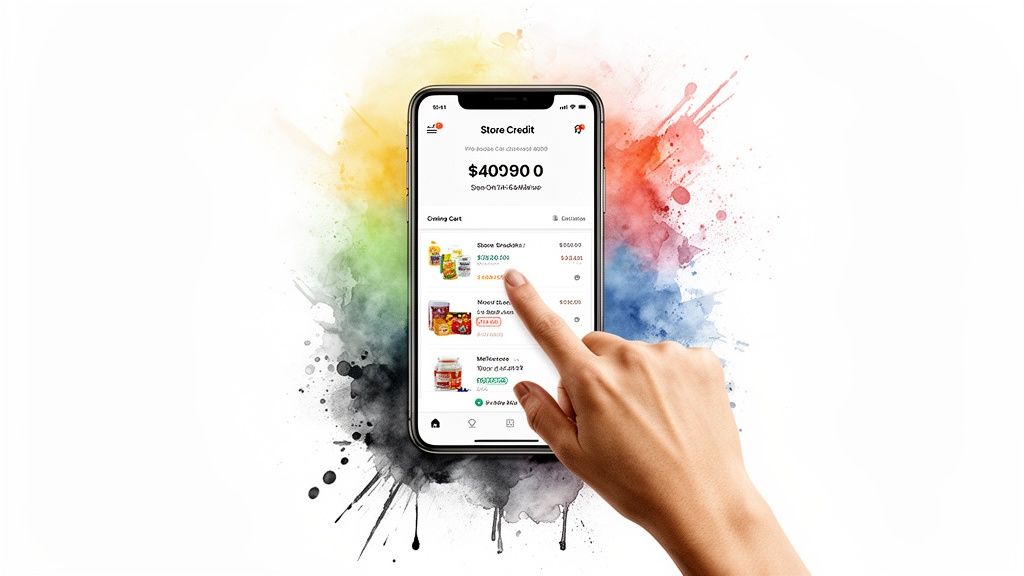
It’s time for something smarter. The modern answer is Shopify-native store credit. And no, this isn't just a different way to say "discount." It's a fundamental shift in how you reward and keep your best customers, with a laser focus on boosting LTV and AOV.
Why Store Credit Outperforms Discounts and Points
Think about it. A discount code instantly devalues your product and your brand. It trains your customers to sit back and wait for a sale, slicing into your profits right out of the gate. Confusing point systems are just as bad, asking customers to do math just to figure out their reward.
Store credit completely flips that script. It feels like real, earned money sitting in a customer’s wallet. This creates a powerful psychological pull, turning a one-time transaction into the start of a real relationship. It's an investment in their next purchase, not just a haircut on the current one.
Unlike a 20% off coupon that gets used and forgotten, store credit creates a funded account that acts as a powerful magnet. It gives customers a compelling, pre-funded reason to come back and spend again, directly driving repeat purchases and increasing lifetime value.
This simple change moves your loyalty efforts from a cost center to a profit driver. You get to protect your margins while building the kind of genuine, long-term loyalty that those confusing point systems just can't touch.
The Two-Part Punch Boosting AOV and LTV
When you roll out a smart store credit strategy, you get a powerful one-two punch that directly moves the needle on your most important growth metrics: Average Order Value and Lifetime Value.
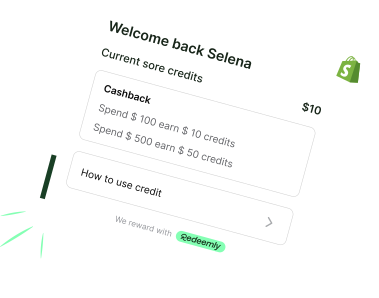
First, you'll see an immediate lift in your AOV. By offering tiered credit rewards (think: "Spend $100, get $10 in credit"), you gamify the whole shopping experience. A customer who sees they're just $15 away from unlocking a reward is far more likely to add one more item to their cart. It’s a simple nudge that makes that first purchase bigger.
Second, that earned credit becomes your secret weapon for driving repeat purchases and increasing LTV. The customer now has a funded balance with your brand, giving them a real incentive to return. That store credit is a tangible reason to choose you over a competitor for their next purchase, turning one-time buyers into loyal, high-value customers. It's that simple.
Keeping It Seamless and Native to Shopify
You know what kills most loyalty programs? Friction. Clunky third-party widgets, slow-loading pop-ups, and confusing dashboards create a terrible user experience that sends customers running. This is where going native with a Shopify solution becomes an absolute game-changer.
Using an app built on Shopify's own store credit system means the entire process is smooth and practically invisible to your customer.
No Checkout Disruption: The credit is applied right at checkout, just like a gift card. No weird codes or external sites to deal with.
No Site Slowdown: Because it’s native, there are no heavy scripts to bog down your page load times, which is critical for protecting your conversion rates.
Effortless Management: You handle everything right inside your Shopify admin, making it dead simple to track and manage.
This streamlined experience ensures your loyalty program actually enhances the customer journey instead of complicating it. By getting rid of the friction, you make it easy and rewarding for customers to stick around, which is the whole point of a retention strategy. To see exactly how this works under the hood, check out our deep dive into using Shopify store credit to build a powerful loyalty program.
By swapping dated discount tactics for a smart, native store credit system, you stop burning through your profits and start building a predictable, sustainable growth engine. You increase AOV on the first sale and use that momentum to guarantee a second, third, and fourth, systematically boosting LTV one customer at a time.
Your Path to Profitable and Sustainable Growth
Let's pull all these threads together. Getting to a place of real, sustainable growth isn’t about making a hard choice between customer acquisition and customer retention. It's about finally getting the balance right.
For far too long, e-commerce brands have been pouring money into the top of a leaky bucket. They spend a fortune to bring in new customers, only to watch their hard-earned profits trickle away as those buyers make one purchase and never come back.
It’s time to break that cycle of expensive acquisition followed by endless, margin-killing discounts. The smartest way to plug the holes in your bucket is to build a retention strategy that actually feels rewarding to your customers. Forget confusing point systems that create more work than they're worth or constant sales that cheapen your brand.
From Leaky Bucket to Loyal Following
This is where a native Shopify store credit system completely changes the game. It’s how you turn a simple transaction into the beginning of a genuine customer relationship.
By giving customers earned credit that feels like real money in their wallet, you create a powerful, built-in reason for them to come back. This is how you systematically increase your Lifetime Value (LTV) and build a business that’s both predictable and profitable.
This approach often gives your Average Order Value (AOV) a nice bump right from the start, as shoppers are motivated to add a little more to their cart to hit a reward threshold. Of course, this is just one piece of the puzzle. To make sure your Shopify store is firing on all cylinders, you need a holistic plan, and these digital marketing strategies for small businesses can really help round out your efforts.
The bottom line is simple. Investing in a smart retention strategy, powered by store credit, is your clearest path to building a healthier brand, a more loyal community, and a business built to last.
Questions We Hear All The Time
Sooner or later, most Shopify merchants hit a wall with discounts and points. They feel the sting of shrinking margins and realize they aren't building real, lasting loyalty. If that sounds familiar, you're in the right place. Here are the common questions we get about shifting to a smarter strategy that actually balances how you get customers and how you keep them.
"Isn't Store Credit Just a Different Kind of Discount?"
This is a great question, and the answer gets to the heart of the strategy. Think of it this way: a discount is a cost you pay right now. You're sacrificing profit on the current sale just to close the deal, which can cheapen your brand over time.
Store credit, on the other hand, is an investment in a future purchase. It’s not a handout; it's "earned money" sitting in your customer's account, creating a magnetic pull to come back. You're rewarding their loyalty in a way that all but guarantees their next order, fundamentally changing their lifetime value.
"Will This Clog Up My Checkout Process?"
Not a chance. In fact, a good store credit system does the opposite, and this is one of its biggest perks. A native Shopify store credit solution is built using Shopify’s own core functions. That means no clunky third-party apps or slow-loading scripts gumming up your checkout flow.
For your customer, it's completely seamless. The credit simply appears as a payment option, exactly like a gift card. It feels like a natural, built-in part of your store, not some awkward add-on. This is crucial for protecting your conversion rate.
A complicated checkout is a conversion killer. By using a native Shopify solution, you avoid adding any friction, ensuring your retention efforts don't accidentally sabotage your acquisition performance. Your site stays fast, and the customer journey remains smooth.
"How Exactly Does Store Credit Bump Up My AOV?"
Store credit increases your Average Order Value (AOV) by turning shopping into a bit of a game. The most effective way to do this is with a tiered rewards system where spending more unlocks a bigger credit.
Imagine a customer seeing a little message: "You're only $15 away from earning a $10 credit!" That simple nudge is often all it takes to motivate them to add one more item to their cart. This tactic directly increases the value of that initial sale while also teeing up a future one. It’s a one-two punch for better unit economics and a higher lifetime value.
Ready to stop the discount death spiral and start building profitable, long-term customer relationships? With Redeemly, you can launch a Shopify-native store credit program that boosts LTV and AOV without wrecking your margins. Get started with Redeemly today.


Join 7000+ brands using our apps