Customer retention programme: Boost LTV & AOV with Shopify Store Credit
Feb 28, 2026
|
Published
The old playbook of endless discount coupons and confusing point systems is officially broken. It’s a magnet for one-off bargain hunters, not the loyal brand fans who boost your lifetime value (LTV). A modern customer retention programme isn't about these margin-killing tactics; it's about building real, profitable relationships using Shopify-native store credit.
Move Beyond Discounts to Profitable Retention
If you're a Shopify merchant, you know the feeling. The customer acquisition cycle can feel like a treadmill you just can't get off. You pour money into ads to bring in new shoppers, only to watch most of them vanish after a single purchase. This constant churn isn't just frustrating; it's a huge financial drain that kills your LTV potential before it even starts.
The real issue is the unsustainable cost of finding new customers compared to the incredible, often-ignored value of keeping the ones you have. When you lean on discount codes, you're "renting" a customer's loyalty for one transaction. You're training them to wait for the next sale, which devalues your brand and eats away at your profit margins. A store credit programme, however, encourages repeat business and increases average order value (AOV), creating a sustainable growth model.
The Staggering Cost of Customer Churn
Losing customers is far more expensive than most merchants realize. In today's competitive e-commerce world, U.S. brands are bleeding a mind-boggling $168 billion annually simply because customers leave and don't come back. This massive number proves that a smart customer retention programme isn't a "nice-to-have"—it's absolutely essential for survival and growing LTV.
For retail, the heartland of Shopify stores, the picture is even grimmer. The average retention rate is just 63%, a full 12% below the cross-industry average. The data tells a clear story: if you're not actively working to keep your customers, you are losing money and future lifetime value every single day. The old methods just aren't cutting it.
The real challenge for modern brands isn't just getting that first sale; it's earning the next one. A loyalty strategy that sacrifices profit for a single transaction isn't a strategy at all—it's a liability.
A Modern, Profit-Centric Alternative: Shopify Store Credit
So, what’s the answer? It's time to shift your focus from transactional discounts to relational rewards. A Shopify-native store credit programme offers a powerful alternative that builds lasting loyalty while protecting your bottom line. Instead of giving away margin upfront with a discount, you reward customers with cash-like store credit they can use on future purchases. Understanding the fundamentals is key, and for many business owners, learning how to improve client retention is the first step toward building a more resilient company.
This approach completely flips the script. It gives customers a real reason to come back, which directly increases their lifetime value (LTV). Better yet, by offering credit based on spend (like "Spend $100, get $10 in credit"), you encourage shoppers to increase their average order value (AOV) on the spot. You can discover more about building a loyal customer base with our guide on powerful retention marketing strategies. This creates a self-funding growth engine that strengthens your unit economics and puts you on the path to long-term, sustainable profitability.
Why Your Customer Retention Programme Might Be Costing You Money
Every Shopify merchant knows they need a customer retention programme. The problem is, many of us fall for the same old tactics that look good on paper but silently bleed our businesses dry. We get caught up in outdated strategies that attract the wrong kind of customer—the one-and-done deal-chaser—instead of building the real, lasting relationships that fuel sustainable growth and increase lifetime value.
The two biggest culprits? Aggressive discount codes and confusing points systems. Both can trap you in a dangerous cycle of teaching customers to expect a handout, which ultimately crushes your margins and fails to lift the metrics that truly matter, like lifetime value (LTV) and average order value (AOV). It’s time we pulled back the curtain on why these old-school methods so often backfire.
The Problem With Discount-Driven Loyalty
Discount codes are the knee-jerk reaction for so many stores, but they’re a double-edged sword. When you constantly dangle "20% OFF," you’re not building loyalty; you’re training customers to wait for a sale. Instead of buying at full price, they'll hold off, knowing another offer is just around the corner.
This behavior is a direct assault on your profit margins and LTV. Every single time a customer uses a discount code, you're accepting a guaranteed loss of revenue. You're essentially paying them to make a purchase, which is a short-term band-aid, not a long-term strategy for increasing lifetime value.
Think of it this way: a discount is like renting a customer’s loyalty for a single transaction. A store credit programme, on the other hand, helps you earn it by investing in a future purchase, directly boosting LTV.
Worse, this approach tends to attract bargain-hunters who have zero allegiance to your brand. They buy once because of the deal and then vanish, doing nothing to improve your repeat purchase rate or lifetime value. This churn forces you right back into the expensive world of customer acquisition, trapping you in a costly, exhausting cycle.
The challenges facing modern retail are immense, from the high cost of employee turnover to razor-thin margins. The data paints a clear picture of why a profit-focused retention strategy is no longer a "nice-to-have"—it's a necessity.
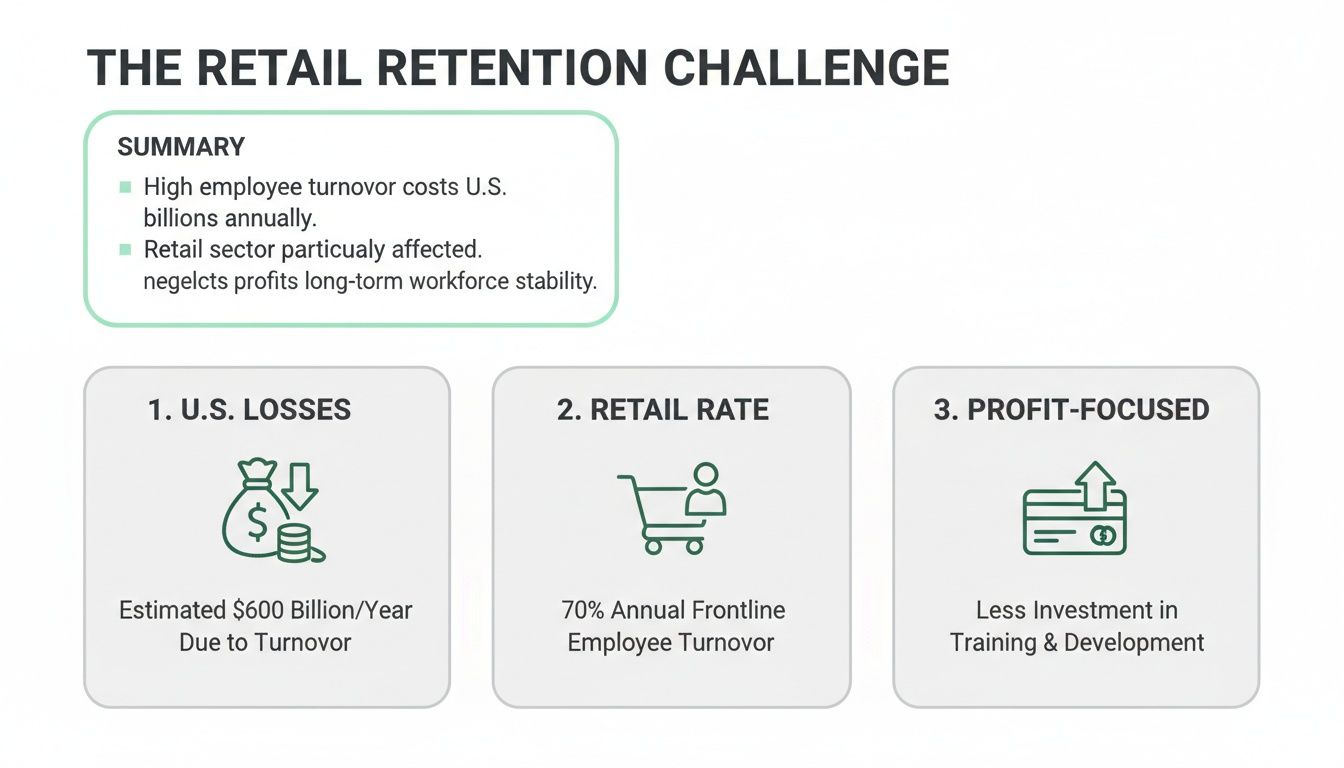
This data screams for a change. It's a wake-up call for merchants to pivot from margin-killing tactics toward a customer retention programme built on Shopify-native store credit that actually builds LTV and AOV instead of just giving away profit.
Why Points Systems Create Confusion and Friction
At first glance, points-based loyalty programs seem like a smarter way to go. Customers earn points for buying things, then redeem them for rewards. Simple, right? Not really. In reality, these systems dump a whole lot of mental work—or "cognitive load"—onto your customers.
Shoppers are suddenly forced to become accountants, trying to do "points math" in their heads. "How many points do I need for that free T-shirt?" "What's 500 points even worth in real money?" This confusion quickly turns into frustration, and many customers just give up and ignore the programme entirely, preventing any positive impact on LTV or AOV.
On top of that, many points systems have high breakage rates—that's the fancy term for points that are earned but never actually redeemed. You might think this is a win since an unclaimed reward costs you nothing, but you'd be wrong. It's a sign of a failed customer experience. An unredeemed reward is a lost opportunity to bring that customer back for another purchase and increase their lifetime value.
Store Credit vs Discounts vs Points A Comparison
When you line up the old methods next to a modern, Shopify-native store credit programme, the difference is night and day. Store credit is straightforward, it feels valuable, and it's built from the ground up to increase LTV and average order value (AOV).
Here’s a head-to-head breakdown of how a store credit programme built for Shopify stacks up against traditional discount codes and complex points systems.
Metric | Discount Codes | Points Systems | Shopify Native Store Credit |
|---|---|---|---|
Margin Impact | Guaranteed margin loss on every transaction. | Cost is unpredictable; high breakage creates poor UX. | Cost is conditional and tied directly to a repeat purchase. |
Customer Experience | Encourages one-off purchases; devalues the brand. | Complex and confusing; creates "points math" friction. | Simple and intuitive; feels like cash in their wallet. |
AOV Incentive | No direct incentive to increase cart size. | Indirect incentive; requires complex tier structures. | Direct incentive to spend more to earn more credit. |
LTV Focus | Attracts low-LTV, price-sensitive shoppers. | Focuses on engagement with the programme, not repeat spend. | Designed to drive repeat purchases and increase lifetime value. |
At the end of the day, discounts and points are fundamentally flawed because they aren't designed to create genuine, profitable relationships. A store credit-based customer retention programme, on the other hand, gives you a clear, powerful path to building a loyal customer base that drives predictable revenue and lasting success by focusing squarely on LTV and AOV.
The Store Credit Advantage for LTV and AOV
So, we've seen how discounts can devalue your brand and how points systems can just leave customers confused. It’s clear we need a better way to handle customer retention—one that doesn't just reward a single transaction but actually builds a lasting relationship. This is where a Shopify-native store credit programme completely changes the game, making LTV and AOV your primary growth levers.
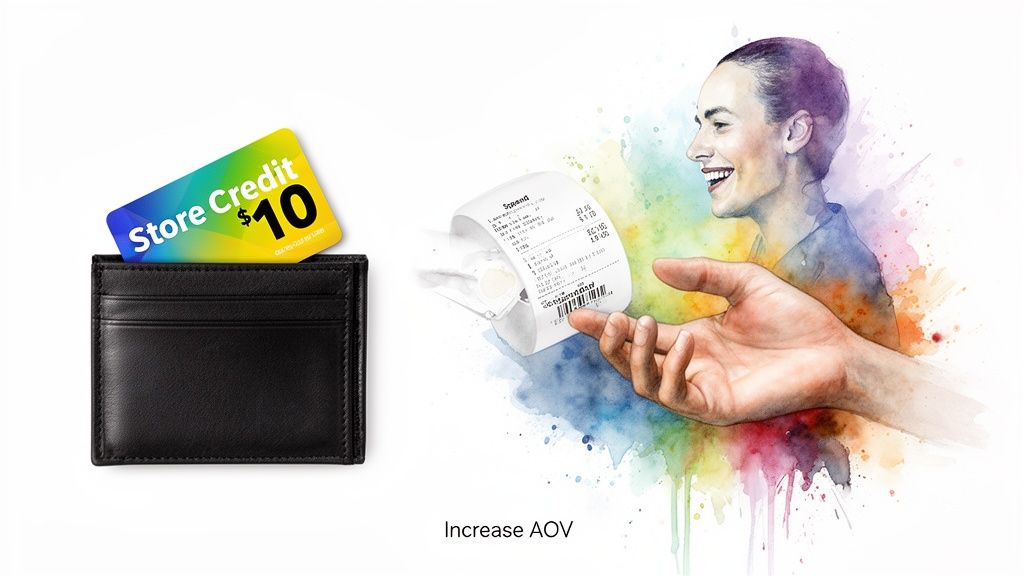
Unlike a discount that’s gone in a flash, store credit feels like cash waiting in a customer's digital wallet. That mental shift is incredibly powerful. A 20% off coupon feels like a temporary sale, but $10 in store credit feels like real money that a customer owns. It gives them a tangible, compelling reason to come back, turning a one-time buyer into a high-LTV fan.
Driving Immediate Increases in Average Order Value
A smart store credit program doesn't just bring people back later; it encourages them to spend more right now. When you tie rewards to specific spending goals, you give shoppers a clear nudge to add just one more thing to their cart, directly boosting Average Order Value (AOV).
Think about this everyday scenario:
The Incentive: You offer "$10 in store credit for every $100 spent."
The Customer's Cart: A shopper is sitting at $85.
The Motivation: They see a message telling them they're just $15 away from earning a $10 reward.
That little nudge is often all it takes. Suddenly, adding another item doesn't feel like spending more—it feels like making a smart investment in a future purchase. This tactic instantly boosts your Average Order Value (AOV), making that very first sale more profitable while planting the seed for the next one.
Protecting Margins and Improving Unit Economics
From a financial standpoint, this is where store credit truly shines. A discount is a guaranteed, immediate hit to your profit margin. Store credit, on the other hand, is a conditional cost.
You only take on the cost of that reward when the customer actually comes back and makes another purchase to use it. This brilliantly ties your retention spending directly to the behavior you want most: a repeat sale that increases LTV.
Store credit turns a cost center into a growth investment. Instead of sacrificing margin for a single sale, you're reinvesting a small portion of your revenue into securing the next one, fundamentally improving your unit economics and lifetime value.
This approach creates a sustainable, self-funding growth loop. The initial bump in AOV you get from customers trying to earn credit often pays for the future cost of their redemption. You stop giving away profits and start using them strategically to fuel a predictable cycle of repeat business.
Building a Sustainable Retention Engine
The spiraling cost of finding new customers makes retention more critical than ever. It can cost a Shopify merchant an average of $226 in paid ads just to land a single new customer in retail. Smart retention strategies slash this dependency. Think about it: the probability of selling to an existing customer is an incredible 60-70%, while it’s a mere 5-20% for a new prospect.
The real magic of a Shopify-native store credit model is its direct impact on Customer Lifetime Value (LTV). Every repeat purchase driven by your programme adds to a customer's total value over their entire relationship with your brand. Of course, to make the most of this, you need to know exactly how to calculate customer lifetime value.
Focusing on LTV builds a more resilient and predictable business. By turning more first-time buyers into loyal repeat customers with store credit, you create a steady revenue stream that isn't at the mercy of volatile ad platforms. You stop renting loyalty and finally start earning it, one profitable, high-AOV purchase at a time.
How to Implement a Store Credit Programme on Shopify
Switching from margin-killing discounts and confusing points systems to a profit-focused customer retention programme is way easier than you might think. Modern, Shopify-native tools let you launch a store credit system that actually boosts lifetime value (LTV) and average order value (AOV)—all without writing a single line of code or slowing your site down with heavy scripts.
Let's walk through a simple, four-step process to get your own Shopify-native programme up and running. This isn't just about giving away credit; it's a practical approach to building a system that rewards customers, protects your bottom line, and drives predictable growth by focusing on LTV and AOV.
Step 1: Define Your Reward Structure
First things first, you need to decide how customers will actually earn credit. The goal here is dead-simple motivation. Unlike a complex points system, a store credit reward should be instantly understood and designed to increase AOV.
A powerful and incredibly popular method is offering a straight percentage back on every purchase. Think: "Get 5% back in store credit on every order." It's simple, transparent, and directly encourages more spending.
Another highly effective strategy is to create tiered rewards based on how much a customer spends. This is a fantastic way to give your AOV an immediate lift. You could structure it like this:
Spend $75, get $5 in credit.
Spend $150, get $15 in credit.
Spend $250, get $30 in credit.
This model gives shoppers a clear, tangible reason to add just one more item to their cart to unlock that next reward tier. They aren't just spending more; they're investing in a future purchase. That little psychological flip frames the transaction as a smart financial decision, not an indulgence, boosting both AOV and the likelihood of a future sale.
Step 2: Set Up the Programme in Shopify
Once you’ve got your reward structure nailed down, setting up the programme is shockingly straightforward with a native Shopify app like Redeemly. The huge advantage here is that these apps are built on Shopify’s own infrastructure. That means no clunky third-party code to slow down your store or, even worse, break your checkout.
Setup is usually just a few clicks:
Install the App: Find a native store credit app in the Shopify App Store.
Configure Your Rules: Pop in the AOV-boosting reward structure you just defined in Step 1.
Activate the Programme: Flip it on with a single toggle.
That’s it. Seriously. Because the app uses Shopify’s core store credit function, it works perfectly with your theme and checkout right out of the box. You completely sidestep the technical headaches and performance issues that often plague non-native loyalty platforms. For a deeper dive into this, our guide on how to give store credit on Shopify has even more tips.
Step 3: Integrate the Experience Into Your Storefront
A retention programme only works if customers actually see it. They need to know their credit balance and understand how to use it. A Shopify-native app makes this feel like a natural, built-in part of your store, not a bolted-on afterthought.
This is what a clean, simple integration looks like, making the customer’s balance clear and accessible.
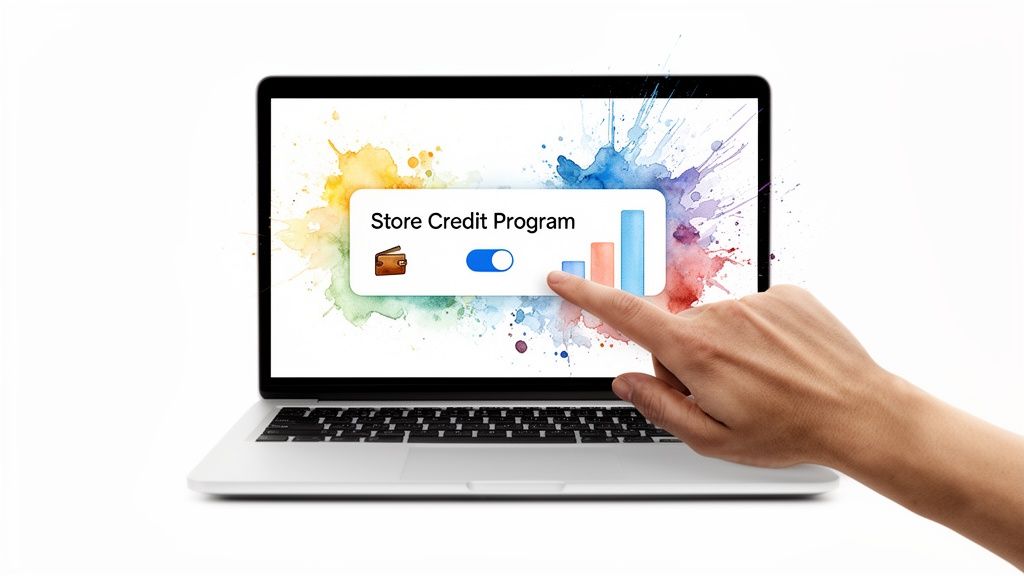
The screenshot shows just how easy it is to activate and configure the programme, making sure the customer-facing elements match your brand’s look and feel. Key integration points you should look for include:
Floating Wallet Widgets: A non-intrusive widget that displays a customer's available credit and follows them as they shop.
Account Page Integration: Showing the credit balance right on the customer's account page where they expect to see it.
Seamless Checkout Redemption: Customers should be able to apply their credit at checkout with one click, just like they would a gift card.
This constant visibility keeps the reward top-of-mind, creating a powerful psychological nudge to come back and spend their "money," which is the key to increasing LTV.
Step 4: Communicate the Programme to Customers
Finally, you need to tell your customers about their new superpower! You have to announce your store credit programme to drive awareness and get people using it.
A reward that customers don't know about is a reward that doesn't work. Proactive communication is what turns your Shopify store credit system into a true LTV-boosting engine.
Use a multi-channel approach to get the word out and keep your customers in the loop:
Launch Announcement Email: Send a dedicated email to your entire list introducing the new programme and highlighting how simple and awesome it is.
On-Site Banners: Use eye-catching banners on your homepage and product pages to promote the AOV-boosting offers.
Post-Purchase Notifications: Automatically email customers after they buy to let them know exactly how much credit they just earned. It’s instant gratification.
Credit Balance Reminders: Set up automated emails to remind customers with a balance that they have "cash in their account" just waiting to be spent.
By following these four steps, you can roll out a powerful, profit-friendly store credit programme that fuels repeat purchases, drives up LTV, and builds a much more predictable revenue stream for your Shopify store.
Building a Predictable Revenue Engine with Store Credit
Putting a Shopify-native store credit system in place is so much more than a simple tactical switch. It's a strategic move that forges a direct link between your customer retention programme and your biggest business goals: higher lifetime value (LTV) and average order value (AOV). This is how you stop treating loyalty as a vague idea and start turning it into a measurable, predictable source of revenue.
When you shift away from confusing points systems and margin-killing discounts, you begin building a truly resilient business—one that runs on repeat purchases from high-LTV customers, not a constant, volatile ad spend.
The real beauty of a Shopify-native store credit solution is the sheer clarity it brings to the table. For the first time, you get a crystal-clear window into the metrics that actually define retention success. You can finally stop guessing and start measuring what truly matters for growing LTV and AOV.
From Cost Center to Profit Center
For far too long, most brands have treated their retention efforts as a cost. Discounts were a direct hit to margins, and clunky loyalty apps were just another operational expense. A Shopify-native store credit system completely flips this on its head, turning retention into a measurable profit driver for LTV.
A discount is a guaranteed cost you pay for a single transaction. Store credit is a strategic investment you make to secure future, profitable revenue and increase lifetime value.
This is the core advantage. The cost of a reward is only realized when a customer returns to make another purchase. That directly ties your investment to a repeat sale and a higher lifetime value. It creates a self-funding loop where you're not just giving away margin—you're reinvesting it into predictable growth.
Measuring the Metrics That Matter: LTV and AOV
With a Shopify-native store credit app, you unlock a dashboard of actionable data that shows the real impact of your programme. Instead of abstract "engagement" numbers, you get hard data on the key performance indicators that directly affect your bottom line.
Average Order Value (AOV): Instantly see how tiered credit offers encourage customers to spend more per transaction.
Repeat Purchase Rate: See exactly how many customers are coming back to use their credit. This gives you a real-time pulse on your loyalty efforts.
Time Between Orders: Track how quickly store credit brings customers back into the fold, shortening the purchase cycle.
Lifetime Value (LTV): Watch the LTV of customers in your credit programme climb as they make their second, third, and fourth purchases.
This data allows you to accurately forecast future revenue based on the earned credit sitting in your customers' accounts. It's like having a window into your future sales, making your business far more predictable. For a closer look at how these apps function, our overview of a top Shopify store credit app offers deeper insights.
Creating a Resilient and Predictable Business
Loyalty initiatives are proven profit multipliers. It’s no surprise that 79% of U.S. consumers buy more often from brands they're enrolled with. Repeat customers—the heart of any solid retention plan—spend a whopping 67% more over time, fueling the LTV surges that create truly resilient businesses. Native store credit systems are masters at this, replacing the confusion of points with intuitive rewards that motivate shoppers without slowing down your site. You can explore more data on how loyalty statistics fuel business growth on sellerscommerce.com.
Ultimately, this shift toward a store credit-based customer retention programme is about taking back control. It empowers you to build a healthier, more predictable business on your own terms—one that's fueled by the loyal, high-LTV customers you’ve earned, not the new ones you're constantly forced to buy.
Answering Your Questions About Store Credit Programmes
Making the leap from the usual discounts or points systems to a Shopify-native store credit programme can feel like a big move. You're probably wondering about the cost, how your customers will take to it, and what it really means for your store's lifetime value (LTV) and average order value (AOV). These are all valid concerns.
Let's walk through the most common questions and hesitations we hear from Shopify merchants. I'll give you clear, straight-up answers to help you see why this strategy is so powerful for building real, profitable customer loyalty.
Isn't a Store Credit Programme Just a More Expensive Way to Give Discounts?
It might look that way on the surface, but when you dig into the numbers, store credit is a much smarter financial move. Think about it: a discount is a guaranteed, upfront loss. The moment a customer uses a coupon code, that margin is gone forever.
Store credit works differently. It's a "conditional" cost. You only "pay" for the reward when a customer comes back to make a second purchase. This is the key difference. You're directly tying your retention spending to the exact behavior you want to see—a repeat sale that grows that customer's lifetime value (LTV).
A discount is a sunk cost on a single sale. Store credit is a strategic investment in a future, profitable transaction that increases LTV.
Even better, when you offer credit based on spending (like, "Spend $100, get $10 back"), you encourage customers to add more to their cart right away. We often see an immediate lift in average order value (AOV) from this alone. That initial revenue boost can easily cover the future cost of the credit, making the whole programme a profitable engine for growth.
Will My Customers Get It? Or Do They Just Prefer Points?
In e-commerce, simplicity always wins. The biggest problem with points systems is they force customers to do mental gymnastics—what we call "points math." People have to constantly figure out what their points are actually worth, and that friction is a huge turn-off. It leads to confusion and disengagement, killing any potential for LTV growth.
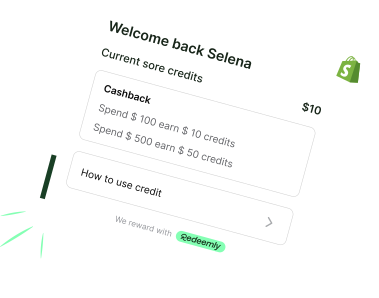
Store credit, on the other hand, is something everyone understands instantly because it works just like cash. A notification saying, "You have $10 in store credit" is clear, tangible, and valuable. There's no translation needed.
This creates a powerful psychological nudge to return to your store and spend that "found money." Customers love how straightforward it is, which is why store credit solutions built for Shopify see far higher engagement and redemption rates than clunky, point-based systems. You're not just giving a reward; you're giving them a real, no-nonsense reason to come back and boost their LTV.
How Does a Native Shopify App Help My Store?
This is a huge one that many merchants miss. Using an app built natively on Shopify’s own framework gives you a massive advantage in both site performance and user experience.
External, non-native loyalty apps often work by injecting heavy JavaScript files into your theme. These scripts can seriously slow down your site, and that slowdown directly hurts your conversion rates and even your SEO rankings. Every extra millisecond of load time is a potential lost sale and a barrier to increasing AOV.
A native app, however, plugs directly into Shopify’s core Store Credit feature. This means the whole experience is perfectly woven into your storefront and checkout.
No Site Slowdowns: It avoids the performance drag you get from clunky, third-party code.
A Seamless Experience: You won't have awkward widgets or pop-ups that break the flow or clash with your brand's design.
Rock-Solid Reliability: Because it uses Shopify's own systems, it's more stable and less likely to break when Shopify rolls out updates.
Choosing a native app means you get a powerful retention programme focused on LTV and AOV without the technical headaches and performance penalties that come with tacked-on solutions. It's a cleaner, faster, and more reliable way to build loyalty.
Ready to stop giving away margin and start building profitable loyalty? Redeemly replaces confusing points and margin-killing discounts with a simple, native Shopify store credit programme that drives repeat purchases and boosts LTV.


Join 7000+ brands using our apps