Shopify Customer Retention Software: The Definitive Guide to Boosting LTV & AOV
Feb 25, 2026
|
Published
Customer retention software is a set of tools designed to build loyalty and keep customers coming back. The goal is to drive repeat business, but not by constantly slashing your prices and hurting your margins.
Instead of throwing one-off discounts at everyone, the smarter play for Shopify stores is to increase lifetime value (LTV) and average order value (AOV). This is achieved by using Shopify-native store credit to give customers a real, cash-like reason to return. It’s a clean, simple, and profitable break from confusing point systems and margin-killing coupon codes.
Why Your Retention Strategy Needs an Upgrade

Too many Shopify merchants get stuck on a hamster wheel of discount codes and sitewide sales. Sure, you get a quick spike in revenue, but at what cost? You're conditioning your customers to never pay full price, which devalues your brand and crushes your profitability.
That old-school approach just doesn't cut it anymore. Today's e-commerce landscape requires a more intelligent path to growth, one built on genuine, lasting relationships that boost LTV. The aim isn't just to get another sale; it's to create a system that keeps people coming back and inspires them to spend more each time they do, directly increasing AOV.
Here’s the mental shift: move from transactional incentives (like a 20% off coupon) to relational rewards (like a $10 store credit balance). A discount is a cost you pay for a single sale. Store credit is an investment you make to secure the next one, which directly fuels your LTV.
The Problem with Old-School Loyalty
Let’s be honest, most traditional loyalty programs are clunky. They introduce friction and complexity with confusing points systems—the exact opposite of what you want when trying to build loyalty.
Take a look at how outdated methods stack up against a modern, native Shopify store credit system:
Feature | Traditional Points & Discounts | Native Shopify Store Credit |
|---|---|---|
Customer Incentive | Vague points or one-and-done coupons. | A clear, cash-like dollar value. |
Impact on AOV | Almost none. It encourages bargain hunting. | Significant. Customers spend more to use their credit. |
Profit Margin | Takes a direct hit on every single transaction. | Preserved. The cost only applies to a future purchase. |
User Experience | Complicated. "How many points do I need again?" | Dead simple. It feels like finding cash in your pocket. |
This isn't just a hunch; the market is moving this way. The global CRM market, which is the engine behind much of this tech, is expected to explode from USD 112.91 billion in 2025 to USD 320.99 billion by 2034, with customer retention as a major catalyst.
If you're ready to get off the discount treadmill, you need to nail the fundamentals. This practical guide on how to improve customer retention is a great place to start. By building your strategy around a clean, profit-friendly model like Shopify-native store credit, you're setting your business up for a much more resilient and profitable future.
Three Core Models of Customer Retention Software
Before you can pick the right retention software, you have to understand the different approaches. For Shopify merchants, these tools boil down to three models, each designed to get customers to come back. Looking at them this way helps you cut through the marketing noise and see how each system actually shapes customer behavior, your brand’s image, and—most critically—your LTV and AOV.
The three main models are Discount-Based Coupon Apps, Points & Tiers Loyalty Programs, and native Store Credit Systems. Each one uses a different psychological hook, and understanding how they work is the key to pushing up both your lifetime value (LTV) and average order value (AOV).
Discount-Based Coupon Apps
This is the most common model. These apps manage discount codes for promotions or sitewide sales. The appeal is simplicity—everyone understands "20% Off" right away.
The problem? You're training your customers to never pay full price. This constant discounting eats away at your profit margins and can make your brand feel cheap. It’s a purely transactional play that does very little to build the kind of loyalty that increases LTV. It's fine for a quick inventory clear-out, but it’s a poor foundation for a long-term retention strategy.
Points and Tiers Loyalty Programs
These programs are a step up from discounts because they turn shopping into a game. Customers earn abstract points for purchases and other actions, then trade them in for rewards. Many add tiers like Silver, Gold, and Platinum to give big spenders extra perks.
The downside is the mental gymnastics required. Customers often get lost trying to figure out what their points are actually worth. ("What does 1,000 points even get me?") This confusion creates friction and is a major reason why engagement with these programs is so low. On top of that, these systems often rely on heavy, third-party code that can noticeably slow down your Shopify store. For a closer look, check out our guide on comparing different loyalty programs for Shopify.
The critical difference: A customer with a $10 store credit balance feels like they have cash burning a hole in their pocket—an immediate, powerful reason to shop. In contrast, a customer with 1,000 points has a confusing puzzle to solve before they even think about buying again.
Native Store Credit and Cashback Systems
This model is built to fix the problems with the other two. Instead of confusing points or margin-crushing discounts, customers earn a clear, cash-like store credit balance, usually as a percentage of what they spend. Because it’s built using Shopify’s own native infrastructure, it’s fast and won’t drag your site speed down.
This approach is a powerhouse for driving up both AOV—as shoppers spend a little more to use their credit—and LTV, as that credit balance acts like a magnet, pulling them back for their next purchase. The global retention software market is exploding, projected to reach USD 1,251.35 billion by 2034, and simple, native tools are becoming essential. To learn more, read about the SaaS industry's outlook and its impact on customer retention.
For modern DTC brands focused on profitability and LTV, native Shopify store credit is the engine that makes it all work.
To put it all together, here’s a high-level look at how these three models stack up against each other.
Comparing Core Retention Software Models
Retention Model | Primary Incentive | Customer Experience | AOV & LTV Impact |
|---|---|---|---|
Discount-Based Coupons | Immediate price reduction (e.g., 20% off) | Transactional and devalues the brand. | Low, trains customers to spend less. |
Points & Tiers Loyalty | Abstract points and status (e.g., 1000 points) | Complex and confusing, causing low engagement. | Moderate, but friction limits potential. |
Native Store Credit | Cash-like balance (e.g., $10 credit) | Clear, intuitive, and feels like a real gift. | High, directly incentivizes repeat spend. |
Ultimately, the goal is to find a system that not only brings customers back but does so in a way that boosts LTV, increases AOV, and strengthens your brand.
How Different Retention Models Actually Impact Your Shopify Store
Picking your customer retention software is a bigger decision than you might think. You're not just choosing a tool; you're choosing a business model. Every strategy—whether it's based on discounts, points, or native store credit—nudges your customers in a specific direction, shaping how they see your brand and how profitable your store becomes.
When you focus on metrics like lifetime value and average order value, a clear winner emerges. It's time to dig into how these models really affect your key Shopify metrics.
This diagram breaks down the core differences between the most common retention models you'll come across.
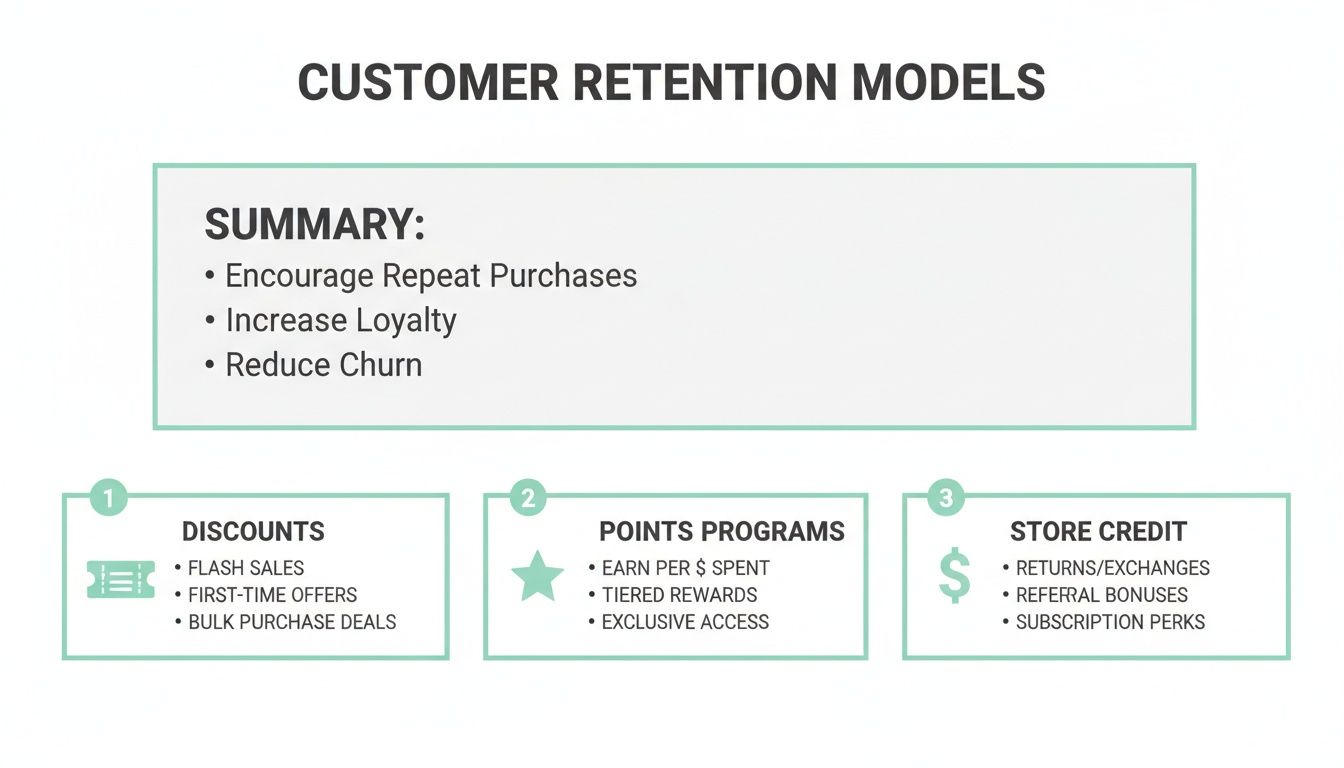
As you can see, Shopify-native store credit boils the reward down to a simple, direct monetary value. This is a world away from the immediate margin hit of a discount or the often-confusing, abstract nature of points.
Direct Impact on Average Order Value
One of the first places you’ll see the impact of a good retention strategy is in your Average Order Value (AOV). But make no mistake, discount coupons and confusing points systems are not designed to lift this number.
Discount-based systems are an AOV killer. By slashing prices, you attract bargain hunters who are laser-focused on one thing: spending as little as possible. They’re here for the deal, not to explore your catalog.
Points programs try to nudge AOV up with thresholds like, "spend $10 more to earn 100 points," but the psychological pull is weak. Points feel abstract, forcing customers to do mental math to figure out the reward's true value. That disconnect is often too vague to change buying habits.
Native Shopify store credit, on the other hand, is a proven AOV driver. When a customer sees a $10 balance sitting in their account, it feels like found money. This makes them eager to spend it, often adding one more item to their cart to justify using the credit and "unlocking" the full value of their order. The incentive is clear, immediate, and powerfully focused on increasing AOV.
Effect on Customer Lifetime Value
AOV is about a single sale, but Customer Lifetime Value (LTV) is the real prize. This is where the gap between store credit and other models widens into a canyon.
Discounting is poison for LTV. It trains customers to wait for sales, turning your brand into a commodity. You’re teaching them to be loyal to the deal, not the brand—a race to the bottom you can't win.
Points and tiers are supposed to build long-term loyalty, but their complexity is their downfall. Many customers never earn enough points for a meaningful reward, so they just check out. It’s a missed opportunity, especially when you consider that while only 18% of companies focus on retention, a tiny 5% increase in retention can skyrocket profits by 25% to 95%. Clunky points systems just aren't effective enough to capture that potential.
Native Shopify store credit is a masterclass in boosting LTV. It creates a simple, powerful reason for customers to come back again and again. A visible balance in their account is a constant, gentle nudge, pulling them back for their second, third, and fourth purchase. This earn-and-redeem cycle builds a habit of loyalty based on real, tangible value, not abstract games.
User Experience and Simplicity
If your customers don't understand your retention program, they won't use it. Simplicity is everything, and this is where native store credit dominates.
Discounts are simple, sure, but they cheapen the brand and create a frustrating user experience as shoppers hunt for coupon codes.
Points systems are notoriously complicated. They force customers to ask:
How many points do I have?
What are these points actually worth in real money?
What can I even buy with them?
This mental friction is a huge barrier to engagement. The more a customer has to think, the less likely they are to come back.
Native store credit delivers the most intuitive experience possible. A dollar value is universal. Seeing "$15.00 available" requires zero interpretation. This clarity removes all friction, making the reward feel immediate, accessible, and far more valuable. When it’s built directly into a customer's Shopify account, it feels like a seamless part of shopping with you, not a clunky add-on.
Shopify Integration and Performance
Finally, the technical side of your retention software matters. Your site’s speed is directly tied to your conversion rate.
Many third-party loyalty apps rely on heavy JavaScript widgets that get bolted onto your Shopify store. These scripts can drag down your page load times, creating a sluggish experience for shoppers and even hurting your SEO.
A native store credit solution, like Redeemly, is built on Shopify’s own rock-solid infrastructure. It taps into the platform's core store credit function, which means no bloated external scripts to slow your site down. The whole system is lightweight, fast, and integrates perfectly with the native Shopify checkout and customer account pages. This guarantees a smooth journey that protects your store's performance and maximizes conversions, making it the clear choice for any merchant focused on increasing LTV and AOV.
Why Store Credit Is Your Profit-First Retention Engine
If you're a profit-focused DTC brand, your real goal isn't just one more sale. It's about building a reliable, high-margin revenue stream by increasing LTV. This is precisely where native Shopify store credit comes in, leaving behind the short-lived sugar rush of discounts and the headache of complex points systems.
Store credit works because it taps into a powerful psychological trigger: the feeling of already having money to spend.
When a customer sees a real dollar amount in their account, it feels immediate—like a gift card just waiting to be used. This "money in the pocket" feeling is a world away from the mental math needed to figure out a points balance. A customer with a $15 credit knows exactly what they've got. A customer with 1,500 points? They're left guessing its real value, which creates a roadblock to their next purchase.

This simple, cash-like approach gives customers a strong reason to come back and spend more, all without devaluing your brand with constant sales.
Boosting AOV Without Hurting Margins
One of the biggest advantages of a Shopify-native store credit system is how it directly lifts your Average Order Value (AOV). Unlike discount codes that just slash the final price, store credit actually nudges customers to add more to their cart.
Think about it. A customer has a $10 store credit. They're far more likely to bump their cart value from $45 to $60 just to "unlock" the full value of that credit and make the purchase feel more worthwhile. It’s a natural reaction to having a clear, spendable balance.
This is a totally different game than offering a 20% off coupon, which usually just attracts bargain hunters focused on spending as little as possible. Store credit flips the script from "How can I save money?" to "How can I best use this money I already have?"
The financial genius of store credit is that it only becomes a cost to your business after it has secured a repeat purchase. Unredeemed credit remains in your cash flow, safeguarding your unit economics until a loyal customer returns to spend it.
The Unmatched Performance of a Native Solution
Your store’s performance is non-negotiable. A slow site kills conversions and hurts your brand's reputation. This is where many third-party loyalty apps, with their heavy scripts and clunky widgets, miss the mark. They bog down your site and disrupt the checkout flow.
A native Shopify solution built on Shopify's own infrastructure avoids these problems completely. It blends right into the customer account and checkout process, giving you a fast, seamless experience. No external scripts to worry about, no jarring pop-ups to distract shoppers.
The clean, unobtrusive design makes the reward feel like a natural part of shopping, not some clunky add-on. That simplicity is the key to getting customers to both use and redeem their credit.
Building a Sustainable LTV Engine
At the end of the day, it’s all about increasing Customer Lifetime Value (LTV). The current state of e-commerce retention is grim, with an average 24.5% retention rate after the first purchase, plummeting to just 10.7% for the second and a tiny 5.6% for the third. This steep drop-off shows a desperate need for better tools that build real loyalty.
Shopify-native store credit tackles this problem head-on by creating a powerful reason for customers to make that crucial second and third purchase. The system builds a simple, rewarding cycle:
Purchase: A customer buys something and earns a percentage back in store credit.
Notification: They get an email letting them know about their new, spendable balance.
Return: That visible credit acts like a magnet, pulling them back to your store.
Redeem & Repeat: They use their credit on their next purchase—often increasing their AOV to use it—and the cycle starts all over again.
This earn-and-spend loop is the heart of a profit-first LTV engine. It builds a habit of repeat purchasing based on real value, not fleeting discounts or confusing points. For a deeper look, check out our guide on what store credit is and how it works. By choosing a native store credit system, you’re investing in a more profitable, resilient, and customer-focused business model.
How to Choose The Right Retention Software
Picking the right customer retention software is a critical financial decision. It's not about finding the tool with the longest feature list. It's about finding a strategy that directly pumps up your Average Order Value (AOV) and customer Lifetime Value (LTV). To get it right, you need a framework that puts profitability and a dead-simple customer experience first.
So, where do you start? The trick is to ask the right questions—the kind that cut through marketing fluff and get to the heart of what actually grows your store. Forget flashy dashboards. Instead, focus on how a system will concretely change customer behavior and impact your bottom line.
A Profit-First Evaluation Checklist
Before you choose any platform, run it through this checklist. These questions are designed to guide you toward a solution that prioritizes simplicity and real profit, highlighting why a Shopify-native store credit approach consistently beats confusing points systems or margin-killing discounts.
1. Does This System Directly Incentivize a Higher AOV?
This is the most important question. Your retention tool shouldn't just bring people back; it needs to get them to spend more when they do.
Discount Coupons: They fail this test. You train customers to wait for a sale and hunt for the lowest price, not spend more.
Points Systems: The incentive is weak. The link between spending a little more now and earning abstract points later is too vague to motivate most shoppers.
Native Store Credit: This is where store credit shines. A customer with a $10 balance is far more likely to push their $45 cart up to $60 just to feel good about "using" their credit. The reward is real money, right now, driving a higher AOV.
2. How Intuitive Is the Reward System for My Customers?
Complexity is the silent killer of engagement. If a customer has to pull out a calculator to figure out what their reward is worth, you've already lost. A simple, cash-like reward system based on native store credit wins every time.
The goal is absolute clarity. A customer sees "$15.00 Available" in their account and gets it instantly. There’s zero mental friction. They understand its value, which makes them far more likely to come back and spend it, boosting your LTV.
3. What Is the Documented Impact on Site Speed?
Your store's performance is sacred. Many third-party loyalty apps are bloated with heavy, external JavaScript that can bog down your site, tanking conversions and hurting SEO.
Always demand performance benchmarks. A truly native Shopify solution leverages Shopify’s own infrastructure, meaning no clunky scripts or widgets dragging down your page load times. This protects your revenue by ensuring a fast, seamless experience.
4. How Seamlessly Does It Integrate with Native Shopify Features?
A great retention tool shouldn't feel like a bolted-on app; it should feel like it was always part of your store. It must integrate perfectly with the native Shopify checkout and customer account pages. As you're looking at different options, it's crucial to think about how well each platform will help you measure customer engagement, a vital sign of retention health.
A native store credit system works within the Shopify ecosystem you already have, creating a smooth and reliable experience. That’s a level of clean integration many complex loyalty programs can't deliver. If you need some help navigating the options, our breakdown of the best Shopify loyalty apps is a great place to start.
By keeping these four areas front and center, you can be confident your choice in retention software will become a true engine for profitable growth.
Common Questions About Customer Retention Software
Making a change to your retention strategy can feel like a big leap, especially if you've relied on discounts. A lot of Shopify merchants have the same questions when they're considering moving from confusing points systems to a native store credit model.
Let's tackle those concerns head-on. Getting clear, straightforward answers will help you see why this approach is the smartest way to boost your lifetime value and average order value for the long haul.
Will Switching to Store Credit Confuse My Customers?
Honestly, it's the other way around. Confusing point systems are what create friction. Native Shopify store credit is far simpler because everyone understands cash value. When a customer sees "$10 to spend" in their account, they get it instantly—no need to figure out what 250 points are actually worth.
A native system displays that dollar balance right in their customer account. It feels like real money waiting for them, making the reward more tangible and valuable. This clarity removes friction, which is why we consistently see higher redemption rates and happier customers who love the simplicity.
A discount is a pre-purchase bribe that eats into your profit on the current sale. Store credit is a post-purchase reward that guarantees a future sale. One drives transactions; the other builds loyalty and increases LTV.
How Does This Software Affect My Store’s Performance?
Site speed is everything. We all know a slow site kills conversions and hurts SEO rankings. The problem with many third-party loyalty apps is their heavy JavaScript and external widgets that drag your store down. It's a frustrating experience for shoppers and a direct path to lost sales.
A Shopify-native solution, on the other hand, is built on Shopify's own infrastructure. It hooks directly into the platform's core store credit functionality. That means no clunky scripts, no slow-loading elements—just a fast, seamless experience that protects your performance and actually improves the customer journey.
How Do I Measure the ROI of This Software?
Great customer retention software makes its value obvious in your numbers. You need to see a direct impact on the metrics that matter most: Average Order Value (AOV), Repeat Customer Rate, and Customer Lifetime Value (LTV). A good platform will give you a clear "before and after" picture of these key performance indicators.
With a native Shopify store credit system, you can also watch your redemption rate like a hawk. This number tells you exactly how many customers you've successfully brought back for another purchase. It's a direct, quantifiable measure of how well you're building profitable, long-term relationships and increasing lifetime value.
Ready to ditch the confusing points and margin-killing discounts? Redeemly uses Shopify-native store credit to boost your AOV and LTV, turning one-time buyers into loyal fans. See how Redeemly can transform your retention strategy today.


Join 7000+ brands using our apps