Ecommerce Loyalty Platforms Driving LTV with Store Credit
Jan 17, 2026
|
Published
Ecommerce loyalty platforms are your secret weapon for turning one-time buyers into lifelong fans. Forget the endless cycle of discounts and confusing points. Modern platforms use smarter rewards, like native Shopify store credit, to build real relationships that drive profitable, repeat business by focusing on lifetime value and average order value.
The Hidden Costs of Discounting Your Brand
For too many Shopify stores, the business calendar is just a series of sales. A flash sale for this, a 20% off coupon for that. It’s a familiar dance to juice short-term revenue. But this reliance on discounts is like a sugar rush for your business—a quick high followed by a long, slow crash that tanks your brand's health.
The core problem? Discounts train your customers to wait. They learn your full price is just a starting point, not a real value. This erodes what your brand is worth in their eyes and conditions them to never, ever pay full price. Before you know it, you're in a race to the bottom, competing on price instead of the quality and experience you’ve worked so hard to build.
Beyond the Immediate Sale
Sure, a discount might lock in a single transaction, but it almost never builds a real connection. Customers who show up for a low price are loyal to the deal, not to you. It's a fragile, transactional relationship that leaves you on a constant, expensive treadmill of finding new buyers to replace the ones who inevitably ghost you. It’s a losing game, especially with customer acquisition costs soaring.
The numbers paint a pretty grim picture for brands stuck in this cycle. On average, ecommerce retention rates hover around a meager 31%. That means nearly 70% of your customers are gone after just one purchase. But here’s the kicker: boosting retention by just 5% can skyrocket profits by as much as 25%. This is exactly why the smartest DTC brands are shifting their focus from one-off sales to building unshakable loyalty. You can find more of these eye-opening customer loyalty rate statistics over on opensend.com.
The biggest hidden cost of discounting is the opportunity cost. Every dollar you give away is a dollar you can't reinvest into better products, amazing customer service, or building a brand that people are proud to buy from, sale or no sale.
A More Sustainable Path to Growth
Instead of renting customers with temporary price cuts, you need to build a community of advocates who genuinely love your brand. This means shifting your mindset from transactional promotions to relational rewards. A modern ecommerce loyalty platform gives you a healthier, more sustainable way to grow by rewarding customers in a way that actually encourages their next purchase.
The most powerful strategy is built around native Shopify store credit. Don't think of it as a discount. Think of it as an investment in your customer's future with you. By giving them cash-like rewards they can only spend in your store, you create a powerful magnetic pull for them to come back. This approach protects your margins, boosts your average order value (AOV), and increases lifetime value (LTV) by building a predictable revenue stream from your best customers. For a deeper dive, check out our guide on how to improve profit margins with smarter strategies.
Comparing Loyalty Reward Models: Store Credit vs. Points
The reward model you choose is the engine that drives your entire loyalty strategy. Many brands get this wrong from the start, defaulting to complicated point systems or the all-too-common discount code. Unfortunately, these older methods rarely build the profitable, long-term relationships they promise.
The best loyalty programs are built on a simple foundation: clarity, tangible value, and a laser focus on increasing customer lifetime value and protecting your profit margins.
Why Traditional Points and Discounts Fall Short
Let's be honest—traditional points programs are a headache. They introduce a made-up currency with a confusing exchange rate. How many points is a dollar worth? Is 1,000 points a little or a lot? This mental gymnastics creates friction and, more often than not, total apathy. Customers just don't bother, and your loyalty program becomes a liability instead of an asset.
And we've already touched on discount coupons. They're a race to the bottom. Slashing prices teaches shoppers to wait for the next sale, cheapening your brand and killing your margins with every order. Sure, you might get a temporary traffic spike, but you aren't building a base of truly loyal customers who buy again and again, which is the key to high lifetime value.
The Clear Advantage of Native Shopify Store Credit
This is where a loyalty model built on native Shopify store credit really shines. It's refreshingly simple—think of it as cash back for your store.
There's no confusing math or abstract points to track. It's just a clear dollar value that customers understand instantly. Spend $100, get $10 in store credit. Simple. The value is immediate, tangible, and feels like real money waiting to be spent.
That clarity is exactly what you need to boost two of the most critical metrics for sustainable growth: customer lifetime value (LTV) and average order value (AOV). When customers see a clear path to a reward ("I'm only $20 away from my next $10 reward!"), they’re naturally motivated to add another item to their cart. That's how you lift AOV.
A loyalty program shouldn’t feel like a puzzle. Store credit eliminates the guesswork by offering a reward that feels like real money, making it the most powerful incentive to bring customers back for a second, third, and fourth purchase, maximizing their lifetime value.
This isn't just about giving something away; it's about building a sustainable growth loop. The diagram below shows how strategies like store credit create a strong foundation for your brand, while discount-heavy tactics chip away at it over time.
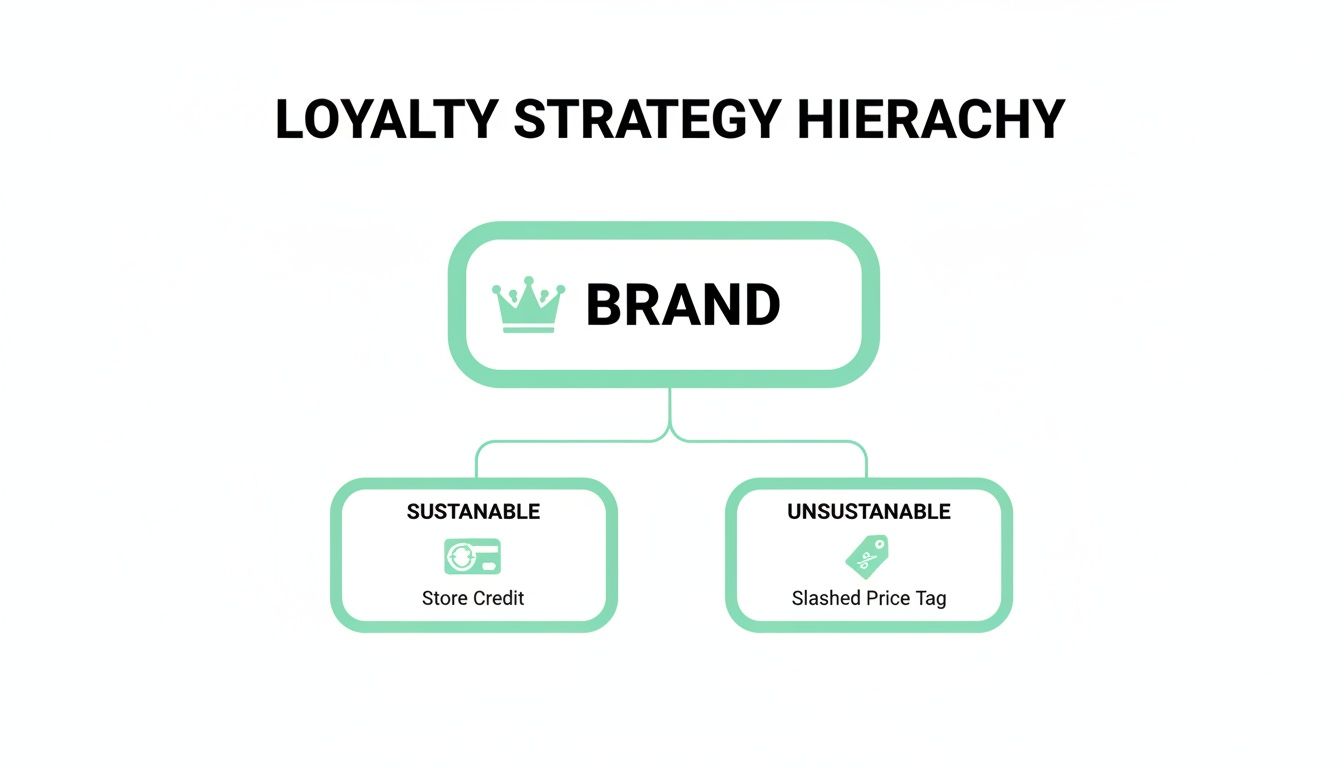
As you can see, discounts might give you a quick win, but store credit is playing the long game—building a foundation for lasting profitability and brand loyalty.
Comparing Loyalty Reward Models
When you put these models head-to-head, the benefits of using store credit become impossible to ignore. It delivers a better experience for the customer and a better financial outcome for your business.
Here’s a quick breakdown of how each reward model stacks up.
Metric | Points System | Discount Coupons | Native Store Credit |
|---|---|---|---|
Margin Impact | Deferred cost, but often redeemed for free products (100% margin loss). | Immediate hit to revenue and profit on the initial sale. | Deferred cost that’s realized only on a second profitable purchase. |
Customer Experience | Often confusing. Customers have to learn a new "currency" and do math. | Simple, but trains customers to devalue your products and wait for sales. | Intuitive and clear. It’s like cash, creating a frictionless and valuable experience. |
LTV & AOV Impact | Weak psychological pull. An abstract point balance is easy to forget. | Zero long-term incentive. The value is gone once the transaction is over. | Powerful. A store credit balance acts like money in the bank, pulling customers back and encouraging larger carts. |
Ultimately, choosing the right model makes all the difference. We know that 9 out of 10 companies have some kind of loyalty program, but their results are all over the map. The ones that succeed—think Starbucks or Sephora—do so because their value is crystal clear. They don't make their customers work for it.
By building your program around store credit, you're aligning your strategy with what actually works: simplicity, profitability, and genuine customer value. That's the formula for sustainable growth.
How Store Credit Boosts AOV and LTV
A great loyalty strategy shouldn't be complicated. For Shopify merchants, the whole point is to move the needle on two core metrics: Average Order Value (AOV) and Customer Lifetime Value (LTV). Unlike confusing points systems, store credit is dead simple. It gives customers a clear, tangible reason to spend more per order and come back more often.
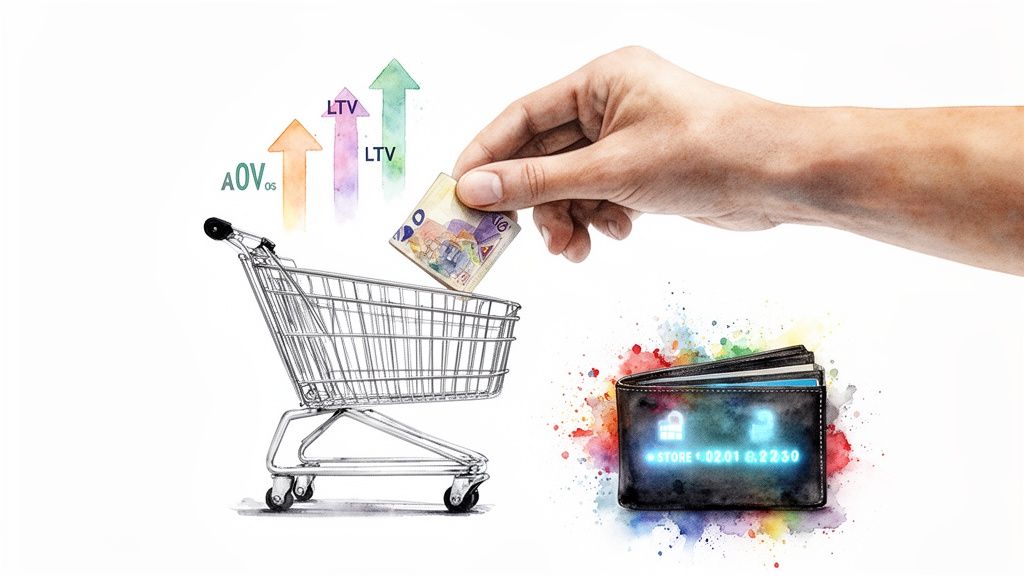
This isn’t just about handing out rewards. It's a strategic investment in your customer relationships. Think of earned credit as a magnet. It creates a compelling reason for shoppers to return and spend again, effectively pre-loading their next purchase.
Driving Bigger Carts with AOV-Boosting Tiers
The quickest win you'll see with a store credit program is a jump in AOV. By setting up simple reward tiers, you gamify the shopping experience and nudge customers to spend just a little bit more during their visit. The psychology here is simple: people love unlocking a new level and feeling like they got a deal.
Let's say a customer has $85 in their cart. A little notification pops up: "You're only $15 away from earning $10 in store credit!" Suddenly, their mindset shifts from spending more to earning more. That small prompt is often all it takes for them to find one more item, pushing their order over the $100 mark.
Here’s how that one small interaction is a huge win for your business:
Immediate AOV Lift: The customer adds a $20 item, turning an $85 cart into a $105 one. You just boosted that transaction's value by nearly 24%.
Margin Protection: Unlike a 10% off discount that eats into your revenue right away, the $10 store credit is a deferred cost. It only gets redeemed on their next purchase.
Future Purchase Secured: You haven't just made a bigger sale today. You've given that customer a financial reason to come back.
Building Long-Term Relationships with LTV
AOV gives you a quick hit, but the real magic of store credit is how it multiplies LTV over time. A customer with a $10 balance in their account behaves differently than one with zero. They have skin in the game. That balance is a gentle, constant reminder that they have money waiting for them at your store.
This simple change turns the customer journey from a series of one-off transactions into an ongoing relationship. That $10 in credit is the bridge connecting their first purchase to their second, their second to their third, and beyond, dramatically increasing lifetime value.
Store credit creates a powerful retention loop. A customer buys, earns credit, and is drawn back to redeem it—often spending more than their credit balance and earning even more rewards for their next visit. This is the core of a high-LTV strategy.
This cycle is the engine of sustainable growth. The global loyalty market, the backbone of ecommerce loyalty platforms, is exploding, projected to hit an incredible USD 31.11 billion by 2033. With customer acquisition costs soaring, retention-focused loyalty programs deliver a 5.2X return on revenue. This makes simple, effective solutions like Shopify’s native store credit system an absolute must-have. You can explore more about these market projections and see exactly why retention is a top priority for growing brands.
Choosing the Right Shopify Loyalty Platform
Deciding to use a store credit loyalty model is a huge step toward building a more profitable, long-lasting brand. But the next move is just as critical: picking the right tool to make that strategy a reality. Not all ecommerce loyalty platforms are built the same, and for Shopify merchants, the difference between a truly native solution and a clunky app is night and day.
Your goal is to find a platform that feels like a natural part of your Shopify store, not some complicated add-on. The right tool should boost your store's performance, protect your margins, and make life incredibly simple for your customers. It should work behind the scenes to lift both your Average Order Value (AOV) and Customer Lifetime Value (LTV) without needing you to micromanage every detail.
Is It Truly a Native Shopify Solution?
The word "native" gets tossed around a lot, but what it actually means is make-or-break. A real native Shopify app is built using Shopify's own core systems—in this case, its own store credit infrastructure. This is a game-changer for a few big reasons.
First off, it means no heavy, third-party scripts are slowing down your site. We all know page speed is a huge deal for conversions, and apps that rely on external code can really drag your performance down. A native solution is lightweight and fast, so it won't undo all the hard work you've put into optimizing your shopping experience.
It also guarantees a seamless experience for your customers. The store credit balance shows up as a natural part of their account and checkout process. No confusing pop-ups, no awkward widgets, and no separate websites they have to log into. It just works, which is exactly what you want.
How Intuitive Is the Customer Experience?
A loyalty program is only good if your customers actually use it. The magic of a store credit system is its simplicity, and the platform you choose needs to reflect that. Can a customer easily see their balance from anywhere on your site? Is it crystal clear how they earn and spend their credit?
The best platforms make the reward feel like cash in the bank. They often use smart on-site reminders, like a floating wallet icon that displays a customer's balance, constantly reminding them they have money to spend. That little nudge turns a passive reward into an active reason to shop, directly encouraging that all-important next purchase and boosting lifetime value.
Your loyalty platform should eliminate friction, not create it. If a customer has to stop and think about how your program works, you’ve already lost the battle for their attention. Simplicity drives engagement.
Vendor Evaluation Checklist for Store Credit Platforms
Picking the right partner can feel overwhelming. This checklist breaks down the essential features you should look for and the key questions to ask when evaluating Shopify-native loyalty platforms that focus on store credit.
Feature/Criteria | Why It Matters | Questions to Ask Vendors |
|---|---|---|
Native Shopify Integration | Ensures fast site speed and a seamless customer experience without clunky external scripts. | Is your app built on Shopify's native store credit and discount infrastructure? |
Intuitive Customer UI/UX | Makes it easy for customers to see, understand, and use their rewards, boosting engagement and LTV. | How do customers see their balance? Is it visible on all pages and during checkout? |
Profit-Protecting Pricing | A pay-for-performance model ensures you only pay for actual results (redeemed credit). | What is your pricing model? Do you charge a fixed monthly fee or a percentage of redeemed credit? |
Automated Communication | Proactively reminds customers to use their credit, driving repeat visits and sales automatically. | Do you offer automated email or SMS reminders for customers with an unspent balance? |
On-Site Nudges & Reminders | Visual cues like a floating wallet icon keep the reward top-of-mind while customers browse. | Does your platform include on-site elements to constantly show a customer's credit? |
Focus on AOV & LTV | The platform's features should be designed to directly increase order sizes and customer loyalty. | How does your platform specifically help me increase AOV and LTV? |
Dedicated Support | Access to expert help ensures you can resolve any issues quickly and maximize your ROI. | What kind of customer support do you offer (e.g., email, chat, phone)? |
Using this checklist will help you cut through the marketing noise and find a platform that truly aligns with your business goals—protecting your profits while building a loyal customer base.
Does It Protect Your Profit Margins?
This one is a deal-breaker. The whole point of moving from discounts to store credit is to stop giving away your profits. So, your loyalty platform's pricing model has to line up with that goal. Steer clear of platforms with high fixed monthly fees that you have to pay no matter how well (or poorly) the program performs.
Instead, look for a model where the cost is tied directly to results. A platform that only charges you when a customer successfully redeems their credit is the way to go. This approach guarantees a positive return on investment because the cost is directly linked to a repeat, profitable sale. You can compare different Shopify loyalty apps to see just how much their pricing structures can impact your bottom line.
Can It Automate Customer Communication?
Earning store credit is only half the story; getting customers to come back and spend it is how you really win. An effective platform absolutely must have automated communication tools built right in. This means sending timely email or SMS reminders to customers who have credit sitting in their account.
A simple, automated message like, "Hey, you have $15 in credit waiting for you!" is an incredibly powerful way to drive repeat traffic. It cuts through the marketing noise and gives people a real, financial reason to visit your store. This kind of automation turns your loyalty program into a proactive retention engine that works for you 24/7. And remember, while your focus is on loyalty, the foundation matters—choosing from the best ecommerce platforms for small businesses can make a huge difference in your program's overall success.
Getting Your Store Credit Program Live on Shopify
So, you're ready to switch to a store credit loyalty program on Shopify? Good news: it's probably way easier than you're imagining. We’re not talking about those clunky, points-based systems that feel like they need a team of developers to get off the ground. A native Shopify solution is built to be fast and intuitive. You can go from an idea to a live, profit-generating program in a matter of minutes, not weeks.
Honestly, the initial setup boils down to just two things: figuring out your reward structure and making sure customers can actually see it. By keeping it simple, you create an incentive that people get right away, which is the secret to nudging up that average order value (AOV) from day one.
Defining Your Reward Tiers
Think of your reward structure as the engine of the whole program. The goal here is to create simple, achievable tiers that make a customer think, "I should just add one more thing to my cart." This is how you directly boost AOV without just slashing your margins with another discount code.
Here are a few models that just plain work:
Simple Spend & Get: This is the crowd-pleaser. "Spend $100, get $10 in store credit." It's crystal clear and incredibly effective.
Tiered Rewards: This is how you encourage bigger carts. "Spend $75, get $5. Spend $150, get $15." It gamifies the shopping experience and gives people a clear goal to shoot for.
Percentage Back: This rewards everyone, every time. "Get 5% back on every purchase." It’s a consistent perk that builds rock-solid loyalty and increases lifetime value.
These work so well because they frame the reward as something earned, not just given away. A customer who sees they're just $20 shy of a $10 reward is far more likely to find something else to buy, putting more money in your pocket on that same visit.
Making Credit Visible and Enticing
Okay, you've set your tiers. Now, you have to make sure people see the money they've earned. An out-of-sight balance is an unused balance. The best native apps blend right into your storefront, often with an on-site "wallet" or a little floating bubble that proudly displays a customer's credit.
A visible store credit balance is a constant, gentle reminder to your customers that they have money waiting for them. This visibility is the single most important factor in turning an earned reward into a repeat purchase and higher lifetime value (LTV).
This visual cue keeps the reward top-of-mind while they browse. It transforms a passive number into an active reason for them to come back and shop again. Setting this up is usually a one-click affair in the app's dashboard, instantly making your loyalty program a tangible part of the shopping experience. If you want a full step-by-step, our guide on how to issue store credit on Shopify breaks down the technical side of things.
Announcing Your New Program
With everything set up, it's time to make some noise. A strong launch is all about getting your best customers on board from the very beginning.
Email Campaign: Draft a dedicated email to your list. Announce the new, simpler way they can earn rewards. Really lean into the "cash-like" value and how easy it is to use.
On-Site Banners: Slap a banner on your homepage or a notification bar at the top. Use exciting, action-focused language like, "Start Earning Cash Back Today!"
Social Media Push: Tell the world on your social channels. You could even offer a little bonus credit for the first week to get people signed up and spending right away.
By focusing on simplicity and real value, your launch will start training your customers to look forward to earning credit instead of just waiting for the next big sale. It's a fundamental shift, but one that leads to a much more profitable and sustainable business.
Frequently Asked Questions About Store Credit
Moving to a store credit loyalty program is a game-changer for building a more profitable brand, but it’s smart to have questions before you dive in. Let's tackle the most common ones Shopify merchants ask, so you can see exactly how this modern approach boosts metrics like lifetime value while protecting your bottom line.
How Is Store Credit Different from a Gift Card?
This is a fantastic question because it gets right to the heart of the strategy. While they both represent a cash value in your store, store credit and gift cards have completely different jobs.
A gift card is basically a product you sell. It’s prepaid revenue that acts as a payment method. Store credit, on the other hand, is a powerful marketing tool. You don’t sell it—you award it to encourage a future purchase and reward genuine loyalty.
Think of it this way: a gift card is a one-time transaction, while store credit is a relationship-builder. True native ecommerce loyalty platforms for Shopify build this earned balance directly into a customer’s account, so it feels like a built-in perk, not some random code they have to hunt down and remember.
Will a Store Credit Loyalty Program Hurt My Profit Margins?
This is a totally valid concern, especially if you’ve been burned by margin-killing discount codes before. The good news is that a well-designed store credit program is actually built to be margin-safe—and it's far healthier for your business than running constant sales.
When you offer a 20% off coupon, you take an immediate, painful hit to your revenue and profit margin on that sale. With store credit, the cost is strategically delayed. Offering a 10% reward (like $10 in credit on a $100 purchase) only costs you something when the customer returns to make a second profitable purchase.
Store credit is an investment in retention, not a cost of acquisition. The expense is only realized when you successfully bring a customer back, a model that directly ties your loyalty spend to a positive ROI and increased lifetime value.
What’s more, customers often spend way beyond their credit balance when they come back. That $10 in credit might be what brings them to your site, but they frequently end up placing a $60 order. You just made another profitable sale and deepened the customer relationship at the same time.
Is It Difficult to Migrate from My Current Points App?
You’d be surprised. Moving away from a clunky, confusing points system to a streamlined store credit platform is actually quite straightforward, especially with a native Shopify app. The whole process is designed to be quick and simple, so there's minimal disruption to your store or your customers.
The migration really boils down to two key steps:
Communicate the Change: Get your customers excited about the update! Frame it as a major upgrade to a simpler, more valuable program with cash-like rewards that are easy to understand and even easier to use.
Convert Existing Points: Run a final conversion that turns any outstanding customer points into a one-time store credit balance. This is a great way to honor their past loyalty while moving everyone over to the new, better system.
Because truly native apps use Shopify's own infrastructure, you can skip the headaches of installing heavy scripts or editing theme code. Most merchants can migrate and launch their new store credit program in a single day, leading to an immediate boost in both site speed and customer experience.
How Do I Get Customers to Actually Use Their Store Credit?
This is where the rubber meets the road. Earning credit is great, but getting customers to spend it is what really drives your lifetime value. The best ecommerce loyalty platforms make this almost effortless by focusing on two things: visibility and communication.
First, you have to make the credit balance impossible to miss. On-site elements like a floating wallet icon or a notification bar that clearly shows a logged-in customer’s balance work wonders. It’s a constant, gentle nudge that they have "money to spend" every time they visit.
Next, you use smart, automated communication to bring them back. The most effective platforms send automated email and SMS reminders when a customer has an unspent balance. A simple, friendly message like, “Hey, you still have $15 waiting for you!” is an incredibly powerful motivator.
By making store credit easy to see and even easier to apply at checkout, you turn a passive balance into an active, compelling reason for customers to shop again—sooner rather than later. This automated cycle is the engine that drives repeat purchases and builds a predictable revenue stream from your best customers.
Ready to build a more profitable loyalty program without the complexity of points or the margin-crushing impact of discounts? Redeemly helps Shopify merchants grow with simple, cash-like store credit rewards that boost LTV and AOV.
Discover how Redeemly can transform your retention strategy today.
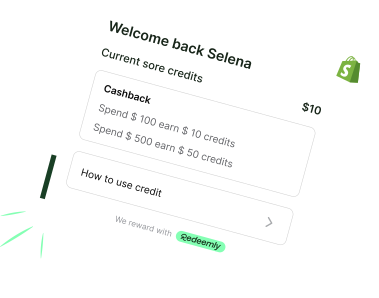


Join 7000+ brands using our apps