Profitable Reward Programs for Businesses That Boost LTV & AOV
Feb 26, 2026
|
Published
Let's be honest. For too many Shopify merchants, the old loyalty playbook is gathering dust on the shelf. It’s a tired, predictable cycle of discounts and confusing points that only seems to attract one-and-done bargain hunters, eating away at your margins without building any real, lasting customer relationships.
This guide is your way out.
Moving Beyond Margin-Crushing Discounts
Traditional business reward programs, with their confusing points systems and endless coupon codes, just aren't cutting it anymore. The smartest brands are making a big shift to a more powerful, elegant, and profitable alternative: native Shopify store credit. This isn’t just a new tactic; it’s a complete rethinking of how you build a loyal customer base that drives sustainable growth.
The real goal here is to send your customer lifetime value (LTV) and average order value (AOV) through the roof—without having to sacrifice your bottom line to do it. To effectively ditch those margin-killing discounts, many businesses are turning to specialized e-commerce marketing services that help them build robust reward programs designed for profitability. This is how you create a loyalty model that truly rewards your business just as much as it rewards your customers.
The Problem With Old Loyalty Models
A lot of brands feel trapped in a race to the bottom, constantly running sales just to keep people from forgetting they exist. It’s a strategy that feels busy, but it does more harm than good by failing to increase customer lifetime value.
It attracts the wrong crowd. You end up training shoppers to wait for a sale, which brings in people who care about the deal, not your brand. They’re not loyal advocates; they’re just waiting for the next coupon.
It bleeds your profit margins. Every single discount code is a direct cut from your revenue, leaving you with less cash to reinvest in what really matters—growing your business. (We talk a lot more about this in our guide on how to improve your store's profit margins).
It cheapens your brand. When your products are perpetually on sale, customers start to see the discounted price as the real price, lowering the perceived value of everything you sell.
This old way of thinking just isn't sustainable. The global loyalty programs market is absolutely exploding, projected to jump from US$80.92 billion in 2024 to a massive US$155.22 billion by 2029. That signals a huge opportunity for brands who get this right—the ones who build programs that create genuine retention instead of just giving away money.
With over 90% of companies now running some kind of loyalty initiative, the trend is clear: it’s time to get smarter and more strategic about how we earn and keep our customers.
Comparing The Most Common Reward Program Models
Not all reward programs are built the same, especially when you're focused on growing your business profitably. To find the right approach, you have to look past the surface-level perks and understand how each model truly shapes customer behavior and, crucially, your bottom line.
Many traditional loyalty strategies feel like you're just giving away margin for a temporary sales bump. Let's dig into the common models to see why native store credit creates lasting customer relationships while others just attract fleeting, one-time buyers. We'll look at the pros, the cons, and how each one stacks up against key growth metrics like Average Order Value (AOV) and Customer Lifetime Value (LTV).
The entire world of customer loyalty has been evolving, moving away from simple, transactional rewards toward more meaningful, relationship-driven strategies.
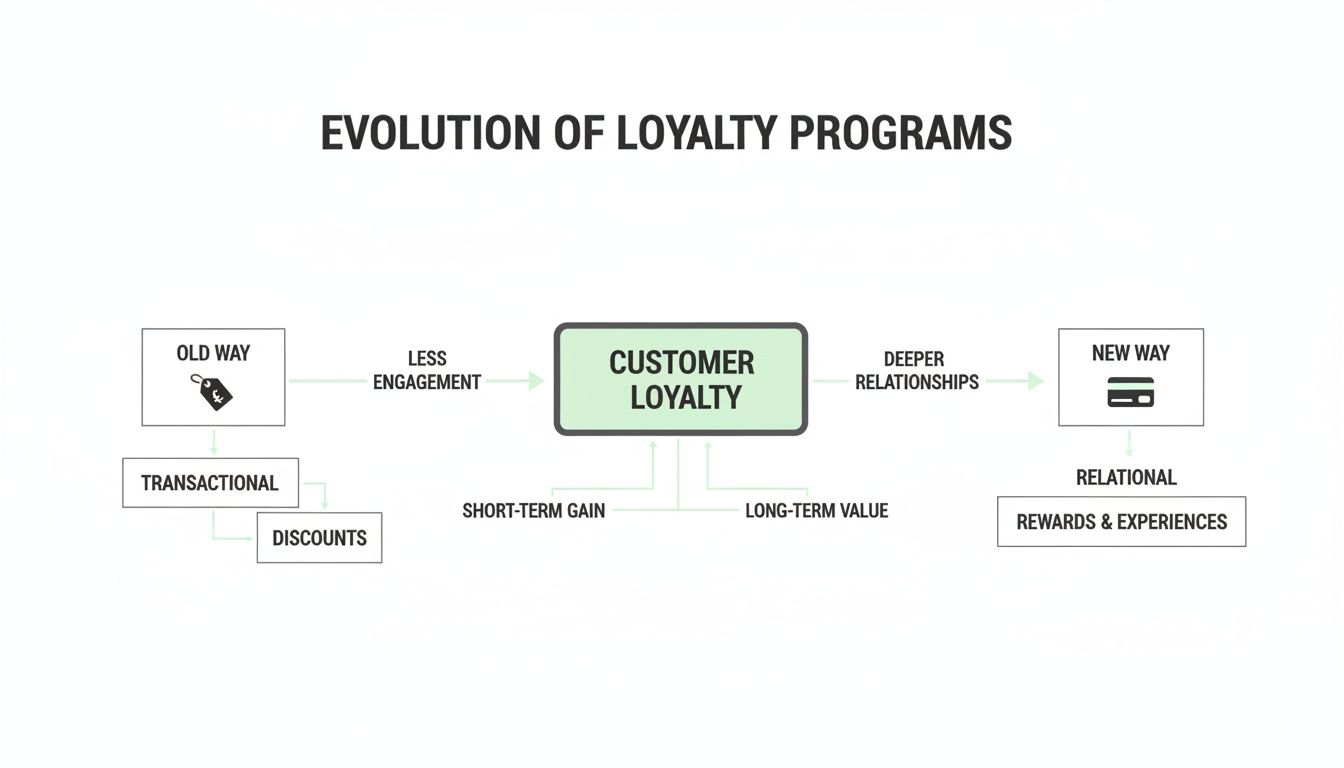
As you can see, the trend is clear: brands are shifting away from price-focused discounts and toward value-centric rewards like store credit, which forge stronger, more profitable connections with customers.
Reward Program Models At a Glance
To make this even clearer, here’s a quick side-by-side comparison of the most popular reward models. Think of this as your cheat sheet for understanding the real-world impact of each strategy on LTV and AOV.
Model Type | Impact on Margin | Customer Experience | Best For |
|---|---|---|---|
Discount Codes | High (Directly cuts into profit on every use) | Simple, but trains customers to devalue your product. | Short-term sales boosts or clearing old inventory. |
Points Systems | Moderate (Margin is impacted at redemption, not purchase) | Can be confusing and create friction ("What are my points worth?") | Brands with huge, highly engaged communities that enjoy gamification. |
Store Credit | Low (Encourages repeat purchases, keeping money in your ecosystem) | Clear, intuitive, and feels like real cash. High perceived value. | E-commerce brands focused on sustainable growth, LTV, and repeat business. |
The takeaway here is that while discounts offer a quick sugar rush, they often lead to a long-term crash. Store credit, on the other hand, provides the sustained energy needed for healthy, long-term growth by directly boosting lifetime value.
Discount Coupons: The Double-Edged Sword
Discount codes are often the first tool merchants reach for. They’re easy to implement and customers immediately get the appeal: enter a code, pay less. But that simplicity hides a pretty significant downside for AOV and LTV.
Relying too heavily on discounts conditions your customers to wait for a sale, attracting bargain hunters who have virtually no loyalty to your brand. They buy when the price is right and vanish when it’s not. This does absolutely nothing to build a long-term relationship or increase their lifetime value. While you might see a temporary spike in sales, you're consistently eroding your profit margins with every single coupon used.
Points Systems: An Unnecessary Complication
At first glance, points systems feel like a sophisticated step up from basic discounts. Customers earn points for various actions and can cash them in for rewards down the line. The problem? You’re essentially asking your customers to learn a new, branded currency.
How many points do I need for a free shipping coupon? What’s the dollar value of 500 points?
This mental gymnastics creates friction. A confused customer is one who disengages. And the data backs this up: while 73% of shoppers say they want to redeem rewards, overly complex points systems make it feel like a chore. This leads to frustratingly low redemption rates and a loyalty program that isn't actually fostering any loyalty or boosting lifetime value.
Shopify Store Credit: The Margin-Friendly Powerhouse
Now, imagine rewarding your customers with something that feels like cash in their pocket—something they instantly understand and value. That’s the magic of a native Shopify store credit program. It’s beautifully simple, direct, and incredibly effective at increasing both AOV and LTV.
When a customer earns store credit, they see a real balance they can apply to their next purchase, not a confusing pile of points. This creates a powerful psychological incentive to return, turning what could have been a one-time buyer into a loyal repeat customer.
Best of all, since that credit can only be spent at your store, it guarantees a future sale and keeps that revenue circulating within your business. Even better, you can set clear earning rules like, "Spend $100, get $10 in credit," which directly encourages shoppers to add more to their cart to hit that threshold. This gives you an immediate, measurable lift in AOV and is the only model that turns a reward into a direct reinvestment in your own brand.
Why Store Credit Is Your LTV & AOV Engine
Picture this: you give your best customers a dedicated digital wallet that only works at your store. That’s the simple but powerful idea behind a store credit rewards program. It completely changes the game, turning customer rewards from a line item expense into a self-funding engine for customer retention. You’re essentially shifting a customer's mindset from hunting for the next discount code to actively reinvesting in your brand.
It’s just a more direct, intuitive way to build loyalty. Instead of making customers do mental math to figure out what their points are worth, you’re giving them something that feels like cash. A $10 credit has a clear, tangible value that creates an immediate psychological pull, giving them a real reason to come back for their next purchase.
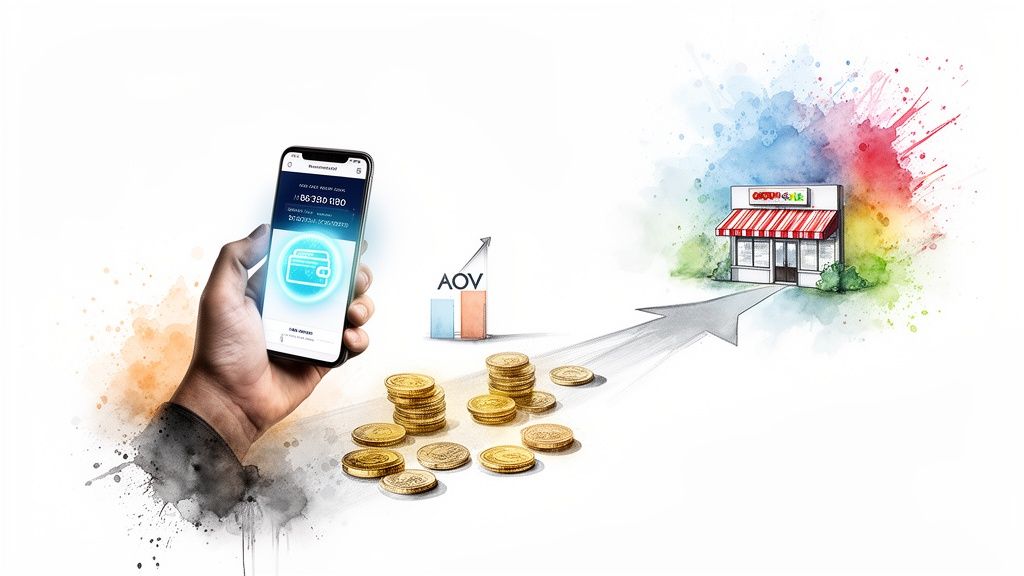
Protect Your Margins and Boost AOV
Discounts are a direct hit to your bottom line. The second you offer one, your profit margin on that sale shrinks. Store credit, on the other hand, operates on a much smarter, more sustainable model. It only becomes a "cost" when a customer actually comes back and redeems it on a future purchase. This subtle but crucial difference protects your margins on the initial sale.
This model is also a fantastic way to nudge your Average Order Value (AOV) higher. By setting clear earning thresholds, you can motivate shoppers to spend just a little bit more right now.
Example Threshold: "Spend $100, get $10 in store credit."
Customer Behavior: A shopper with $85 in their cart suddenly has a very compelling reason to find one more item to hit that $100 mark and unlock the reward.
This kind of "gamified" spending directly increases your AOV, but it feels like a win for the customer, not like an upsell. They get more value, and you get a bigger sale.
Store credit creates a "pre-paid" next purchase. It's not just a reward; it's a guaranteed future transaction that keeps revenue flowing back into your business.
And the data backs this up. A staggering 83.0% of loyalty program owners who track ROI are seeing positive returns, with their programs generating 5.2 times more revenue than they cost, according to the latest global customer loyalty report. This ROI is especially powerful for Shopify merchants who swap out margin-killing discounts for store credit models like Redeemly, where costs are only incurred on redemption. It's a win-win: you protect your profits while driving repeat business.
Drive Repeat Purchases and Increase LTV
At the end of the day, the goal of any loyalty strategy is to increase Customer Lifetime Value (LTV). This is where store credit truly shines. It creates a powerful retention loop that’s hard to break. Once a customer has a credit balance sitting in their account, they have a very real reason to choose your store over a competitor for their next purchase.
That simple incentive is often all it takes to turn a one-time buyer into a loyal, repeat customer.
The Store Credit Retention Loop:
A customer makes a purchase and earns credit.
They now have a balance just waiting to be spent—a built-in reason to return.
They come back to use their credit, and often end up adding more to their cart.
That second purchase earns them even more credit, and the cycle starts all over again.
For Shopify merchants, the benefits get even better. When you use a native, script-free integration, the entire experience is seamless. There are no clunky third-party widgets slowing down your site or getting in the way of the checkout flow. It’s an effortless and incredibly effective way to build a more predictable, more profitable business by maximizing customer lifetime value.
Tracking The Metrics That Actually Matter
Launching a rewards program without tracking the right data is like driving with your eyes closed. Sure, you're moving, but you have no clue if you're actually heading toward your destination. To know if your store credit strategy is really working, you have to ignore the vanity metrics and zoom in on the numbers that directly fatten your bottom line: LTV and AOV.
These are the metrics that tell the real story of customer behavior. They reveal whether your program is building genuine loyalty or just bleeding your profit margin. A well-designed store credit system should create a clear, positive shift in these four key areas.
Customer Lifetime Value (LTV)
Customer Lifetime Value (LTV) is the big one. It’s the total amount of money you can realistically expect a single customer to spend with you over their entire time as a customer. Think of it as the ultimate report card for loyalty, and boosting it should be the number one goal of any rewards program worth its salt.
Store credit is pure rocket fuel for LTV. It gives customers a concrete reason to make that second, third, and fourth purchase. That little balance sitting in their account is a powerful nudge, keeping them locked into your brand instead of wandering off to a competitor. When you see your LTV start to climb, you know your loyalty engine is firing on all cylinders.
Average Order Value (AOV)
Average Order Value (AOV) is all about how much a customer spends in a single checkout. While LTV plays the long game, AOV gives you instant feedback on how your rewards are shaping what people buy right now.
This is where strategic reward thresholds really shine. By offering something like, "Spend $100, get $10 in store credit," you’re actively nudging shoppers to toss one more item into their cart to hit that goal. If your AOV goes up after you launch your program, that's hard proof your incentives are working exactly as intended.
A rising AOV shows that your store credit program isn’t just a cost; it’s an investment that pays for itself with bigger, more profitable orders.
Repeat Purchase Rate
Your Repeat Purchase Rate simply measures the percentage of customers who come back to buy again after their first purchase. This metric is a dead-simple indicator of customer satisfaction and how "sticky" your brand really is.
A solid store credit program should have a huge impact here. The credit a customer earns basically acts as a pre-paid coupon for their next visit, making it a no-brainer to return. This metric is a direct driver of customer lifetime value. If you really want to get into the weeds on this, you can learn more about the crucial user retention metrics that define true customer loyalty.
Redemption Rate
Finally, there’s the Redemption Rate. This tracks how many customers are actually using the store credit they’ve earned. This is where the beautiful simplicity of store credit absolutely demolishes confusing point systems. A high redemption rate is a fantastic sign.
It means your rewards feel valuable, are easy to understand, and are even easier to use. Unlike points that often get forgotten and expire, store credit feels like real money just waiting to be spent. A low redemption rate tells you something is broken—maybe the reward is too small or the process is clunky. But a high one? That’s confirmation your program is actively driving the repeat business it was designed for.
How To Launch A Store Credit Program On Shopify
Alright, let's turn all this theory into action. The good news? Launching a native store credit program on Shopify is much easier than you’d think. With a native app like Redeemly, you can skip the complex coding and site-slowing scripts entirely and get a powerful, profit-friendly loyalty engine up and running in just a few minutes.
This approach neatly dodges the technical headaches that usually come with traditional reward programs. And frankly, it's where the industry is heading. Over 90% of companies now have loyalty programs, but the smart ones are obsessed with making them better. A recent study found that 32% are prioritizing user experience updates and 26% are focused on making redemptions easier. A native Shopify solution hits both of those targets, giving you a serious competitive edge without the technical baggage.
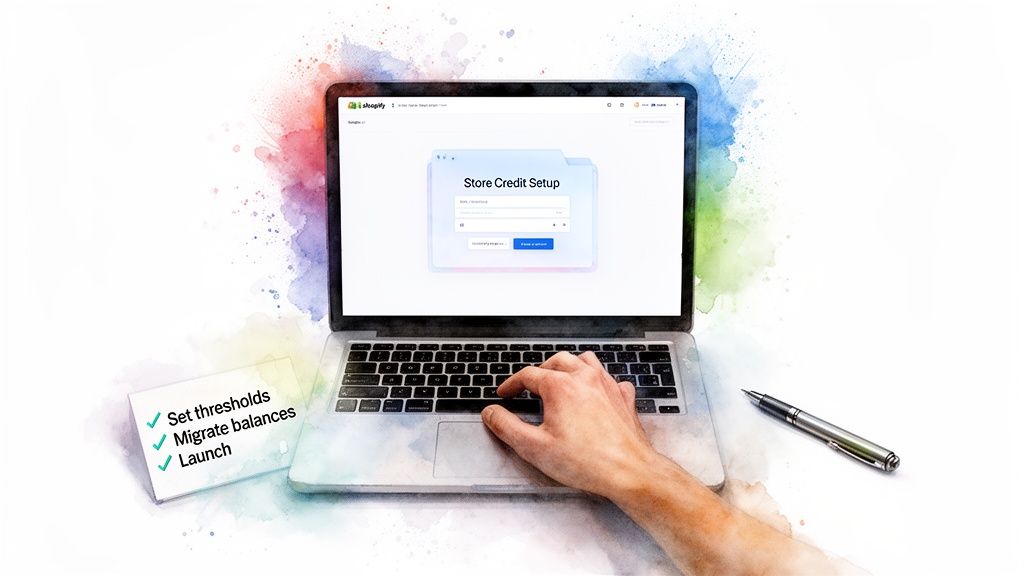
Setting Up Your Reward Structure
First things first: you need to set the rules of the game. Your goal here is to find that sweet spot—a reward threshold that nudges customers to spend more without you giving away the farm. It's all about boosting your Average Order Value (AOV) intelligently.
The "Spend X, Get Y" model is a classic for a reason. It just works.
Example: "Spend $100, get $10 in store credit."
This simple rule instantly gamifies shopping. A customer with $85 in their cart sees a clear path to getting a reward, making it a no-brainer to add that one last item. Boom. Your AOV just went up. The trick is to look at your current AOV and set a spend goal that feels like a slight—but totally doable—stretch for your typical shopper. For a deep dive into the nuts and bolts, check out our guide on how to issue store credit on Shopify.
Communicating Your New Program
A brilliant rewards program that no one knows about is, well, pretty useless. Getting the word out is absolutely critical to building excitement and getting customers on board. You'll want to hit them from all angles.
On-Site Widgets: Add a floating widget or build a dedicated loyalty page. Make it easy for shoppers to see their credit balance and understand how to earn more.
Email Campaigns: Blast an announcement to your entire list. Frame it as "cash back" on every purchase—a simple, valuable perk they won't want to miss.
Post-Purchase Flows: This is a golden opportunity. In your order confirmation emails, remind customers of the store credit they just earned. It's the perfect little nudge to get them thinking about their next visit.
Expert Tip: Frame this as an upgrade. You're not just launching another program. You’re giving your customers an exclusive perk with real, tangible value every single time they shop.
Migrating From Points Or Discounts
If you’re moving away from an old points or discount system, a smooth transition is everything. You need a solid plan that builds trust and makes customers feel like they're getting an even better deal.
Start by announcing the "upgrade" to your new, simpler Shopify store credit system. Be direct. Tell them you're ditching confusing points for straightforward cash-back rewards they can actually use.
For your existing members, you have to make the switch seamless. Calculate the dollar value of their current points and convert it into a generous store credit balance. Call it a "welcome gift" to the new program. This one move prevents any feeling of loss and creates instant buy-in, making sure your most loyal customers feel appreciated right from the start.
Real-World Examples of Profitable Loyalty Programs
Theory is one thing, but seeing a profit-friendly loyalty model in action is where the magic really happens. Let's look at a few direct-to-consumer brands that broke free from the endless cycle of margin-crushing discounts by making the switch to a simple Shopify store credit system.
These aren't just feel-good stories. They’re practical case studies showing how the right reward program can directly boost critical metrics like Average Order Value (AOV) and Customer Lifetime Value (LTV).
From Low Repeat Rate to High LTV
Imagine a growing skincare brand with a classic problem: lots of first-time buyers, but a repeat purchase rate that just wouldn't budge. Their customers loved the products, but they’d been conditioned to wait for the next 20% off sale—a habit that was killing their margins.
So, they made a change. By implementing a native store credit program right within their Shopify store, they flipped the script. Instead of constant discounts, they started offering $10 in store credit for every $100 spent. This simple shift gave customers a tangible reason to come back and spend the balance they'd earned.
The results were almost immediate and truly impressive:
Their repeat purchase rate shot up by 40% in the first quarter alone.
The average customer LTV saw a 30% jump in just six months.
This move transformed one-time deal-seekers into loyal fans who felt genuinely valued for their business, not just for snagging a temporary sale.
Boosting AOV Without Sacrificing Margins
Here's another great example from an apparel store that was struggling to get customers to buy more per order. Their AOV was flat, and every time they ran a sale, it just attracted bargain hunters who would grab a single, heavily discounted item.
They launched a native Shopify store credit system with a clear, engaging threshold. They framed the new perk as "cash back for your next purchase," which clicked with customers in a way that abstract points never could.
Ultimately, the most successful reward programs are those that master the art of improving customer lifetime value, and this brand's new system did exactly that. By encouraging shoppers to add just one more item to hit their reward goal, they saw a 25% increase in AOV without ever having to slash their prices.
Got Questions About Switching Your Rewards Program?
Moving away from the familiar world of points and discounts can feel like a big leap. It’s natural to have questions. Let's tackle some of the most common concerns we hear from Shopify merchants when they're thinking about switching to a store credit system.
Is Store Credit Really Better Than Points?
For most Shopify e-commerce brands, the answer is a resounding yes. Think of it this way: store credit feels like real money in your customer's wallet. It's simple, tangible, and a whole lot more exciting than a random pile of points.
What’s more motivating? Trying to figure out what 500 points is worth, or seeing a clear $10 credit ready to be spent? That clarity is what drives customers to actually use their rewards, come back to your store, and spend. Plus, it's a smarter move for your bottom line. You only incur the cost when a customer redeems their credit, which helps protect your profit margins and fuels sustainable growth.
How Do I Move My Customers From Discounts to Credit?
You don’t just switch it—you launch it like an upgrade. Frame the change as the launch of a new, exclusive Shopify loyalty program that gives customers "cash back" on every single purchase.
The key is to highlight how much better it is for them. Instead of having to wait around for a sale, they're now earning real value every time they shop. To get everyone on board and excited from day one, kick things off with a launch bonus. A great way to do this is by converting any existing points they have into an even more generous store credit balance.
Will Store Credit Actually Increase My AOV?
Absolutely. A well-built native store credit program is one of the best tools out there for bumping up your Average Order Value (AOV). You can create simple, compelling incentives that encourage customers to spend a little more.
For example, you could set up a rule like, "Spend $100, get $10 in credit." It turns shopping into a bit of a game.
Suddenly, customers are nudged to add that one extra item to their cart to hit the next reward level. It’s a powerful psychological trigger that increases how much they spend, but it feels like a win for them, not a sales tactic.
Ready to replace margin-crushing discounts with a loyalty program that actually drives profitable growth? With Redeemly, you can launch a native Shopify store credit program in minutes and start boosting your AOV and LTV today. Get started at https://redeemly.ai.


Join 7000+ brands using our apps