Boost Your Shopify Conversion Rate Optimisation with a Focus on LTV
Mar 3, 2026
|
Published
Shopify conversion rate optimisation isn't just about changing a button color and hoping for the best. It's a core strategy for building a truly profitable brand. We’re not just trying to turn more visitors into customers; the real goal is to increase the lifetime value of every single conversion.
Let's Rethink Your Shopify CRO Strategy
Too many Shopify brands I see are caught in the same trap: an endless cycle of margin-killing discount coupons. They chase quick conversion bumps with 20% off codes, only to watch their profits nose-dive and attract one-time bargain hunters. Worse, they're training their customers to just sit and wait for the next big sale.
This old way of thinking treats Shopify conversion rate optimisation like a short-term numbers game. It completely ignores the two metrics that actually matter for sustainable growth: customer lifetime value (LTV) and average order value (AOV).
A smarter approach frames CRO as a long-term growth engine. It's about building a system that profitably maximizes the value of every visitor you get. We're not just focused on getting that first sale; we're focused on building relationships that increase LTV and AOV. And this is where a strategic shift from discounts and confusing points systems to native Shopify store credit becomes a complete game-changer.
The Undeniable Power of Small Gains
Most Shopify stores float around an average conversion rate of 1.4%. But the top-tier brands? They’re hitting 3-5% or even higher. This proves that smart, strategic changes can easily double or triple your revenue without spending a penny more on traffic.
Think about it: if your brand is pulling in $50,000 a month from your ad spend and SEO efforts, just a one-percentage-point lift in your conversion rate adds an extra $35,714 to your bottom line. That's pure profit, all from working smarter with the traffic you already have.
This flowchart maps out the journey from the short-term fix of discounts to the long-term loyalty you get with a solid store credit program.
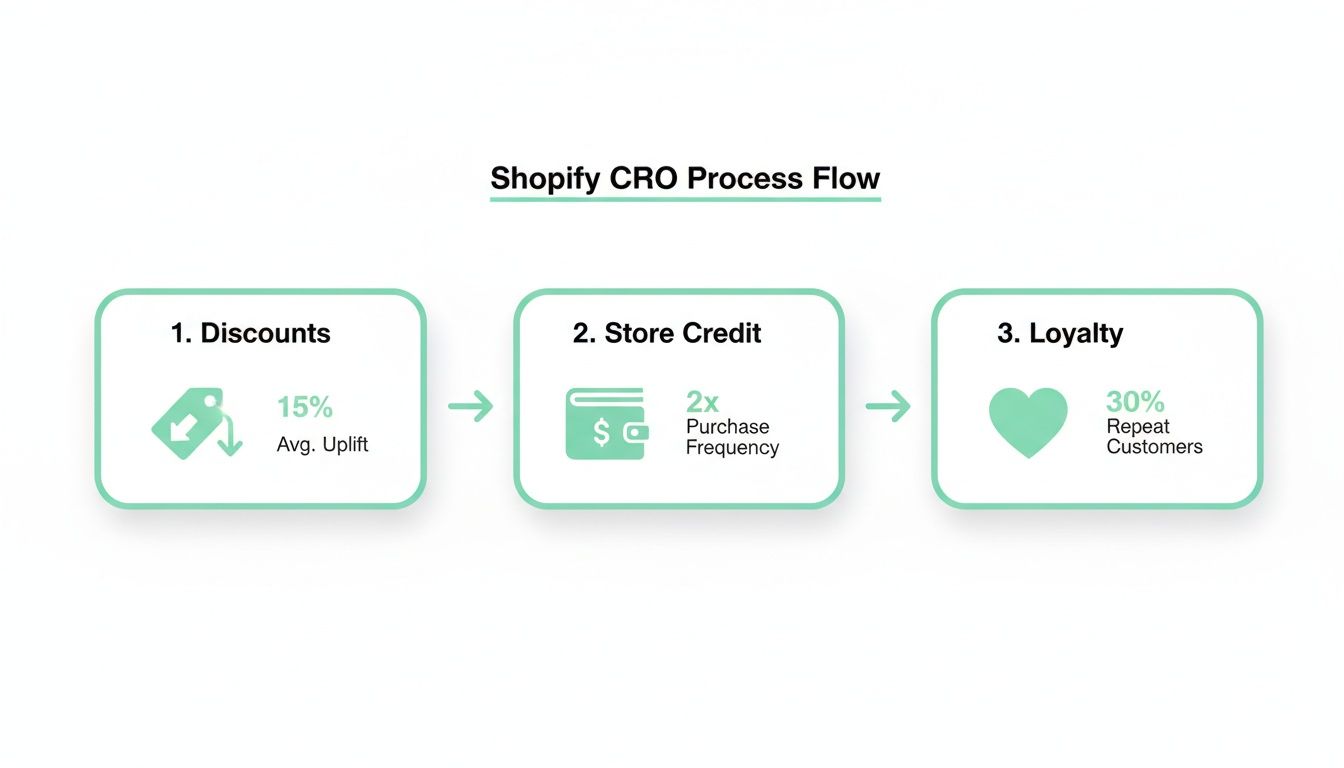
While discounts give you a quick hit, it's clear that store credit builds a reliable path to repeat purchases and a much healthier LTV.
From One-Off Discounts to Lasting Loyalty
The core of this modern CRO playbook is breaking free from the high of discount codes and overly complicated points systems. The real power lies in the simplicity and effectiveness of native store credit. This is how you build a powerful retention engine that fuels both LTV and AOV.
The goal is to create a system where customers are rewarded for their loyalty with something that feels like cash in their pocket, encouraging them to spend more to increase AOV and return sooner to boost LTV. This turns a one-time transaction into the beginning of a long-term, profitable relationship.
Instead of constantly eroding your margins with sales, you offer a margin-safe incentive that drives the right kind of customer behavior. Just look at the benefits:
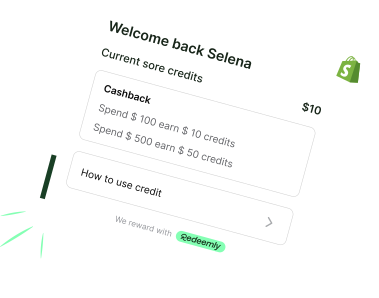
Boosted AOV: Customers naturally add more to their cart to hit a reward threshold, like "Spend $100, get $10 in store credit."
Increased LTV: Earned credit is a powerful magnet, pulling customers back for their second, third, and fourth purchases.
It's Simple: Native store credit is incredibly intuitive. $10 in credit is $10 to spend—there are no confusing points for your customers to calculate.
To see just how different these two approaches are for your bottom line, let's compare them side-by-side.
Discounts vs Store Credit: A Profitability Snapshot
Metric | Discount Coupons | Native Store Credit (e.g., Redeemly) |
|---|---|---|
Primary Goal | Drive immediate, one-time sales. | Encourage repeat purchases and increase LTV. |
Margin Impact | Direct and immediate reduction in profit margins. | Protected margins; incentive is "funded" by future sales. |
Customer Behavior | Trains customers to wait for sales, devaluing the product. | Encourages brand loyalty and higher spending per order. |
AOV Impact | Often lowers AOV as customers buy only discounted items. | Increases AOV as customers spend more to earn rewards. |
LTV Impact | Can negatively impact LTV; no built-in reason to return. | Significantly increases LTV by creating a compelling reason to shop again. |
Cash Flow | Discount is realized immediately, reducing cash from the sale. | Credit is "banked" for future use, improving cash flow on the initial order. |
The takeaway is clear: while discounts offer a temporary sales lift, a store credit strategy builds a more resilient, profitable, and loyal customer base over the long run, directly increasing both AOV and LTV.
To really dig in and start building a more profitable ecommerce business, it's essential to Boost Sales with Shopify Conversion Rate Optimization. And for a closer look at the data behind these numbers, check out our analysis of the average Shopify conversion rate.
Building Your High-Conversion Foundation
A killer CRO strategy isn't just about clever pop-ups or discount codes. It’s about building a rock-solid foundation first. Before you start tweaking incentives or split-testing headlines, you have to get the basics right. And the biggest, most overlooked conversion killer? Site speed.
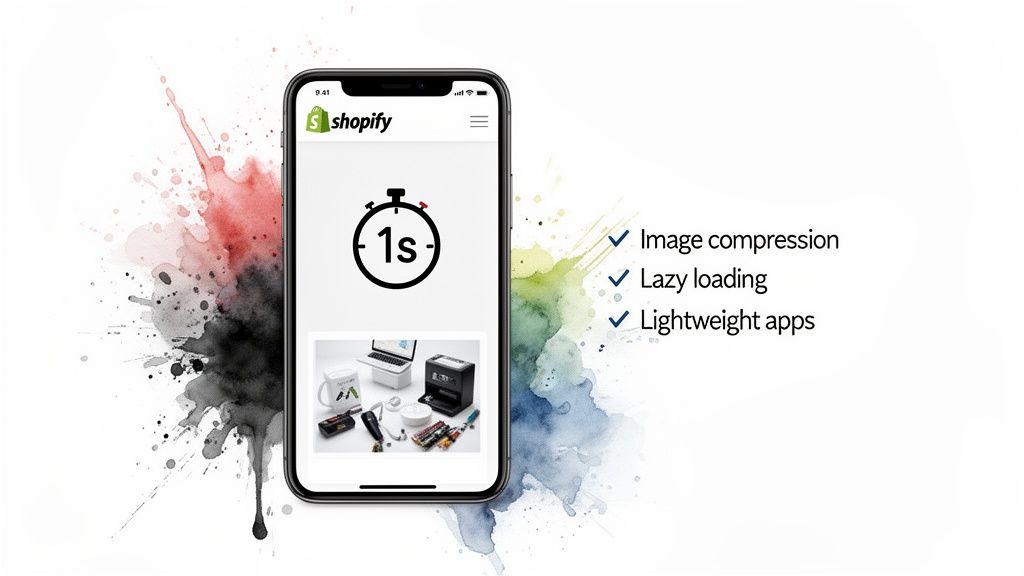
You’ve spent good money on ads to get shoppers to your store. Losing them because your page took too long to load is like setting that cash on fire. The data here is brutal but also incredibly clear.
Every extra second of load time slashes your conversion rates by 7-10%. On the flip side, stores that nail sub-2-second load times see a 0.4-0.7 percentage point lift. Just look at Sunday Citizen—a masterclass in speed optimization. By compressing images and refining their layout, they boosted Largest Contentful Paint by 25%, cut Cumulative Layout Shift by 61%, dropped their bounce rate by 4%, and lifted conversions by 6%. That's pure profit from their existing traffic. This Shopify conversion rate optimization guide has even more data on this if you want to dive deeper.
Achieve Sub-2-Second Load Times
Your target is simple: get your load time under two seconds. Anything slower is actively costing you sales. This isn't about magic; it's about being disciplined with your site's media and apps.
Here’s what you absolutely must do for a faster Shopify store:
Aggressive Image Compression: Those gorgeous, high-res product shots are non-negotiable for selling, but they're performance poison if they aren't optimized. Use tools to crush them down into modern formats like WebP without any visible quality loss. Shopify's CDN is great, but don't rely on it alone—upload already-optimized files.
Implement Lazy Loading: Why load every single image on a long collection page the second someone lands? Lazy loading tells the browser to only load images as the user actually scrolls to them. This dramatically improves that critical initial page load time.
Audit Your Apps: Let's be honest, not all Shopify apps are built well. Some are lean and mean, but others inject bloated scripts that bring your whole storefront to a crawl. Do a ruthless audit of your installed apps. If it’s not essential or is known to be slow, get rid of it.
Technical fixes are one thing, but this is also part of a bigger picture. The goal is always to improve ecommerce customer experience, and a fast, snappy website is the very first sign that you respect your customer's time.
Design for Mobile-First Shoppers
With over 60% of all ecommerce traffic now coming from smartphones, a mobile-first design isn’t just a good idea—it’s mandatory. If your store is a pain to use on a phone, you're alienating the majority of your customers.
And a true mobile-first experience is more than just a layout that shrinks to fit. It means designing every interaction for the thumb. Menus should be easy to tap, product galleries should be swipeable, and checkout forms need to be dead simple to fill out on a small screen.
Think about the user’s real-world context. A mobile shopper is often distracted, on the go, and has zero patience for a clumsy interface. Your design needs to be so intuitive it feels invisible, guiding them effortlessly toward the 'buy' button.
This is a fundamental shift in thinking. Don’t design for a big desktop screen and then try to cram it onto a phone. Start with the smallest screen and build the experience up from there. It forces you to be lean, fast, and focused on what truly matters for conversion.
Conduct a Mini-Audit to Find Friction
You don’t need a fancy agency to spot the glaring problems holding your store back. A quick, honest audit from the perspective of a new customer can reveal a ton of low-hanging fruit.
Pull out your phone right now and try to buy something from your own store. Be brutally honest.
Your Quick Audit Checklist:
Homepage Clarity: Do I instantly get what you sell within three seconds? Is your main value prop front and center?
Navigation Simplicity: Can I find a specific product category in two taps or less? Is the menu a confusing mess?
Product Page Essentials: Is the "Add to Cart" button visible above the fold (without scrolling)? Can I find the price, sizing, and shipping info immediately?
Cart & Checkout Process: How many clicks from cart to confirmation? Are there surprise shipping costs? Do you force account creation?
This simple exercise will shine a spotlight on the painful friction points you've probably gone blind to. Every confusing link, hidden fee, or awkward tap is a potential lost sale. Fixing these foundational problems is the first, and most powerful, step you can take.
Making Your Product Pages Actually Sell
Think of your product page as the final, most important conversation you have with a potential customer. It's the moment of truth. Is this just a page with a price and a button, or is it a compelling argument that convinces someone to buy? All too often, I see beautiful Shopify stores with product pages that are little more than digital brochures—pretty, but they don't close the deal.
A product page that truly converts is a different beast entirely. It’s been meticulously engineered to answer every question, dissolve every doubt, and create a powerful, undeniable urge to click "Add to Cart." This isn't just a small tweak; it’s a core part of any serious Shopify conversion rate optimisation plan focused on LTV.
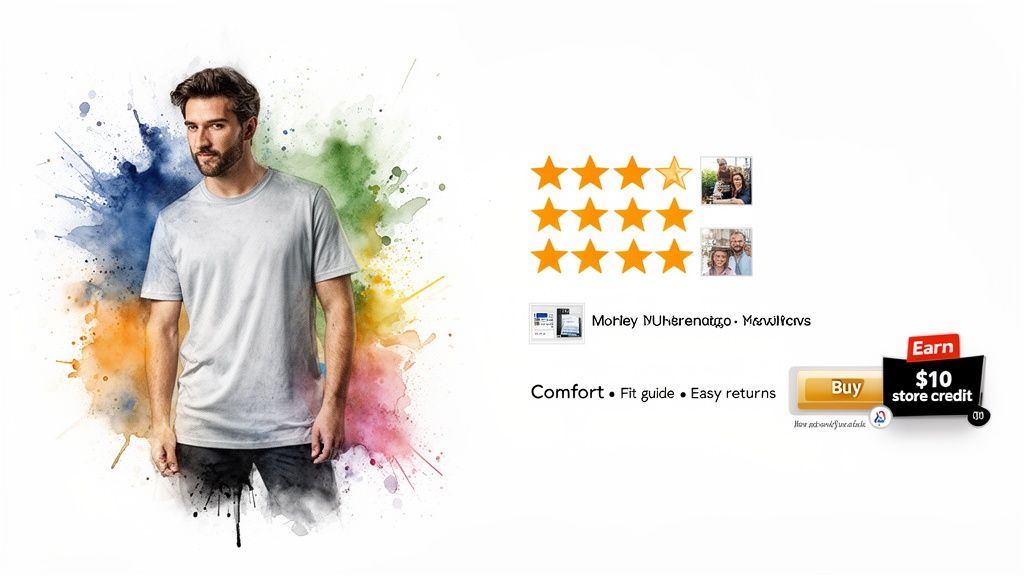
Let's break down how to build one.
Give Them a Reason to Trust You with Social Proof
When was the last time you bought something online without checking the reviews first? Exactly. Nothing builds confidence like seeing that other people have already taken the leap and are happy with their purchase. Social proof—reviews, ratings, and customer photos—is the fastest way to turn a skeptical visitor into a confident buyer.
These trust signals are proven conversion boosters. We've seen stores with over 50 product reviews achieve a 15% higher conversion rate. Some modern review apps even use AI to summarize feedback, showing shoppers an at-a-glance snapshot like "85% praise quality." For a deeper dive, especially for apparel brands, Shopify has some great insights on fashion conversion optimization.
The trick isn't just to collect reviews, but to weave them into the fabric of the page. Place a star rating right under the product title. Showcase a gallery of customer photos. Make the proof impossible to miss.
Remember, your professional photos show the product in a perfect light. User-generated content shows it in a real light—and for a new customer, "real" is almost always more persuasive.
Answer Every Question Before They Have to Ask
Every little bit of uncertainty is friction. And friction is what causes people to abandon their carts. Your job on the product page is to sand down every rough edge of doubt until the path to purchase is perfectly smooth.
This means going way beyond a basic description.
Talk about benefits, not just features. Instead of saying "100% Pima cotton," frame it as, "Feel the unmatched softness of our Pima cotton, which only gets better with every wash." You're selling an experience, not just fabric.
Create truly helpful fit guides. A generic S-M-L chart is lazy. Show the model's height and the size they're wearing. Give actual garment measurements. Add helpful notes like "designed for a relaxed fit" or "consider sizing down."
Be upfront about materials and care. "Machine wash cold, tumble dry low" isn't boring detail; it's a statement of confidence. It tells the customer you're not hiding any high-maintenance surprises and that the product is built to last.
When a shopper feels like you've anticipated their every question, they feel understood. That confidence is what gets them to click "buy."
Tie It All Together with a Smarter Incentive
Okay, so you've built trust and provided all the details. Now, how do you give them that final nudge without giving away your profits? For years, the default answer was a pop-up with a 15% discount code. That’s a terrible habit that kills your margins and LTV.
There’s a much smarter, more profitable way to seal the deal: native store credit.
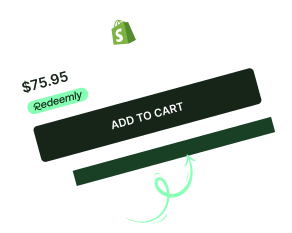
Think about a shopper who's on the fence. They like the product, they trust your brand, but they’re hesitating. Then, right below the "Add to Cart" button, they see a simple, powerful message:
"Earn $10 in store credit with this purchase."
This one line completely changes the psychology of the purchase. Suddenly, they aren't just spending money; they're earning a reward for their next visit. It’s a brilliant tactic that accomplishes three things at once:
It provides an immediate incentive to convert without discounting the product.
It protects your profit margins, as the cost is only realized on a future purchase.
It instantly starts building customer lifetime value (LTV) by encouraging a second order.
This is how you turn a one-time transaction into a long-term relationship. You're not just making a sale; you're creating a loyal customer who feels valued from their very first purchase, directly boosting your AOV and LTV.
Driving AOV and LTV with Margin-Safe Store Credit
For too long, the ecommerce playbook has been stuck on a broken record: discounts. Got slow-moving inventory? Run a sale. Want to hit a monthly target? Blast a 20% off code. This relentless cycle is one of the biggest threats to your profitability, training customers to devalue your brand and simply wait for the next price drop. It's a short-term high with a long-term hangover of eroded margins and low LTV.
True Shopify conversion rate optimisation isn’t about chasing one-off sales. It's about building a profitable, sustainable business. This means shifting your focus from the transactional nature of discount codes and confusing points systems to a relational model built on real loyalty and higher LTV.
The most powerful tool for this shift? Native Shopify store credit. It’s far simpler than confusing points systems and infinitely safer for your margins than constant sales.
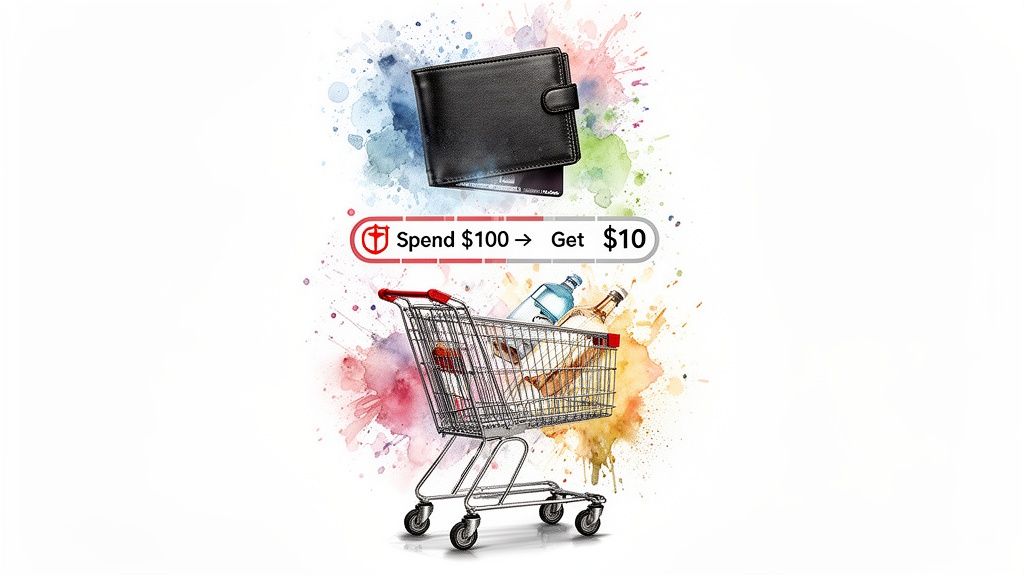
This strategy fundamentally changes the customer conversation from "what can I get?" to "what can I earn?", directly fueling higher AOV and LTV.
The Flawed Logic of Discounts and Points
Let's be blunt: discount codes are a direct hit to your bottom line. A 15% off coupon means you instantly kiss 15% of your profit goodbye on that order. It also encourages cherry-picking, where shoppers buy only the discounted item and then disappear, contributing nothing to your customer lifetime value (LTV).
Confusing points programs aren't much better. They introduce cognitive friction, forcing customers to do math. "Wait, how many points do I have? What's 1,000 points worth? $5? $10?" This abstract system lacks the immediate, tangible appeal needed to motivate a purchase right now.
Store credit, on the other hand, is beautifully simple. It functions like cash. $10 in credit is $10 to spend. This clarity makes it an incredibly effective psychological trigger for both spending more now (AOV) and coming back later (LTV).
Instead of giving away margin upfront, you’re investing in a future purchase. You're directly fueling your retention engine and building a more profitable customer base.
Boosting Average Order Value with Spend-Based Rewards
One of the most immediate benefits of a store credit system is its impact on Average Order Value (AOV). The strategy is refreshingly straightforward: implement a spend-based reward threshold.
A model I’ve seen work wonders is: "Spend $100, Get $10 in store credit."
Picture a customer with $85 worth of products in their cart. They see a clear, visible message that they are just $15 away from earning $10 in "cash" for their next purchase. Suddenly, the decision to find one more small item becomes a no-brainer. They start looking for a pair of socks, a lip balm, a cleaning cloth—anything to get them over that threshold.
This small nudge accomplishes several key goals at once:
You've just increased that order's value by nearly 18%, boosting your AOV.
You did it without discounting a single product in their cart.
You've essentially "funded" their next visit, making a second purchase highly likely and increasing LTV.
This isn't just a theory; it's predictable human behavior. By making the reward threshold visible on product pages and in the cart, you gamify the shopping experience in a way that directly benefits your AOV and bottom line. You can explore a deeper analysis of this tactic in our guide to using Shopify store credit to grow your brand.
The Retention Magnet Driving Lifetime Value
Earning the credit is only half the story. The real magic for LTV happens when that credit pulls the customer back to your store. A customer with a $10 credit balance sitting in their account is a customer with a powerful, tangible reason to return.
This is where you move from a single transaction to building real customer lifetime value. An effective store credit program uses automated reminders and on-site visibility to keep that "free money" top of mind.
Your Store Credit Retention Playbook
Constant On-Site Visibility: Use a floating "wallet" widget that is always visible on your store, showing logged-in customers their available credit balance. Seeing "$10 available" is a constant, gentle reminder to shop.
Smart Post-Purchase Emails: Your order confirmation email shouldn't just be a receipt. Celebrate the credit they just earned! "Congratulations! You've just earned $10 toward your next order." This builds excitement and anticipation for their next visit.
Automated Reminder Campaigns: If a customer hasn't used their credit after 30 or 60 days, send a friendly, automated email. "Hey, just a reminder you have $10 in store credit waiting for you! It's the perfect time to treat yourself."
This systematic approach turns earned credit from a passive balance into an active marketing channel. It shortens the time between purchases and can dramatically increase your repeat purchase rate. A customer who buys twice is exponentially more valuable than two customers who each buy once—and store credit is the most margin-safe way to make that second purchase a reality, supercharging your LTV.
Crafting a Seamless Checkout and Post-Purchase Flow
All the effort you pour into your site—the beautiful product photos, the compelling copy, the lightning-fast page speed—it all leads right here. The checkout. This is the moment of truth, and for most stores, it’s a leaky bucket.
Think about it: the Baymard Institute has found the average cart abandonment rate hovers around a staggering 70%. That’s not just a number. It’s a sign that something in the final stretch is causing massive friction, and it’s costing you a fortune in lost sales.
The goal isn't just to make small tweaks. It's about surgically removing every single obstacle between your customer and that "complete purchase" button. This is exactly where a smart, native Shopify store credit strategy can transform your shopify conversion rate optimisation, turning a clunky, frustrating process into a smooth-as-silk experience that actually builds loyalty and LTV.
Make Paying with Credit Effortless
Here’s where so many loyalty programs completely fall apart. They rely on clunky points systems or discount codes that force customers to do all the work. The shopper has to leave the checkout, find a separate loyalty portal, figure out how to convert points into a coupon, then copy and paste a random string of characters into the right box. It’s a mess.
Every single one of those steps is a potential exit point.
Native Shopify store credit flips this entire process on its head. Instead of being an afterthought, it should show up as a clear, simple payment method—just like a credit card or Shop Pay.
When a customer has a $15 credit balance, they shouldn't need a manual or a search party to use it. It should be a simple button or checkbox. When it feels like a built-in digital wallet, it becomes a trusted part of the buying process, not a frustrating hurdle.
This kind of seamless integration is what truly separates an elite checkout experience from an average one. You’re respecting the customer's momentum and getting out of their way.
Accelerate Conversions with One-Click Checkout
On mobile, speed isn’t just a feature; it's everything. Accelerated checkouts like Shop Pay are no longer optional. They’re table stakes. Data shows that Shop Pay can boost your checkout-to-order rate by as much as 50% over a standard guest checkout. Even better, it makes the entire process up to 4x faster.
Now, combine that speed with native store credit. This is where the magic happens. A returning customer can log in via Shop Pay, see their store credit balance automatically, and apply it with a single tap. It's the absolute gold standard for a frictionless checkout that drives repeat purchases and LTV.
And speaking of friction, always, always offer a guest checkout option. Forcing shoppers to create an account is one of the most notorious conversion killers in the book. You can encourage them to create an account after the sale, but don't block the purchase by demanding it upfront.
Extend the Experience Beyond the Purchase
The moment a customer clicks "buy" isn't the end. It’s your first opportunity to get them excited about the next purchase and increase their LTV. Your order confirmation page and follow-up emails are some of the most valuable real estate you own.
Don't just flash a generic "Thanks for your order!" message. Use that moment to reinforce the smart decision they just made.
Post-Purchase Reinforcement Tactics:
Celebrate Their Reward: Hit them with an immediate dose of positive reinforcement. A prominent message like, "Congratulations! You just earned $12 in store credit" feels like an instant win.
Show Their New Balance: Make it tangible. Display their updated balance right then and there: "Your new wallet balance: $27." This turns a simple purchase into a visible investment for their next visit.
Build Anticipation: Your order confirmation email is no longer just a receipt. It’s a retention tool. Remind them of the credit they have waiting for them, planting the seed for their return.
By mastering the checkout and post-purchase flow, you’re not just making a single sale. You're laying the groundwork for a profitable, long-term relationship. If you want to dive into the technical setup, our guide on how to issue store credit on Shopify breaks down the entire process.
Your Questions on Store Credit Answered
I get it. Moving away from the discount code security blanket to a system focused on LTV and AOV feels risky. It’s a totally different way of thinking—shifting from chasing one-off sales to actually building a base of loyal, high-value customers.
Let's walk through the big questions that always come up when merchants are thinking about making this switch.
How Is Native Store Credit Different from a Points Program?
Think of Shopify’s native store credit like a digital gift card that lives in your customer’s account. It's just like cash. There’s no confusion, no hoops to jump through.
The value is crystal clear: $10 in credit is $10 to spend.
Confusing points programs, on the other hand, force customers to do mental math. They have to figure out abstract rules like "100 points = $1." This little bit of friction is often enough to kill the motivation to spend more or return. Store credit is immediate and intuitive, which makes it a much stronger incentive for customers to come back and spend more, directly boosting LTV.
Will Replacing Discounts with Store Credit Hurt My Conversions?
This is the number one concern, and it’s a fair one. You’ll probably see some bargain hunters drop off—the ones who only buy with a 15% off code. But that's okay. Those customers have a very low LTV.
Your focus is shifting to a much more valuable type of customer. Instead of a one-time discount, you're offering a reason to come back, like "Earn $15 credit on this order." This is a powerful lever for increasing Average Order Value.
You might filter out a few one-time deal seekers, but you'll dramatically increase the lifetime value (LTV) of the customers who stick around. The goal is no longer just a single conversion; it's building a profitable, long-term relationship. When you show earnable credit right on the product page, you create a new kind of urgency that pushes customers to add more to their cart, which often more than makes up for any dip in conversions from discount-only shoppers.
You're making a strategic choice to invest in customers who see value in your brand beyond the price tag. It's a trade: you're swapping a low-margin, one-time transaction for a high-LTV relationship built on earned loyalty.
This is what smart Shopify conversion optimization looks like today. It's about profitability per customer, not just the raw number of sales.
How Do I Measure the Success of a Store Credit Program?
Success here isn't just about your top-line conversion rate. You need to look deeper at the metrics that truly reflect the health of your business: LTV and AOV. Your dashboard should tell a story about customer loyalty and profitability.
Here’s what you absolutely need to track:
Customer Lifetime Value (LTV): This is your north star. Are customers spending more with you over their entire relationship with your brand? If this number is going up, your program is working.
Average Order Value (AOV): Keep an eye on AOV across all orders, but pay special attention when customers are close to an earning threshold. Are they adding that one extra item to their cart just to earn the credit? This is a direct measure of your program's effectiveness.
Repeat Purchase Rate: Is store credit actually bringing people back for a second, third, or fourth purchase? This shows the direct impact of your retention efforts on LTV.
Time Between Purchases: Is store credit shortening the buying cycle? A customer who comes back in 60 days instead of 90 is a massive win for your cash flow and LTV.
Modern apps give you dedicated dashboards to watch these metrics, so you can see the real ROI your loyalty program is delivering. The data will prove you’re not just converting visitors—you’re building a more resilient and profitable business centered on high LTV and AOV.
Ready to replace margin-killing discounts with a loyalty program that actually grows your LTV? Redeemly helps you launch a native Shopify store credit system that customers love and your bottom line will thank you for.


Join 7000+ brands using our apps