Shopify Conversion Rate Optimization: A Guide to Boosting LTV and AOV
Mar 2, 2026
|
Published
Let's be honest. For too long, "conversion rate optimization" has been code for "how many discount coupons can we throw at people until they buy something?" This is a race to the bottom, and it's a terrible way to build a sustainable Shopify brand.
True Shopify conversion rate optimization isn't about chasing a vanity metric. It's about building a profitable business with customers who come back again and again. It means shifting your entire mindset away from bleeding margins with constant sales and confusing points systems. Instead, you should focus on increasing Customer Lifetime Value (LTV) and Average Order Value (AOV) with a smarter incentive: native Shopify store credit.
Rethinking Shopify Conversion Rate Optimization
Most brands get stuck in a rut. They see a dip in sales, panic, and immediately blast out a 15% off coupon code. Sure, you might see a temporary spike in transactions. But what you're really doing is training your customers to never pay full price. You're eroding your brand's perceived value and killing your margins in the process.
The real goal isn't just more sales. It's more profitable sales that increase customer LTV. It's about turning a first-time buyer into a loyal fan who shops with you for years. This is where a simple, powerful tool comes into play: native Shopify store credit.
The Smart Shift from Discounts to Store Credit
Think about this for a second. Instead of giving away 15% of your revenue on the spot with a coupon, what if you rewarded a customer with store credit after their purchase? This one small change completely flips the script and has a massive impact on LTV and AOV.
Here’s why store credit crushes traditional discounts and points:
It Protects Your Margins: A discount is an immediate, guaranteed loss. Store credit only becomes a "cost" when the customer returns to spend it on a future purchase. You’re essentially funding customer retention with your own product margin—genius.
It Naturally Increases AOV: You can easily set up tiered rewards. "Spend $100, get $10 in store credit" is a powerful motivator that encourages shoppers to add just one more item to their cart to hit that next level.
It’s a Magnet for Repeat Purchases (Higher LTV): Earned credit feels like free money burning a hole in a customer's pocket. It gives them a real, tangible reason to come back to your store instead of a competitor's, directly boosting LTV.
It's Simpler Than Points: Customers intuitively understand "$10 store credit." Complicated systems like "earn 10 points for every dollar spent" create mental friction and devalue the reward. Store credit is cash-like and instantly understandable.
The core idea is simple but powerful: You're not just selling a product; you're creating a built-in financial incentive for your customer to come back. This transforms a one-time buyer into a loyal, high-LTV customer.
Why This LTV-First Approach Matters
We see it all the time. The average Shopify store's conversion rate hovers somewhere between a respectable 1.4% and 3.2%. But the top-tier brands? They're playing a different game entirely. They achieve much higher numbers because they obsess over the entire customer journey and long-term value, not just the first sale.
This is the strategic difference between a traditional, discount-heavy CRO approach and a modern, LTV-focused one using store credit.
Traditional CRO vs LTV-Driven CRO
This table breaks down the fundamental shift in thinking:
Metric | Traditional CRO (Discount/Points-Heavy) | LTV-Driven CRO (Store Credit Model) |
|---|---|---|
Primary Goal | Increase short-term transaction volume. | Increase long-term customer lifetime value (LTV). |
Main Incentive | Percentage-off discounts or complex points. | Simple, cash-like store credit earned on purchases. |
Impact on Margin | Immediate margin erosion on every sale. | Margins are protected on the initial sale. |
Customer Behavior | Trains customers to wait for sales or ignore points. | Encourages repeat purchases and builds loyalty for higher LTV. |
Effect on AOV | Often lowers AOV (customers buy only the discounted item). | Increases AOV through tiered credit reward thresholds. |
Brand Perception | Can devalue the brand, making it feel "cheap." | Reinforces value and rewards loyalty. |
The takeaway is clear: one path leads to a constant struggle for profitability, while the other builds a resilient, high-LTV business.
Smart optimization is about more than just ads. It's about finding and fixing the leaks in your funnel to turn more browsers into buyers—without giving away the farm. For a wider perspective, you can dig into other proven ways to improve ecommerce conversion rates across your entire strategy.
This guide will walk you through exactly how to implement this profit-first framework on your own store, step by step. Let's get started.
Find and Fix Your Hidden Conversion Killers
Before you can even think about boosting conversions, you have to play detective. I guarantee that no matter how slick your Shopify store looks, it’s leaking money somewhere. The secret to effective Shopify conversion rate optimization isn't about endlessly testing button colors; it's about finding the exact moments a potential customer gets frustrated and bounces.
The good news? You don't need a bunch of expensive tools to get started. Your most powerful diagnostic kit is already sitting right there in Shopify Analytics and Google Analytics 4 (GA4). These are all you need to trace the customer's path from their first click to the final "thank you" page and pinpoint your biggest drop-off points.
I like to think of this process as an evolution—moving away from old-school, discount-heavy tactics toward a smarter, LTV-focused strategy.
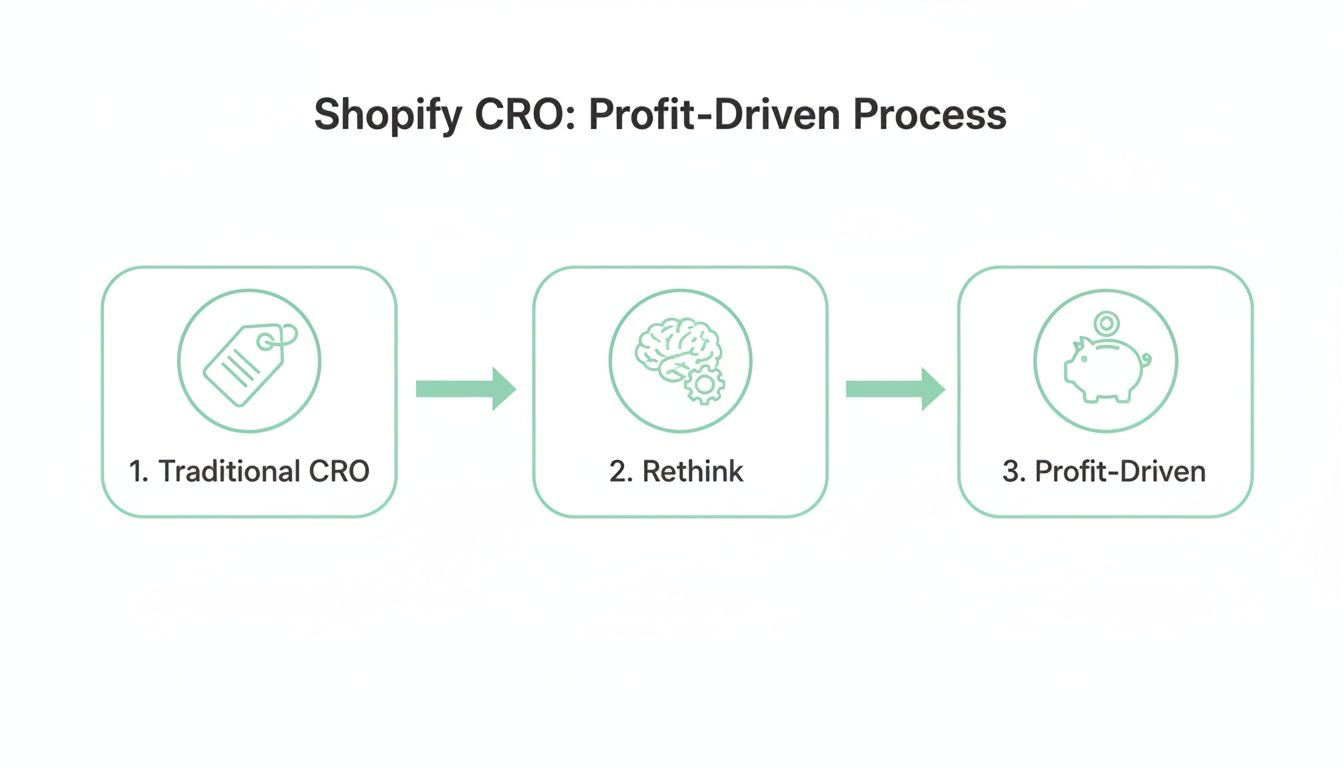
This shift is crucial. It’s about building a healthier, more sustainable business with higher LTV, not just chasing vanity conversion numbers.
Tracing the Customer Journey Funnel
Your first mission is to map out your store's conversion funnel. Jump into Shopify Analytics and head straight for the Online store conversion report. This report is your command center, breaking down user sessions into clear stages:
Sessions: The total number of visits to your store.
Added to Cart: The percentage of sessions where someone added at least one item to their cart.
Reached Checkout: Of those who added to cart, the percentage that actually started the checkout process.
Sessions Converted: The grand finale—the percentage of sessions that ended in a completed purchase.
This data is your treasure map. If you see a massive plunge between "Added to Cart" and "Reached Checkout," your cart page is likely the problem. If the drop-off is between "Reached Checkout" and "Sessions Converted," the checkout itself is tripping people up.
A huge gap between these stages is a screaming red flag. For instance, if 40% of your shoppers add items to their cart but only 10% make it to checkout, you're losing three-quarters of your highest-intent customers right before the finish line.
Identifying Common Conversion Bottlenecks
Once you know where you’re losing people, the next step is to figure out why. After auditing hundreds of stores, I've seen the same conversion killers pop up again and again.
Product Page Friction Your product pages have one job: build enough confidence for the click. Any hint of confusion or doubt will cause hesitation. I always look for these culprits first:
Weak Value Propositions: Is it crystal clear why your product is the one they should buy? If it takes more than three seconds to understand, it’s not working.
Poor Product Photography: Are the images high-quality? Do they show the product from all angles, in use, and up close? Pixelated or generic photos scream untrustworthy.
Missing Information: Shoppers are looking for specifics. Sizing charts, material details, care instructions—this information needs to be impossible to miss.
Here’s a real-world example: A fashion brand I worked with saw a shocking 60% drop-off on their best-selling dress page. After a quick audit, we found the size guide link was practically hidden in the footer. We moved it to a prominent button right next to "Add to Cart," and they cut that drop-off rate in half almost overnight.
Cart and Checkout Complexities The final steps of a purchase need to be dead simple. Any surprise or extra field is an excuse for the customer to bail. Be on high alert for:
Surprise Shipping Costs: This is the undisputed #1 reason for cart abandonment. Be upfront about costs long before the final payment screen.
Forced Account Creation: Don't put a wall between your customer and the purchase. Always offer a guest checkout option.
Complex Forms: On mobile especially, long and confusing forms are a conversion death sentence. Keep it simple.
Technical Glitches: These are the silent killers. A broken button or a script error can sabotage your conversions without you even knowing. Understanding how to go about handling JavaScript errors is a non-negotiable skill for maintaining a smooth user experience.
By pinpointing these issues, you move from guessing to executing a targeted action plan. It’s about using your own data to make smart decisions that directly grow your revenue. And honestly, plugging these leaks is almost always more profitable than just dumping more money into ads. As you'll see, these fixes are foundational to a healthier bottom line, which we explore further in our guide on how to improve profit margins.
Swap Your Discount Strategy for Margin-Safe Store Credit to Boost AOV and LTV
Let’s be honest. The constant cycle of discount codes is one of the biggest threats to building a truly profitable Shopify brand. It’s a race to the bottom that trains customers to wait for a sale, devaluing your products and chipping away at your margins with every single order.
Real Shopify conversion rate optimization isn’t about just giving away revenue to close a sale. It’s about investing in smart incentives that actually grow your business for the long haul. This is where a native Shopify store credit system completely changes the game.
Forget about those convoluted points systems that feel like you need a math degree to figure them out. Store credit is dead simple, powerful, and it just works. When a customer has $10 in store credit, they don't see some abstract reward—they see $10 of real money sitting in their account, waiting to be spent. It feels completely different from a fleeting 15% OFF coupon.
This psychological shift is the secret to unlocking both a higher Average Order Value (AOV) and a much healthier Customer Lifetime Value (LTV), all without bleeding profit.
The "Spend More, Get More" Playbook for AOV
One of the absolute best ways to put store credit to work is through a tiered rewards program. The logic is beautifully simple: the more a customer spends now, the more credit they earn for their next purchase. It’s a powerful nudge that can easily turn a casual browser into a bigger spender.
Picture this scenario for a skincare brand:
A customer is sitting with a $68 cart, just a little shy of your free shipping threshold.
A dynamic banner pops up on the cart page: "Spend $75 and get $10 in store credit!"
Seeing a clear path to a tangible reward, the customer happily adds a $12 face mask to their order.
In that one moment, a few fantastic things just happened. The customer feels like they just made a smart move, you’ve boosted your AOV by over 17%, and you’ve protected your margin. Unlike a discount, that $10 credit only becomes a cost when they return to spend it—essentially funding their own retention and increasing LTV.
By framing the incentive as a future benefit, you avoid the "race to the bottom" mentality of discounts. You're not cheapening your product; you're rewarding loyalty and encouraging customers to spend more to increase AOV.
This is exactly how many top-tier Shopify stores consistently blow past the typical 2-3% conversion rate. Getting into that elite 3-5% range means focusing on high-impact strategies that boost LTV, and store credit is one of the most powerful tools in the shed.
Turn That Earned Credit into an LTV Engine
The real magic of store credit kicks in after that first purchase. The credit they earned acts like a powerful magnet, pulling that customer right back to your store. A shopper with a $10 balance is far more likely to return than one with zero. They have a personal, built-in reason to make a second purchase, which is the core of increasing LTV.
This creates a self-sustaining LTV growth loop:
First Purchase: The customer spends more to earn a credit reward, which immediately boosts your AOV.
The Return: That earned credit gives them a strong financial reason to come back, shrinking the time between purchases and increasing repeat purchase rate.
Second Purchase: They redeem their credit but often spend more than the credit amount, solidifying their connection to your brand and driving up your LTV.
This cycle is the bedrock of a high-LTV business. You’re not just chasing one-time, discount-hungry buyers; you’re actively building a habit of repeat purchasing. With every completed loop, customer loyalty gets stronger and your revenue becomes more predictable.
Why Native Shopify Store Credit Is the Clear Winner
The key to making this strategy feel effortless for everyone is using a native Shopify store credit system. A native solution, like our app Redeemly, is built directly into the Shopify ecosystem, which is far superior to clunky points apps.
It's Fast and Lightweight: No heavy third-party scripts to slow your site down. Site speed is non-negotiable for conversions, and native apps ensure you don’t trade performance for features.
It’s Seamless for Customers: The credit looks and feels just like a native Shopify gift card. Customers can see their balance and apply it at checkout with a single click. No confusing portals, abstract points, or manual codes required.
It Protects Your Margins & Funds LTV: This is the most important part. You aren't giving away profit upfront. The "cost" of the credit is only realized when a customer comes back to make another purchase, effectively using your own product margin to fund LTV growth.
By shifting from a discount-first mindset to a store credit loyalty program, you're not just optimizing for conversions—you're optimizing for profitability and long-term brand health. You can see the nuts and bolts of this strategy by reading our in-depth guide on implementing Shopify store credit. It’s an approach that transforms your marketing spend from a cost center into a direct investment in your most valuable asset: your high-LTV customers.
Design a Mobile Experience That Converts
Let's be blunt: most of your traffic is on a phone. If your mobile site is slow, clunky, or just a pain to use, you're not just annoying people—you're actively throwing sales away. Generic advice like "make it mobile-friendly" is ancient history. To win in today's market, you need a mobile-first playbook designed to maximize AOV and LTV from every visitor.
This isn't just about making things look pretty. Every single tweak we make has to tie back to our main goal: making more money. We're engineering a mobile experience that directly pumps up your Average Order Value (AOV) and Customer Lifetime Value (LTV).
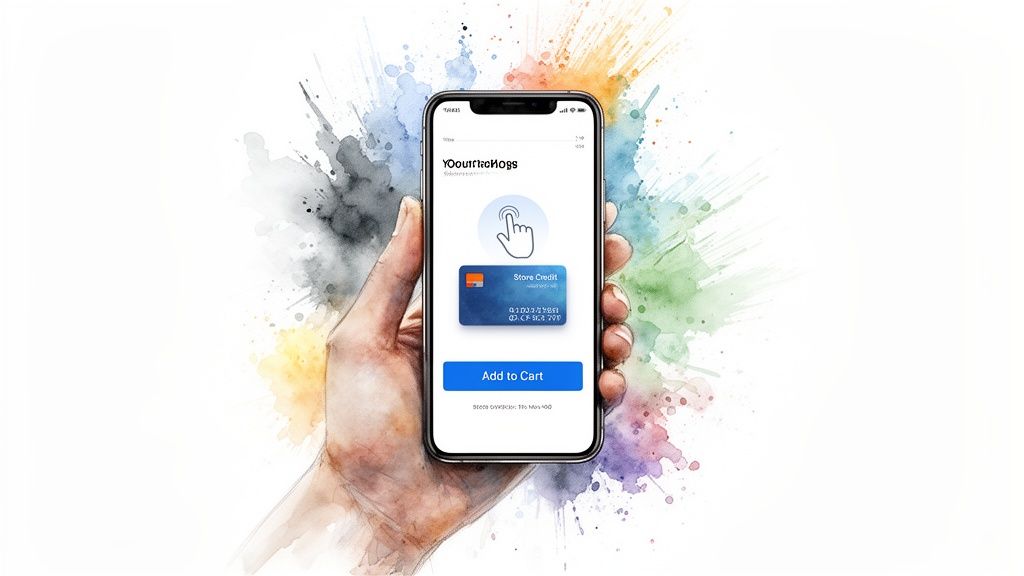
Engineer Your Site for One-Thumb Navigation
Picture how someone actually uses their phone. They’re scrolling with one thumb, probably while juggling a coffee or watching TV. Your mobile site has to be built for that reality. Every tap, every scroll should feel totally natural.
A perfect place to start is with a sticky 'Add to Cart' button. I’ve seen it a hundred times: a customer is ready to buy but has to scroll all the way back up a long product page to find the button. Many just give up. A sticky button keeps that crucial next step right under their thumb, no matter where they are on the page. It’s a simple change that dramatically cuts down on frustration.
Along the same lines, put your navigation, search bar, and other key links at the bottom of the screen. This is a game-changer for ergonomics. It caters directly to how people hold and use their phones, making everything feel effortless. For some great real-world examples of this in action, check out these top Shopify website examples.
Prioritize Speed and Simplicity
On mobile, speed isn’t a nice-to-have; it's the price of admission. Your product photos have to be stunning, but they also have to load instantly. Use modern image formats like WebP and make sure your Shopify theme is smart enough to serve up properly sized images automatically.
The same goes for your forms. Nobody enjoys typing out their life story on a tiny keyboard. Be ruthless. Cut every single field from your checkout and contact forms that isn't absolutely essential. The fewer taps it takes, the more people will actually finish.
A mobile shopper's patience is measured in milliseconds. Every extra second of load time or every unnecessary form field is another reason for them to second-guess their purchase and abandon your site.
Integrate Store Credit to Drive Mobile AOV & LTV
This is where your smart mobile design really starts to pay off. One of the most effective ways to get a mobile shopper to pull the trigger is by showing them they have a store credit balance. The screen is small, so you have to be clever about it.
A floating wallet widget that's always visible but doesn't get in the way is pure gold. It constantly reminds shoppers about the "free money" they have sitting there. When someone sees they have $15 in store credit, it creates an immediate and powerful reason to buy right now, driving both conversion and LTV.
This strategy taps directly into the huge opportunity in mobile CRO. The data is clear: targeted mobile improvements can lead to a +37.8% lift in conversions and a 22% longer session duration. By using a native app like Redeemly, you can add a visible store credit wallet that pushes mobile shoppers to add more to their cart to earn credit (boosting AOV) and reminds them to come back and spend it (boosting LTV), slashing drop-offs in the process.
When you prove that every optimization, no matter how small, directly boosts your core numbers, your mobile site stops being just a storefront. It becomes a powerful engine for higher AOV and LTV.
Create a Frictionless Cart and Checkout Flow
The cart and checkout process is the final boss battle of your entire conversion strategy. This is it. The moment where all your hard work pays off, or where a high-intent shopper leaves for good. With cart abandonment rates stubbornly hovering around 70%, even tiny tweaks here can unlock a significant amount of revenue.
Think about it: a customer with items in their cart is practically waving cash at you. Your only job is to make it easy for them to hand it over. Don't give them a single reason to pause, get distracted, or second-guess their decision. Every unnecessary field, every unexpected click, and every last-minute surprise is an escape hatch.
Kill Friction with Smart Checkout Design
Your checkout needs to be a slip-n-slide, not an obstacle course. It should feel fast, simple, and almost effortless. I’ve audited hundreds of Shopify stores, and the biggest conversion killers at this stage are almost always self-inflicted wounds.
Start by walking through your own checkout flow right now, but with a critical eye. Are you making any of these common mistakes?
Offer Express Payment Options: This is non-negotiable. You absolutely must have accelerated checkouts like Shop Pay, Apple Pay, and Google Pay enabled. Why? Shop Pay alone can boost conversions by up to 50% over a standard guest checkout. It pre-fills everything and turns a multi-step chore into a single, satisfying click.
Enable Guest Checkout: Forcing someone to create an account before they can buy from you is like putting a bouncer at the door of your store. It’s pure friction. Let them buy as a guest first. You can always invite them to create an account on the thank-you page after you’ve already secured the sale.
Minimize Form Fields: Do you really need their phone number? Is the "Company" field essential for a B2C order? Every single box you ask someone to fill out is a micro-commitment. Get ruthless. Cut every field that isn't absolutely critical to fulfilling the order. This is especially true on mobile, where typing is a pain.
Speed is one thing, but transparency is just as crucial. We’ve all been there—ready to buy, only to be hit with an unexpected shipping cost at the very last second. It’s the #1 reason people abandon carts. Show all costs, including shipping and taxes, as early as you possibly can. A shipping calculator right on the cart page is a fantastic way to set expectations and prevent that final-step sticker shock.
The Ultimate Nudge: Store Credit at Checkout
Now, let's tie it all together. Imagine a customer has breezed through your new, streamlined checkout. They see the final price and hesitate for just a moment.
Then, they see it—a simple, clear option: "Apply your $10.00 store credit." That little nudge is often all it takes to push them over the finish line. It reframes the purchase, making it feel even smarter and reinforcing the value they're getting.
This isn't just another discount; it's a reward they've already earned. By making store credit a native, one-click option within the Shopify checkout, you’re not just reducing friction—you're actively incentivizing completion and boosting LTV at the most critical moment.
This simple feature transforms your checkout from a purely transactional page into a final, powerful tool for retention and conversion. It's the last, best chance to remind a customer of the value you provide, directly tying their past loyalty to their current purchase.
Mini Case Study: A 70% Abandonment Rate Slashed
Let me give you a real-world example. A direct-to-consumer apparel brand I worked with was getting crushed by a brutal 70% cart abandonment rate. They had great traffic and plenty of people adding items to their cart, but the sales just weren't materializing. It was obvious the checkout was a leaky bucket.
We launched a two-pronged attack focused on LTV:
Checkout Simplification: First, we stripped their checkout down to the absolute essentials. We enabled Shop Pay and made guest checkout the default, most prominent option. This immediately reduced the initial effort required from shoppers.
Visible Store Credit: Next, we integrated a native store credit system (similar to what you can do with a tool like Redeemly) that made a customer's balance impossible to miss. It was displayed in the cart and showed up as a one-click payment option at checkout. This encouraged both checkout completion and future purchases.
The results were almost instant. By combining a smoother flow with the powerful psychological nudge of an "Apply Store Credit" button, their cart abandonment rate plummeted to under 45% in the first month. Better yet, their repeat purchase rate climbed by 20% in the following quarter, directly increasing LTV. They didn't just plug a leak; they turned their checkout into a powerful LTV-generating asset.
Your Top Shopify CRO and Store Credit Questions Answered
As you start dialing in your Shopify conversion strategy, you’re bound to have questions. That’s a good thing—it means you're thinking critically about what really moves the needle. This section is all about tackling the common questions we hear from merchants who are making the smart shift away from discounts toward a more profitable store credit model focused on AOV and LTV.
What Is a Good Conversion Rate for a Shopify Store?
Everyone wants a magic number, but the truth is, a "good" conversion rate is one that's consistently getting better and is profitable for your business.
Industry averages tend to sit somewhere between 1.4% and 3.2%, but chasing a specific number can be a dangerous game. It's easy to get sucked into offering margin-crushing discounts just to say you hit a certain percentage.
Instead, I always tell merchants to benchmark against themselves. A store converting at 3% using margin-safe store credit is almost always more profitable than one converting at 5% by burning cash on constant sales. The real goal here is to lift conversions while also boosting your Average Order Value (AOV) and Lifetime Value (LTV). That’s the recipe for sustainable growth.
Why Is Store Credit Better Than a Points System for Increasing LTV?
Honestly, it all comes down to psychology and simplicity. Store credit is just easier for the human brain to process.
When you offer someone a “$10 store credit,” they immediately get it. It feels like cash in their wallet, a tangible reward they can spend right away. That’s a powerful motivator.
On the other hand, a "1,000 points" system is abstract. It makes your customer do mental math to figure out what it’s actually worth. That tiny bit of friction is often enough to dilute the reward's impact and weaken their desire to come back.
The cash-like value of store credit creates a strong pull for customers to return and make another purchase. When integrated natively into Shopify, the process of earning and redeeming credit is seamless, directly encouraging the repeat business that builds true long-term loyalty and LTV.
By removing that mental hurdle, the reward feels more valuable and does a much better job of driving those crucial repeat purchases that are the foundation of high LTV.
How Can I Increase My Shopify AOV Without Using Discounts?
This is where a tiered store credit program really shines. It’s a fantastic way to encourage shoppers to spend a little more without cheapening your brand.
Here’s a real-world example:
Offer $5 in credit on orders over $75.
Then, offer $15 in credit on orders over $125.
This simple setup gives shoppers a clear incentive to add one more item to their cart to reach that next reward tier. It reframes the incentive as a future gain, protecting your current profit margins, unlike a flat 10% off coupon that just eats into your revenue. For an extra push, you can add a dynamic progress bar to the cart page showing them exactly how close they are to unlocking their next reward, which directly drives up AOV.
Will a Store Credit Program Slow Down My Site?
Not if you choose the right tool. A well-built, native Shopify app is your best bet here.
Native apps are designed to work seamlessly with Shopify’s existing infrastructure, so they don’t add a bunch of code bloat that drags down your site speed. The parts your customers see, like a wallet widget or a notification bar, are built to be incredibly lightweight and load asynchronously.
In simple terms, they load separately without holding up the rest of your page. You get all the powerful AOV and LTV benefits of a native store credit program without the conversion-killing lag that so many clunky, third-party points and loyalty scripts can cause.
Ready to stop burning profits with endless discounts? Redeemly helps you build a more profitable Shopify store by replacing confusing points and margin-killing coupons with real, cash-like store credit. It’s the simplest way to boost AOV and LTV.
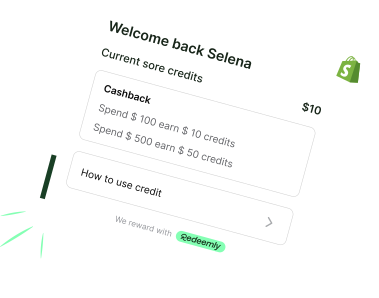


Join 7000+ brands using our apps