Shopify Referral Program App Guide to Boost LTV With Store Credit
Feb 3, 2026
|
Published
Let’s be real for a moment: most referral programs just don't work. They're built on a shaky foundation of discount codes that do more harm than good. You end up attracting one-time bargain hunters, slicing into your margins, and making your brand feel cheap. This transactional approach trains customers to wait for a sale instead of buying because they love your products, directly hurting your average order value and lifetime value.
It’s a vicious cycle that slowly erodes your bottom line and prevents sustainable, profitable growth.
Rethinking Referrals Beyond Discounts

The classic "give a discount, get a referral" playbook sounds simple enough. The problem? You attract customers who are loyal to the deal, not to your brand. It’s like trying to fill a leaky bucket—you’re constantly spending to acquire customers who will disappear the second the sale is over, crushing any chance of a high lifetime value (LTV).
And all that discounting takes a big bite out of your profits. Sure, a 20% off coupon might close a sale, but it also lowers the perceived value of your products. Before you know it, you've conditioned shoppers to never pay full price. That's a dangerous road that leads straight to a lower average order value (AOV) and a diluted brand identity.
The Problem with Points and Coupons
Feeling the pain of discounts, many brands pivot to complicated points systems. But these often just trade one problem for another, creating more confusion than excitement. Customers are left scratching their heads, wondering, "What are 500 points actually worth?" More often than not, they forget about them entirely, and the points expire. It's a frustrating experience that does little to build real loyalty or drive repeat purchases.
This old-school thinking is all about the short-term transaction, not the long-term relationship. It's helpful to understand the broader landscape of referral partner programs to see how a truly modern system fosters genuine partnerships with your customers, not just one-off sales.
The real goal isn't just to get one more sale. It's to acquire a new, high-quality customer who will stick around. The right Shopify referral program app completely shifts the focus from chasing single transactions to building lasting customer lifetime value (LTV).
The fundamental flaw of discount-based referrals is that they reward deal-seeking behavior. You end up paying to acquire customers who are programmed to cost you money on every future purchase, which is a losing game for sustainable growth.
A Modern Strategy for Profitability
So, what's the alternative? Instead of coupons and confusing points, the modern approach uses native Shopify store credit. This one simple change has a massive impact on your business. Store credit feels like cash in your customer’s digital wallet, giving them a powerful, tangible reason to come back and shop again, directly boosting LTV.
This strategy plugs all the holes left by traditional programs:
Protects Margins: Customers spend their credit on future purchases, which are often full-priced items.
Increases AOV: Shoppers are naturally encouraged to add more to their cart to "use up" their credit balance.
Boosts LTV: Getting that second purchase is critical. Store credit is one of the most effective ways to make it happen, dramatically increasing a customer's lifetime value.
This isn't just a different reward; it's a completely different growth philosophy. You stop bribing new people with discounts and start rewarding your best customers with a real asset they can use to deepen their relationship with your brand.
Designing Your Store Credit Referral Program
Let's get into the heart of it: building a referral program that actually works. A successful program all comes down to a smart reward structure. This isn't just about giving stuff away; it's about creating an irresistible system that turns your happy customers into your most powerful marketing channel for acquiring high-LTV customers.
The psychology behind your offer is everything. You have to craft a reward that feels genuinely valuable—enough to make someone stop scrolling and share—without eating into your profit margins. This is where store credit shines, especially when you ditch those vague percentage-based discounts for a solid dollar amount.
Why A Fixed Dollar Credit Wins
Think about the difference between offering "15% off" versus "$15 in store credit." On the surface, they might look similar, but how your customers perceive them is night and day.
A 15% discount often encourages smaller, one-off purchases. It subtly devalues your product. But a $15 store credit? That feels like cash in hand. It’s a tangible asset sitting in their account, motivating them to come back and spend more to use it all. This directly bumps up your average order value (AOV). Suddenly, the credit isn't just a way to save a few bucks; it's a reason to shop.
Key Takeaway: Store credit transforms a fleeting discount into a tangible asset. This mental shift encourages customers to return and spend more, laying the groundwork for a much healthier customer lifetime value.
From my experience, the best strategy is a two-sided reward. Both the person sharing (your advocate) and their friend (the new customer) need to feel like they're getting a great deal. This sense of reciprocity makes your advocate feel generous, not salesy, and gives the new customer a compelling reason to give your brand a shot.
Structuring Your Offer for Maximum Impact
Simplicity is your secret weapon. A confusing offer creates friction and kills momentum. A clean, straightforward one inspires immediate action. The best Shopify referral program apps are the ones that let you set up these kinds of compelling, easy-to-understand rewards.
Here’s a proven framework that you can put into action today:
For the Advocate (Your Current Customer): Give them store credit after their friend completes a purchase. A great starting point is $20 in store credit for every successful referral. This means you only reward actual conversions, which is fantastic for your cash flow.
For the Friend (The New Customer): Offer an upfront store credit to sweeten their first order. Something like $10 off their first purchase of $50 or more works wonders. It lowers the barrier to entry for a new buyer, while the minimum spend protects your AOV.
This dual-credit system is a powerhouse. We already know that referral programs are retention machines—returning customers drive nearly 41% of total sales for established stores. But when you layer on store credit incentives, you can see repeat purchase rates climb by an additional 20-30%.
And it gets better. When you customize your referral program with on-brand messaging, it can achieve a 35% higher conversion rate than a generic, out-of-the-box solution. This proves that a well-designed offer doesn't just bring in new shoppers; it builds loyalty and higher LTV from the very first interaction. If you want to dive deeper, you can explore more Shopify statistics to see the full picture.
To really drive home the difference, let's compare the business impact of a traditional discount system versus a native store credit program.
Discount Codes vs. Store Credit Referral Rewards
This table breaks down how each reward type affects key business metrics, from customer loyalty to your bottom line.
Metric | Discount-Based Program | Store Credit Program |
|---|---|---|
Customer LTV | Lower; encourages one-time, deal-seeking behavior. | Higher; promotes repeat purchases and brand loyalty. |
Profit Margins | Often eroded by deep, site-wide discounts. | Protected; credit is spent back into the business. |
Average Order Value | Can decrease as customers only buy what's necessary. | Increases as customers "spend up" to use their full credit. |
Customer Experience | Can feel transactional and impersonal. | Feels like a valued member benefit or VIP perk. |
Operational Lift | High; managing unique codes and expiration dates is complex. | Low; credit is automated and managed within the customer's account. |
Brand Perception | Can devalue the brand, making it seem "always on sale." | Strengthens brand value by rewarding loyalty, not just discounting. |
As you can see, shifting from discounts to store credit isn't just a small tweak—it's a strategic move. It reframes your entire referral program from a simple sales tactic into a powerful, long-term loyalty and retention engine designed to maximize LTV and AOV.
Choosing and Implementing a Native Shopify App
Even the most generous referral program will fall flat if your customers can't find it or don't know it exists. The secret to a program that actually drives sales is a completely frictionless experience, and that's only possible with a native Shopify referral program app that feels like a natural part of your store.
Forget about clunky pop-ups or sending customers to a confusing external dashboard. The goal is to weave the referral experience directly into your customer's journey.
The right app does this by using on-site widgets and floating wallets that subtly display a customer's available store credit. This constant, gentle reminder of their "cash on hand" keeps your brand top of mind, encouraging them to share and, more importantly, to come back and spend, which is the foundation of high lifetime value.
Placing Prompts at High-Impact Moments
Visibility is everything. To get people to actually use your referral program, you need to ask them to share when they’re happiest with your brand. A native app gives you the power to strategically place these prompts at the moments that matter most.
Think about these high-impact opportunities:
The Post-Purchase Page: Right after a customer clicks "buy," their satisfaction is peaking. A prompt here is perfectly timed to turn that excitement into a referral.
Order Confirmation Emails: These emails have some of the highest open rates of anything you'll send. Adding a referral link transforms a simple transactional message into a growth engine.
Customer Account Pages: When customers log in to check an order's status, they're already engaged. Showing their share link and credit balance right there is a no-brainer.
This approach makes sharing feel like a natural next step, not an annoying chore. While Shopify doesn't have a built-in referral feature out of the box, merchants who use dedicated apps see incredible results. Some report sales boosts of up to 30%, and referral marketing often drives 4x higher conversion rates than traditional ads because it’s built on real trust. If you want to see the data for yourself, you can explore how top Shopify stores leverage referral marketing.
The goal isn't to interrupt the customer, but to integrate into their journey. A well-placed prompt on the 'thank you' page feels like a helpful suggestion, while a random popup feels like an annoying ad.
Ensuring a Seamless Checkout Experience
Now for the final, critical piece of the puzzle: redemption. This is where so many referral programs stumble, creating friction with confusing discount codes or complicated points conversions. But with a native Shopify app built around store credit, the experience is beautifully simple.
When a new customer who was referred gets to your checkout, the app should automatically recognize their credit and give them a simple, one-click button to apply it. No hunting for codes. No remembering balances.
This effortless process dramatically reduces cart abandonment and gives your conversion rates a healthy lift. It shows both the new customer and the original advocate how much you value them, directly fueling a higher lifetime value for everyone involved. For a deeper dive into different loyalty approaches, check out our guide on comparing Shopify loyalty solutions.
How to Migrate from Points to a Store Credit System
Thinking about ditching that clunky, confusing points program? Good. Moving to a store credit system is one of the smartest upgrades you can make for your Shopify store. You're swapping out abstract "points" for something that feels like real cash in your customers' pockets, a move that directly boosts lifetime value (LTV).
The secret to pulling this off without a hitch is all in the communication. You have to frame this as what it is: a major upgrade for your customers, not a downgrade. Get them excited about it. Let them know you're making their rewards simpler, more transparent, and way more valuable. No more weird math, just real credit they can spend on whatever they want.
Communicating the Transition to Customers
Your announcement email is where you make your first impression. A subject line like "An Exciting Upgrade to Your Rewards Is Here!" sets the right tone. Get straight to the point and sell the benefits: no more confusing conversions or hidden rules, just straightforward credit that shows up in their account.
When it comes to converting their existing points, don't be stingy. Generosity goes a long way here. Let’s say 100 points used to be worth $1. If a customer has 850 points, don’t just convert it to $8.50. Round it up and give them a $10 store credit. This small gesture prevents any feeling of being short-changed and shows you genuinely value their loyalty.
This flowchart maps out exactly how a native store credit referral program works from start to finish.
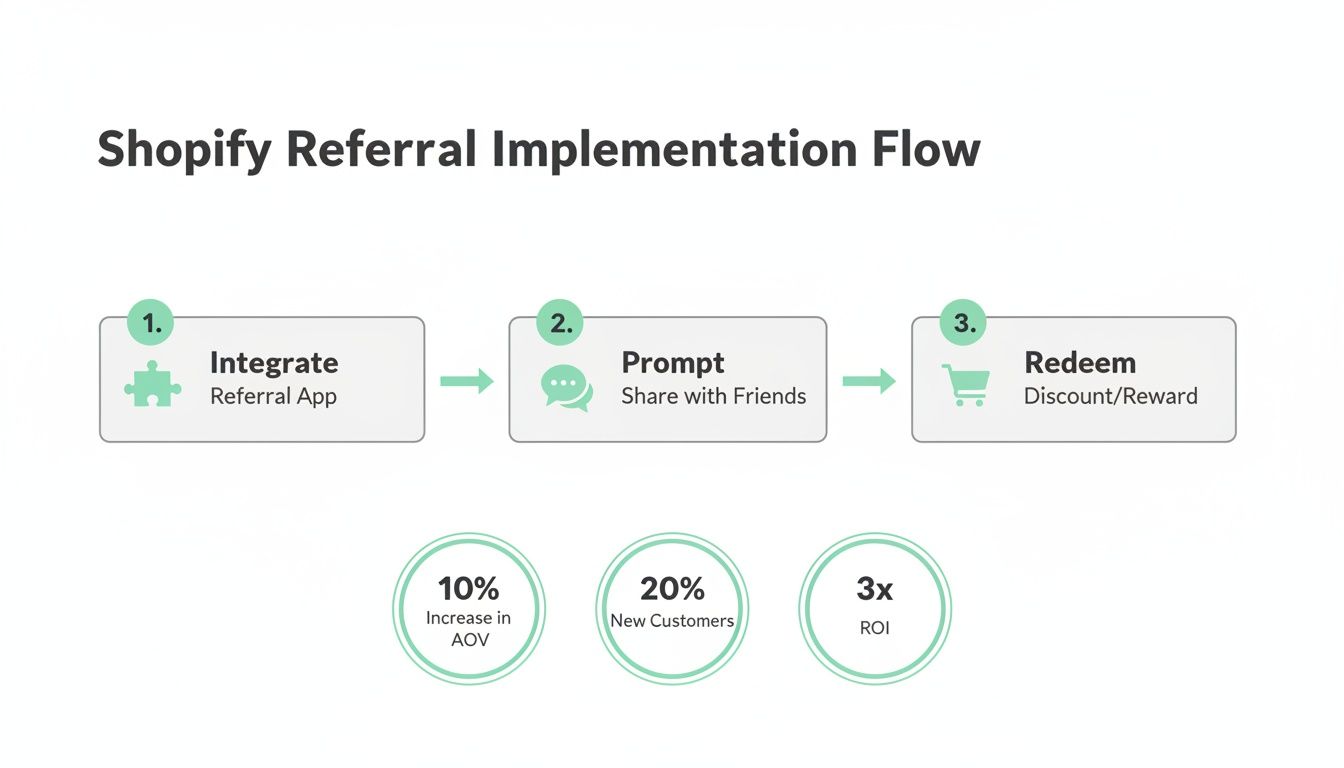
As you can see, a seamless integration leads right into customer prompts and super-easy redemption at checkout. This smooth process is what drives key metrics like LTV and AOV.
Pro Tip: Don't leave things open-ended. Set a firm deadline for the old points system—give everyone 30-45 days' notice to use their points. Once that date passes, automatically convert any leftover balances to the new store credit. It’s clean, simple, and fair.
This approach ensures everyone feels taken care of and gets your customers genuinely excited about a rewards system that actually feels rewarding. It’s a powerful way to reinforce their relationship with your brand and encourage that next purchase. Managing this change thoughtfully is a great foundation as you explore more advanced strategies, like building effective loyalty program tiers to keep your top customers engaged for the long haul.
Measuring the True Impact on Your Bottom Line
It’s time to stop chasing vanity metrics. Clicks, impressions, and share counts might look good on a report, but they don't tell you if your referral program is actually making you money. To see the real success of your Shopify referral program, you have to focus on metrics that directly impact growth, like average order value and customer lifetime value.
When you switch to a store credit system, you’re fundamentally changing what you measure. You're no longer just counting shares; you're tracking how those shares turn into loyal, repeat customers who spend more over time. This isn't about creating a temporary sales spike—it's about building a sustainable growth engine.
And the beauty of store credit? It’s fantastic for cash flow. A reward only becomes a "cost" when a happy customer comes back to your store to buy something else. It's a simple, elegant model that perfectly aligns your marketing spend with customer retention and a higher lifetime value.
Key Metrics That Actually Matter
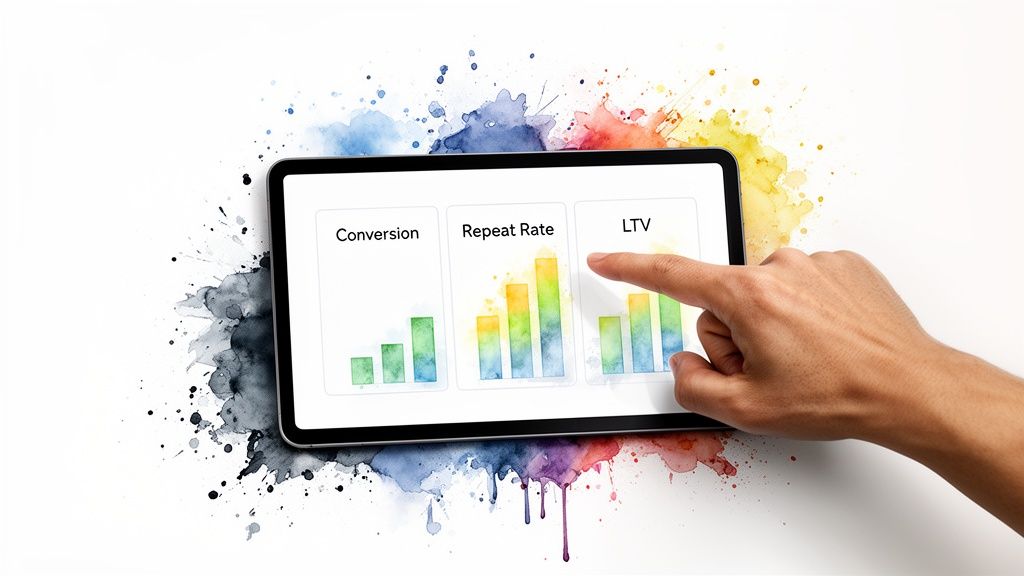
Forget complicated spreadsheets. To get a clear picture of how your program is performing, all you need is a simple dashboard tracking a handful of core metrics. These are the KPIs that show the direct impact on your average order value (AOV) and, most importantly, your customer lifetime value (LTV).
Here's what your essential dashboard should be tracking:
Referred Customer Conversion Rate: Out of everyone who clicks a referral link, how many actually buy something? This is your acid test for how compelling the offer is to a brand-new audience.
Repeat Purchase Frequency: This one is huge. How often are these new, referred customers coming back to shop again compared to your average customer? This is where you see the LTV magic happen.
Average Order Value (AOV) of Referred Customers: When referred customers use their store credit, are they spending more than a typical shopper? A higher AOV here means the credit is doing its job of encouraging a bigger cart.
Customer Acquisition Cost (CAC): Simply divide the total store credit redeemed by the number of new customers you gained. This gives you the true, hard cost for acquiring a customer through your referral channel.
Assessing the long-term win from your store credit program really comes down to LTV. If you need a solid framework, external resources can offer a detailed customer lifetime value calculation to get you started.
Understanding Your Program's Profitability
Let's be honest, the cost-effectiveness of word-of-mouth is just undeniable. A well-run referral program on Shopify can turn trusted recommendations into sales at 3-4 times the rate of standard advertising. That’s massive.
When you combine that efficiency with a predictable reward, like a flat $15 store credit, your budgeting and forecasting become so much easier. We've seen that active promotion can boost participation by 3x or more, especially since 68% of Shopify traffic is mobile—perfect for quick social sharing.
The real "aha!" moment comes when you compare the LTV of a referred customer to one you got from paid ads. When you see with your own eyes that referred customers are more valuable over their lifetime, you’ll have all the proof you need that this program is a profit center, not a cost center.
Ultimately, tracking these specific KPIs gives you the data you need to make smart decisions. You can tweak credit amounts, play with your promotional messaging, and double down on what’s working, all with the confidence that you’re driving real, sustainable growth for your brand. This kind of analysis is what separates good programs from great ones. For a deeper dive, you can learn more about how to https://www.redeemly.ai/blogposts/how-to-calculate-customer-ltv in our detailed guide.
Your Questions About Store Credit Referral Programs, Answered
Making the leap to a store credit system is a fantastic move, but it’s completely normal to have a few questions before you get started. I’ve seen countless merchants wonder about the nitty-gritty details of setting it up, whether their customers will "get it," and what it really does for the bottom line.
Let's walk through the most common questions I hear and give you the straight answers you need to feel confident about this switch.
Isn't a Points System Basically the Same Thing?
Not even close. The real magic of store credit is its simplicity. $10 in store credit is just that—$10. It feels like cash in hand. On the other hand, "500 points" feels like a game with confusing rules. Customers have to do mental math to figure out what it's worth, and that friction is often enough to make them not even bother.
From a purely technical standpoint, using a native Shopify referral program app that taps directly into Shopify's own store credit function is a game-changer. It's faster, far more reliable, and integrates seamlessly into the checkout process. No more clunky third-party syncing or frustrating glitches for your customers. Store credit is designed to drive that next purchase, while points often just sit there, collecting digital dust.
Will My Customers Actually Understand How to Use It?
Absolutely. Customers are already familiar with the idea of gift cards or having a balance in their account. In fact, many see it as more valuable than a flimsy one-time discount code. A well-designed app makes using it second nature.
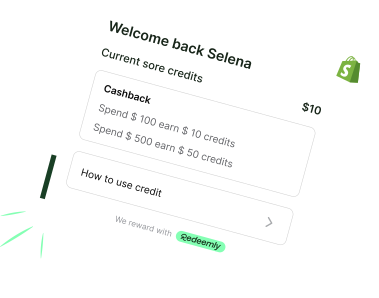
Think of it this way: modern referral apps give customers a little "floating wallet" on your site that always shows their available credit. When they hit the checkout, they can apply their balance with a single click. It’s often a whole lot easier than digging through their inbox to find and copy-paste a promo code. The easier you make it, the more they'll use it.
What's the Best Way to Kick Off My New Referral Program?
You can't just flip a switch and expect people to find it. A strong, multi-channel launch is the key to building real momentum right out of the gate.
Here are a few tactics that I’ve seen work time and time again:
A Big Email Announcement: Tell your entire list about the new program. Don't just announce it; sell them on the value of earning real store credit for sharing a brand they already love.
Hit Them at Peak Excitement: Your post-purchase page and order confirmation emails are prime real estate. Customers are at their happiest right after buying, making it the perfect time to ask for a referral.
Make it Impossible to Miss: Add a permanent link to your referral program in your site’s main navigation menu and footer. If they have to hunt for their referral link, they won't use it.
It’s worth remembering that referred customers have a 37% higher retention rate than customers from other channels. Getting the word out isn't just about getting new sales; it’s about attracting better, more loyal customers from the start.
How Can I Tell if This Is Actually Making Me Money?
Measuring the ROI of a store credit program means looking past vanity metrics like shares and clicks. You need to focus on what truly impacts profitability and customer loyalty. The entire goal is to increase lifetime value (LTV) and average order value (AOV), so those are your North Star metrics.
Keep a close eye on these key performance indicators (KPIs):
Referred Customer LTV: How does the lifetime value of a referred customer stack up against someone who came from a Facebook ad? The difference is often staggering.
Repeat Purchase Rate: Are referred customers coming back to buy again? This tells you if you're building a loyal base and increasing LTV.
Average Order Value (AOV): Do customers spend more when they’re cashing in their store credit? Often, they see it as "free money" and treat themselves to a bigger cart.
Customer Acquisition Cost (CAC): A simple one to track. Just divide the total credit you've issued by the number of new customers it brought in.
The best part? Store credit only becomes a real cost when a customer comes back to make another purchase. That means your ROI is naturally healthier compared to giving away upfront discounts that just eat into your initial profit margins.
Ready to swap out confusing points and margin-killing discounts for a referral program that actually grows your business? Redeemly makes it incredibly simple to launch a native Shopify store credit program that drives up LTV and AOV. Get started with Redeemly today and turn your best customers into your most powerful growth engine.


Join 7000+ brands using our apps