Top shopify website examples to boost retention and LTV
Dec 15, 2025
|
Published

Stuck in the endless cycle of discounts and complex points systems that erode your margins? You're not alone. Many Shopify merchants feel trapped, believing that slashing prices is the only way to drive sales and foster loyalty. This approach, however, often leads to a race to the bottom, attracting one-off bargain hunters instead of building a community of profitable, long-term customers. The real challenge isn't just making the next sale; it's engineering a customer journey that systematically increases lifetime value (LTV) and average order value (AOV) without sacrificing your brand's integrity.
This curated collection of shopify website examples is your blueprint for breaking free. We're moving beyond flashy designs to dissect the strategic architecture behind the most successful stores on the platform. While Shopify is a standout choice among the best ecommerce platforms for small business, simply having a store isn't enough. You need a strategy that turns shoppers into repeat buyers and boosts their lifetime value.
Inside, you'll find a deep dive into real-world stores that masterfully use native Shopify store credit as a powerful, margin-friendly alternative to traditional discounts. Each example includes a detailed breakdown of:
Conversion-focused design: Specific UX/UI elements that guide users to purchase.
AOV-boosting tactics: How they use incentives like store credit bonuses to encourage larger cart sizes.
Loyalty and retention loops: The exact mechanisms, such as seamless store credit programs, that keep customers coming back and spending more.
Forget generic inspiration. This is a tactical playbook filled with actionable takeaways, screenshots, and direct links to each store. Prepare to learn how to build a Shopify experience that generates both immediate profit and lasting customer loyalty. Let's get started.
1. Shopify Theme Store
Before diving into specific live stores, the single best resource for high-quality Shopify website examples is the official Shopify Theme Store itself. It's not just a marketplace; it's a curated gallery of what’s possible on the platform, acting as a foundational starting point for any brand serious about its design, user experience, and conversion potential. Think of it as a strategic blueprint library, where every theme is a pre-vetted framework for success.
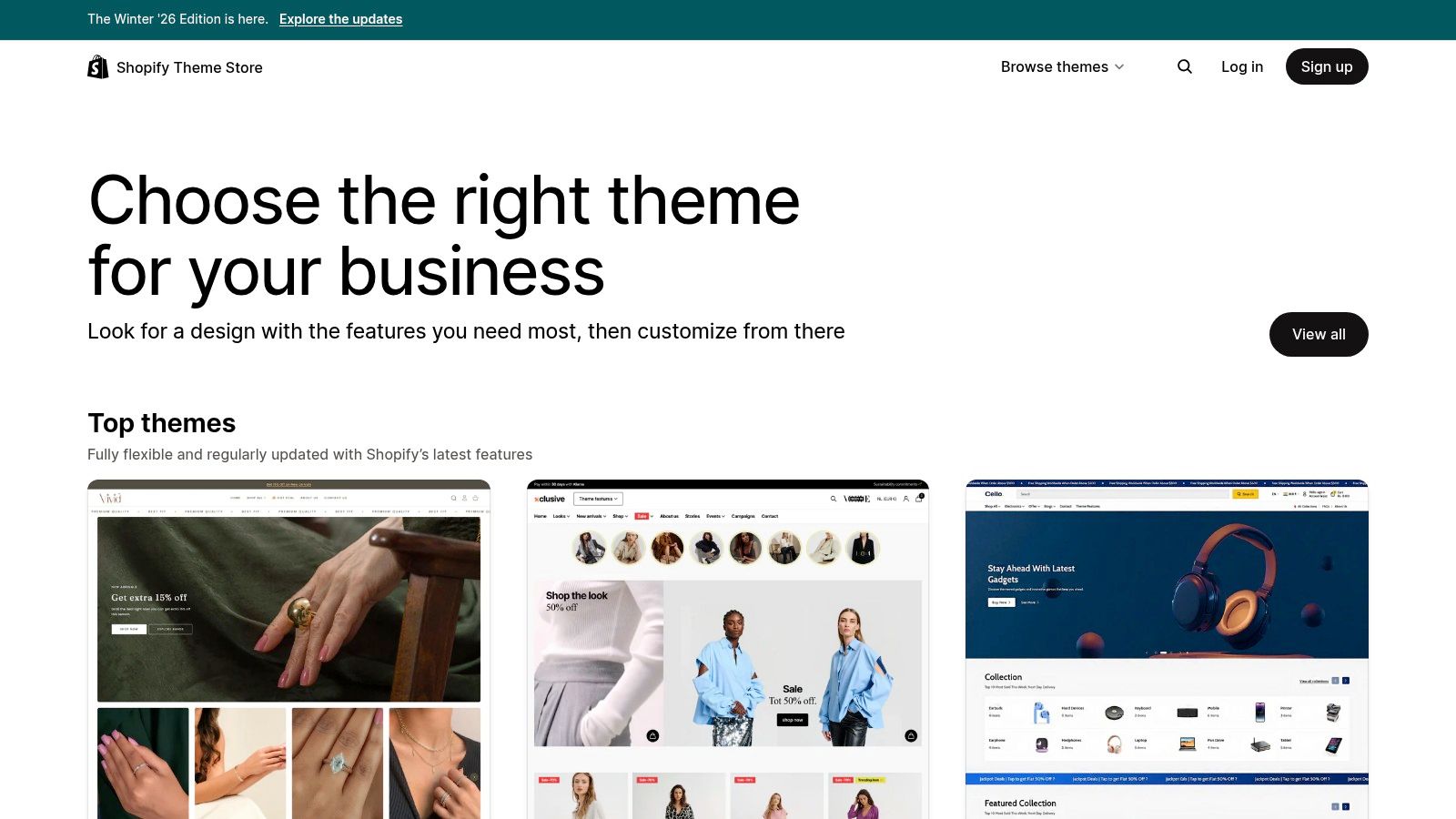
Unlike third-party marketplaces, every theme here is guaranteed to be compatible with Shopify’s latest features, including Online Store 2.0 architecture. This ensures you can leverage powerful section-based editing, metaobjects, and app integrations without worrying about code conflicts or performance issues. The themes are built to a high standard, focusing on speed, accessibility, and mobile-first design principles.
Strategic Breakdown & Key Features
The Shopify Theme Store's power lies in its interactive demo stores. Each theme listing includes a fully functional demo, allowing you to experience the customer journey firsthand. You can test navigation, product filtering, cart functionality, and checkout flows. This is crucial for evaluating how a theme supports strategies aimed at increasing lifetime value (LTV) and average order value (AOV).
Strategic Insight: Use the theme demos as an interactive checklist. Ask yourself: "Does this layout make it easy to showcase bundled products or upsells?" or "Is the customer account page structured to prominently display a store credit balance?" This proactive analysis ensures your chosen theme supports your high-LTV goals from day one.
Key Features to Analyze in Demos:
Product Page Layouts: Look for themes with flexible sections for cross-sells, "complete the look" suggestions, and space to promote loyalty benefits like earning store credit on purchases.
Cart & Checkout Experience: Analyze the mini-cart or cart drawer. Is there a clear spot for a progress bar (e.g., "You're $10 away from a $5 store credit bonus") or an upsell offer?
Customer Account Pages: A well-designed customer account page is critical. Evaluate if it has a clean, customizable area to display a native store credit balance, turning it into a retention hub.
Actionable Takeaways for Merchants
The most significant advantage is the "Try theme" feature. You can install any paid theme on your store for free to customize it with your own branding, products, and apps. You only pay if you decide to publish it, eliminating the financial risk of choosing the wrong design.
How to Leverage the Theme Store Effectively:
Filter by Your Needs: Don't just browse. Use the filters for industry, catalog size, and specific features like "Quick buy" or "In-store pickups."
Test for Retention-Friendliness: During your free trial, install your key retention apps (like a store credit or loyalty program). See how seamlessly they integrate. Does the theme have intuitive sections on the customer account page to display a store credit balance?
Prioritize Support and Updates: Official themes come with developer support and regular updates. This is non-negotiable for long-term store health and security, ensuring your site always works with new Shopify features.
Website: themes.shopify.com
2. ThemeForest (Envato) – Shopify Themes
For brands seeking a vast landscape of design possibilities beyond the official Shopify ecosystem, ThemeForest stands out as a massive third-party marketplace. It offers an enormous variety of Shopify website examples through thousands of theme demos, often at more aggressive price points. While the official store is a curated gallery, ThemeForest is a sprawling international bazaar, showcasing a diverse range of aesthetics from countless independent authors.
This marketplace is a powerful tool for discovery, especially for merchants looking for niche designs or feature-rich themes at a budget-friendly price. The sheer volume means you can find templates tailored to nearly any industry. However, unlike the official store, themes are not vetted by Shopify, meaning code quality, performance, and support standards can vary significantly between authors. Diligence is key when exploring this platform.
Strategic Breakdown & Key Features
ThemeForest's primary strength is its extensive filtering and live preview system, allowing you to quickly sort through thousands of options. Each theme includes a live demo, screenshots, and often a detailed changelog and customer reviews. This setup is excellent for brainstorming and seeing how different layouts handle complex product catalogs or specific marketing messages.
Strategic Insight: Leverage ThemeForest demos to evaluate how third-party designs accommodate AOV and LTV-boosting strategies. Pay close attention to the customer account page structure. A well-designed theme will have clear, customizable sections where a native store credit balance or loyalty status can be prominently displayed, turning a functional page into a powerful retention tool.
Key Features to Analyze in Demos:
Header & Announcement Bars: Look for themes with flexible, multi-line announcement bars. These are prime real estate for promoting "spend $X more to earn a $Y store credit bonus" campaigns that directly drive up average order value.
Customer Account Pages: Assess the layout of the account dashboard. Is there a natural, visually appealing place to showcase a store credit balance? A clunky design can hide this key incentive, reducing its effectiveness and lowering LTV.
Mega Menus & Navigation: Complex menus can be used to feature "bestsellers" or "shop by benefit" categories, guiding customers toward higher-margin products and increasing the chance of a larger cart size.
Actionable Takeaways for Merchants
The biggest advantage of ThemeForest is the competitive pricing and variety, but this comes with the responsibility of due diligence. Before purchasing, thoroughly vet the theme author, read recent reviews, and check the support policy and update frequency.
How to Leverage ThemeForest Effectively:
Prioritize Top Authors & Reviews: Don't just sort by "newest" or "price." Filter by "bestsellers" and look for authors with a high number of sales and positive ratings. These are often the most reliable and well-supported themes.
Test the Demo for Retention Clues: During your demo review, imagine where your store credit display would live. Can you easily add a section to the product page that shows "Earn $5 in store credit with this purchase"? If the layout is too rigid, it may hinder your LTV-focused efforts.
Check for Online Store 2.0 Compatibility: Ensure any theme you consider is compatible with Shopify's Online Store 2.0 architecture. This is non-negotiable for future-proofing your site and using modern, flexible section-based editing.
Website: themeforest.net/category/ecommerce/shopify
3. TemplateMonster – Shopify Themes
As a long-standing digital marketplace, TemplateMonster offers a vast and diverse catalog of Shopify website examples through its extensive theme collection. It operates as a broad, multi-vendor platform, providing merchants with an alternative to Shopify's official store, often at more competitive price points. This makes it an excellent resource for brainstorming design ideas across countless industries, from fashion to electronics.
While the official Theme Store guarantees a certain baseline of quality and compatibility, TemplateMonster provides sheer volume and variety. You can find highly niche designs and unique layouts that might not be available elsewhere. This is the place to look for inspiration if you want your store to break away from more common Shopify aesthetics, but it requires a more discerning eye to vet individual theme developers.
Strategic Breakdown & Key Features
TemplateMonster's value lies in its powerful filtering and the visibility of vendor-specific details. Each theme listing includes a live demo, comprehensive feature lists, user reviews, and developer ratings. This transparency allows you to assess not just the design but also the reputation and support quality of the creator behind the theme before you commit.
Strategic Insight: Leverage TemplateMonster's demos to identify layouts that prioritize AOV-boosting features natively. Look for themes with prominent announcement bars, built-in product bundling sections, and flexible homepages that can showcase store credit promotions or "spend more, earn more" tier-based incentives without needing custom code.
Key Features to Analyze in Demos:
Mega Menus & Navigation: A well-designed mega menu can dramatically improve product discovery. Analyze how different themes handle complex navigation, making it easier for customers to find what they want and add more to their cart.
Customer Account Integration: How does the theme present the customer account area? A generic layout is a missed opportunity. A great theme provides space to highlight a store credit balance, turning a utility page into a reason for a customer's next purchase.
Vendor Ratings & Sales Data: Pay close attention to the number of sales and the average rating for a theme. A theme with hundreds of sales and a high rating is a strong signal of quality, reliability, and good developer support.
Actionable Takeaways for Merchants
TemplateMonster is a treasure trove for merchants on a budget or those looking for a very specific design that isn't available on the official store. The key is to approach it with a clear evaluation process to mitigate the risk of variable quality. Many vendors also offer paid installation and customization services, which can be a cost-effective way to get your store launched quickly.
How to Leverage TemplateMonster Effectively:
Filter Aggressively: Use the extensive filters to narrow down options by features (e.g., "Mega Menu," "Lazy Load Effect"), industry, and compatibility with Shopify 2.0. This quickly weeds out outdated or irrelevant themes.
Vet the Vendor: Before purchasing, click through to the vendor’s profile. Check their overall rating, read reviews on their other products, and see how long they've been on the platform. A reputable developer is crucial for long-term support.
Test for Incentive-Friendliness: When viewing a demo, imagine where you would place calls-to-action for your store credit program. Does the product page have a clean space to mention "Earn $5 in credit with this purchase"? Is the header clear enough for a store credit balance display?
Website: www.templatemonster.com/shopify-themes/
4. Creative Market – Shopify Themes
For brands prioritizing a unique, design-forward aesthetic, Creative Market offers a compelling alternative to mainstream theme stores. It's a marketplace populated by independent creators, making it a goldmine for finding Shopify website examples with a distinct, boutique feel. This platform is less about a one-size-fits-all solution and more about sourcing a theme that serves as the centerpiece of a cohesive, visually-driven brand identity.
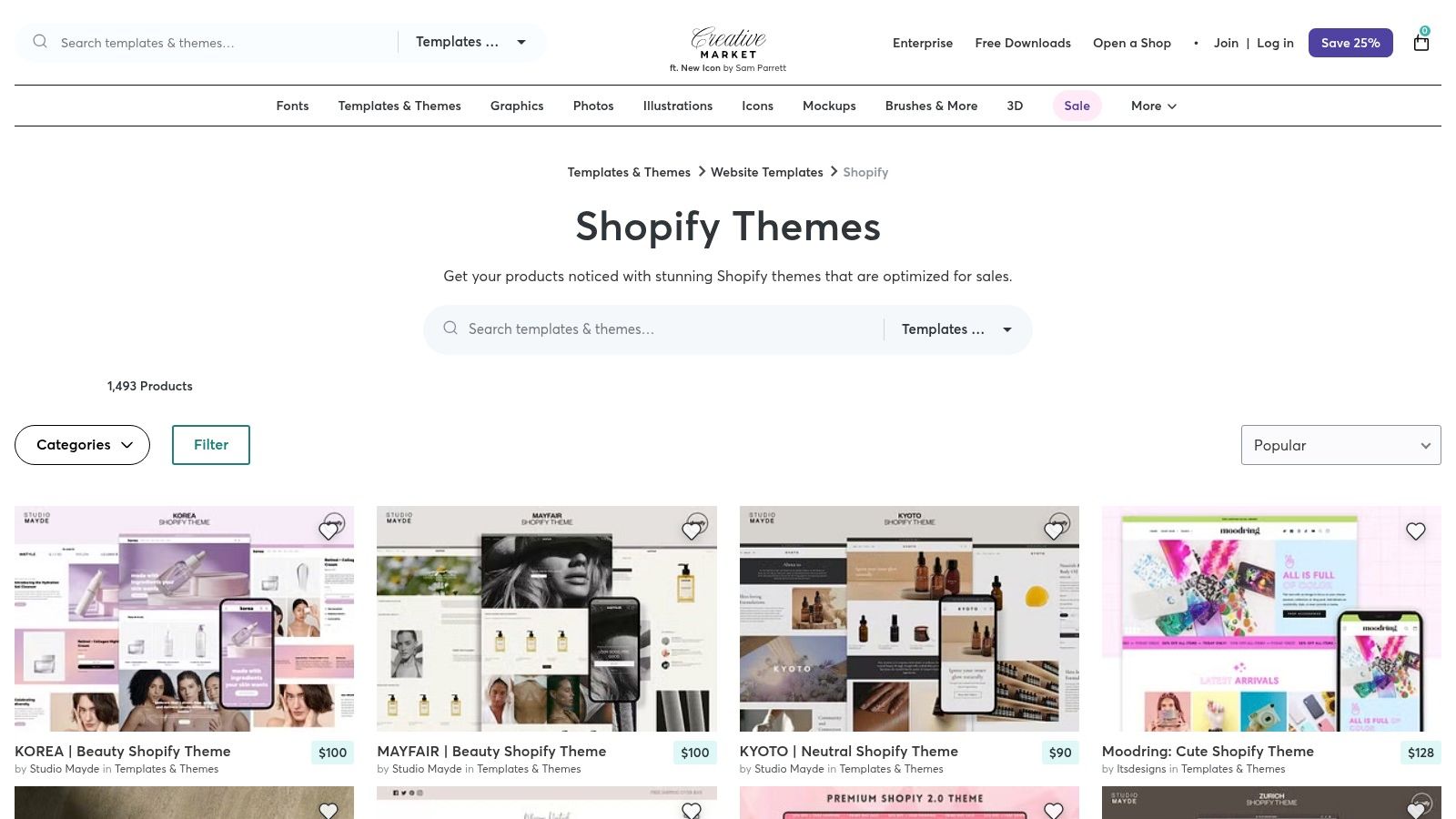
What sets Creative Market apart is its ecosystem. You aren't just buying a theme; you're often buying into a specific designer's aesthetic. This allows you to purchase complementary assets like custom fonts, graphics, and social media templates directly from the same creator, ensuring unparalleled brand consistency. While the selection is smaller than larger marketplaces, the quality and originality are often higher, catering to merchants who want their store to stand out visually.
Strategic Breakdown & Key Features
Creative Market functions as a curated gallery where each theme reflects an independent designer's vision. This is particularly valuable for niche brands that need to make a strong first impression. The themes here often feature more adventurous layouts, unique typographic choices, and artistic flourishes that you won't find in standard templates. This visual storytelling can be a powerful tool for building brand equity and increasing customer lifetime value.
Strategic Insight: Use Creative Market to find a theme that aligns with your brand's core story. A unique design can implicitly communicate quality and exclusivity, justifying premium pricing and encouraging customers to invest in your brand, not just a product. Think about how the theme's design can host strategic elements, such as a prominent display for store credit balances or unique call-to-action styles for post-purchase offers.
Key Features to Analyze in Demos:
Aesthetic & Brand Cohesion: Look beyond functionality to see how the theme's design language supports your brand. Can you easily source matching fonts, icons, and patterns from the same creator on the marketplace?
Creator Support & Updates: Unlike the official Shopify store, support and updates are handled by the individual designer. Check their profile for reviews, update history, and support policies before purchasing.
Customization for LTV: Indie themes can sometimes be more opinionated in their design. Evaluate the demo to see how flexible the sections and settings are. Can you easily integrate a "You have $X in store credit" banner in the header without breaking the aesthetic?
Actionable Takeaways for Merchants
The primary advantage of Creative Market is the ability to build a comprehensive brand kit from a single, trusted source. Themes are purchased with a one-time license, which is often more straightforward than subscription models.
How to Leverage Creative Market Effectively:
Vet the Creator: Don't just look at the theme demo. Examine the creator's entire storefront, read reviews for their other products, and check how recently the theme was updated.
Bundle Your Brand Assets: When you find a theme you love, see if the creator also sells fonts, social media templates, or graphic packs. Purchasing a bundle can save time and ensure a professional, cohesive look across all customer touchpoints.
Plan for Technical Vetting: Since these are third-party themes, test them thoroughly in a development environment. Install your essential apps for loyalty, store credit, and upsells to confirm compatibility and ensure the theme's code doesn't create conflicts.
Website: creativemarket.com/themes/shopify
5. Shopify Blog – 50 Best Shopify Stores to Inspire Your Own (2025)
Moving from theoretical frameworks to real-world application, the official Shopify Blog offers one of the best-curated galleries of live Shopify website examples. This list is not about theme demos; it's a handpicked collection of 50+ successful, high-performing stores across diverse industries. It serves as an invaluable lookbook for benchmarking everything from branding and user experience to merchandising and conversion strategies. Think of it as a masterclass in modern e-commerce execution, updated annually to reflect current trends.

Unlike a theme store that showcases potential, this resource reveals proven success. Each example is a live business effectively using the Shopify platform to drive sales and build a loyal customer base. You get to see how top brands structure their navigation, present their products, and, crucially, how they implement retention strategies to boost LTV. It’s the perfect free tool for gathering inspiration before you commit to a design or marketing strategy.
Strategic Breakdown & Key Features
The power of this list lies in its ability to provide tangible, real-world answers to strategic questions. By studying these top-tier stores, you can deconstruct how they drive key metrics like average order value (AOV) and customer lifetime value (LTV). You can observe how they merchandise collections, bundle products, and subtly guide customers toward higher-value purchases without relying on aggressive discounting.
Strategic Insight: Use this list as a competitive analysis tool. Visit a store in your niche and analyze their customer account page or loyalty section. Are they using a confusing points system, or have they simplified the experience with a native-feel store credit balance? This helps you understand customer expectations for retention incentives in your specific market.
Key Features to Analyze in Live Stores:
Merchandising & Upsells: How are stores presenting "Shop the Look" sections, product bundles, or post-purchase offers? Look for patterns that encourage customers to add more to their carts.
Brand Storytelling: Analyze how compelling copy, high-quality imagery, and "About Us" pages work together to build a strong brand identity that fosters loyalty.
Retention Signals: Look for signs of loyalty programs, email/SMS signup incentives, and how they communicate value beyond the initial purchase. Do they emphasize earning Shopify store credit as a reward instead of discount codes?
Actionable Takeaways for Merchants
The most significant advantage of this resource is that it's a free, high-quality source of competitive intelligence and design inspiration. It helps you validate your ideas against what’s already working for the best in the business, saving you time and money on A/B testing fundamental layouts.
How to Leverage the Blog Post Effectively:
Focus on Your Niche: Start by studying the 3-5 stores in the list that are most similar to your own. Analyze their product page layouts, checkout flow, and post-purchase experience.
Deconstruct the Customer Journey: Place a test order (if possible) or go through the entire funnel up to the payment step. Note every pop-up, upsell, and email capture form you encounter.
Benchmark for LTV: Pay close attention to how these brands encourage repeat business. Is it through a subscription model, a loyalty program based on store credit, or exclusive content? This insight is crucial for building your own retention engine.
Website: www.shopify.com/blog/6037086-40-stunning-ecommerce-stores-built-using-shopify
6. PageFly – Landing Page Examples (plus Builder)
While a great theme provides a solid foundation, high-growth brands often need to move beyond standard templates for specific campaigns. This is where PageFly excels, offering a gallery of high-converting Shopify website examples focused on landing pages, product pages, and other crucial conversion points. It’s less about a full-site overhaul and more about a surgical approach to optimizing the pages that drive the most revenue and increase AOV.

PageFly combines a curated inspiration gallery with a powerful drag-and-drop page builder app. This unique pairing allows you to not only see what works for top brands but also immediately replicate those successful patterns within your own store. It's a practical, action-oriented resource for merchants who want to build custom experiences for new product launches, seasonal promotions, or targeted ad campaigns without needing to code.
Strategic Breakdown & Key Features
The true value of PageFly is its direct link between inspiration and execution. The example library isn't just a collection of pretty designs; it's a catalog of strategic layouts that are proven to convert. You can filter by industry (fashion, beauty, tech) and page type to find relevant patterns for your specific goals, whether it’s increasing AOV or capturing leads.
Strategic Insight: Use the PageFly examples to deconstruct high-impact product pages. Look for how top brands use sections to build a narrative, incorporating social proof, user-generated content, cross-sells, and clear calls-to-action. Analyze how they integrate store credit messaging, like "Buy now and earn $10 toward your next purchase," to build lifetime value directly into the page layout.
Key Features to Analyze in Examples:
Conversion-Focused Elements: Identify how examples use countdown timers, trust badges, and prominent testimonials to build urgency and credibility.
AOV-Boosting Layouts: Look for pages designed with sections for "Shop the Look," bundled offers, or one-click upsells that encourage a larger cart size. These are perfect opportunities to promote "spend more, earn more" store credit tiers.
Template Replicability: Assess how easily a specific layout can be adapted to your own brand using PageFly’s drag-and-drop builder and pre-built sections.
Actionable Takeaways for Merchants
PageFly’s biggest advantage is its free plan, which allows you to install the builder and start creating a limited number of pages without any financial commitment. This lets you test its capabilities and see if you can effectively replicate the design patterns you admire from the example gallery.
How to Leverage PageFly Effectively:
Start with a Goal: Don't browse aimlessly. Define your objective first, whether it's creating a presale landing page or an advertorial-style page for a specific campaign.
Deconstruct, Don't Copy: Find an example you like and identify its core strategic components. Instead of a direct copy, adapt the layout and flow to fit your brand's unique value proposition and offers.
Optimize for Retention: When building your page, strategically place elements that encourage repeat business. For instance, add a section promoting your store credit program as a key benefit, which is a powerful tactic discussed in many retention marketing strategies.
Website: pagefly.io/pages/landing-page-examples
7. StoreLeads – Shopify Store Directory and Examples Database
To move beyond curated galleries and analyze what real, successful stores are doing in your specific niche, StoreLeads is an essential competitive intelligence tool. It’s not a theme marketplace but a massive, searchable database of live Shopify stores. This platform allows you to reverse-engineer the competition’s tech stack, design choices, and, most importantly, their retention strategies, making it a goldmine for finding highly relevant Shopify website examples.
Unlike simply browsing the web, StoreLeads gives you granular filtering capabilities. You can search for stores by category, country, estimated sales volume, and the specific apps they have installed. This allows you to find direct competitors and analyze how they are tackling challenges like customer retention and increasing lifetime value, particularly through their choice of loyalty and store credit tools. It's a strategic tool for market research, not just design inspiration.
Strategic Breakdown & Key Features
StoreLeads’ primary value is its ability to connect technology with strategy. Instead of guessing which loyalty app a competitor uses, you can filter for stores using specific platforms and see how they integrate them into their user experience. This transforms abstract ideas about store credit programs into concrete, replicable tactics for boosting LTV and AOV.
Strategic Insight: Use StoreLeads to build a "swipe file" of retention-focused competitors. Filter for top stores in your niche that are also using store credit or loyalty apps. Analyze their customer account pages, product descriptions, and post-purchase flows to see how they communicate the value of their programs. Are they ditching points for a simpler, cash-value credit system?
Key Features to Analyze in Your Search:
App & Technology Usage: Search for stores using specific loyalty, subscription, or store credit apps. This is the fastest way to find real-world examples and see how different brands implement their LTV strategies.
Industry & Niche Filtering: Find the top-performing stores in your exact vertical. A fashion brand can learn more from another successful apparel store's store credit program than from a generic example.
Estimated Sales & Growth: Focus your analysis on stores that are at or above your target revenue level. Their strategies have been validated by the market, making them more reliable models to follow.
Actionable Takeaways for Merchants
The real power of StoreLeads is turning data into action. While full access requires a subscription, the platform provides an unparalleled view of the competitive landscape. You can identify trends, discover new apps, and validate your strategic hypotheses before investing time and money.
How to Leverage StoreLeads Effectively:
Identify Retention Leaders: Create a filtered list of stores in your industry using loyalty or store credit apps. Study how they message these programs on their homepage, product pages, and checkout to drive higher AOV.
Reverse-Engineer Tech Stacks: See which apps are most common among high-growth stores in your niche. This can help you prioritize your own app investments for things like post-purchase upsells or customer support.
Validate Your Theme Choice: Before committing to a theme, search for successful stores that are already using it. This confirms that the theme can scale and supports the features you need for long-term growth.
Website: storeleads.app
Shopify Website Examples — 7-Way Comparison
Source | Implementation complexity 🔄 | Resource requirements ⚡ | Expected outcomes 📊 | Ideal use cases 💡 | Key advantages ⭐ |
|---|---|---|---|---|---|
Shopify Theme Store | Low — one‑click installs and admin trials 🔄 | Moderate — paid themes common, vendor support included ⚡ | Production‑ready, Shopify‑compatible stores 📊 | Brands needing reliable, supported themes and quick launches 💡 | High trust & compatibility; seamless install/rollback; ⭐⭐⭐ |
ThemeForest (Envato) – Shopify Themes | Variable — depends on author and theme complexity 🔄 | Low–Moderate — budget pricing & frequent sales, support varies ⚡ | Wide range of designs; quality varies by seller 📊 | Price‑sensitive projects seeking many style options 💡 | Huge variety and aggressive pricing; ⭐⭐ |
TemplateMonster – Shopify Themes | Moderate — many options, some require polishing 🔄 | Moderate — competitive pricing; optional installation services ⚡ | Niche‑focused themes, occasional need for adjustments 📊 | Browsing industry templates and buying with install help 💡 | Good filters and installation services; ⭐⭐ |
Creative Market – Shopify Themes | Low–Moderate — design‑centric themes from indie creators 🔄 | Low — one‑time purchases; smaller selection ⚡ | Aesthetic, brand‑forward frontends; maintenance depends on creator 📊 | Boutique/brand‑first stores seeking unique visuals 💡 | Strong aesthetic variety and matching brand assets; ⭐⭐ |
Shopify Blog – 50 Best Shopify Stores (2025) | N/A — inspiration gallery, no install process 🔄 | Free — content access only ⚡ | Real-world store examples for benchmarking and UX insight 📊 | Research, merchandising, and LTV strategy inspiration 💡 | Vetted, up‑to‑date live examples; ⭐⭐⭐ |
PageFly – Landing Page Examples (plus Builder) | Moderate — requires app integration and page building 🔄 | Low — free tier available; time to build and test ⚡ | High‑converting landing/product pages; testable templates 📊 | Campaigns, product launches, and AOV optimization 💡 | Pattern‑based templates + A/B testing; ⭐⭐⭐ |
StoreLeads – Shopify Store Directory & Database | Low (searching) — higher if using exported data for research 🔄 | High — paid subscription for full access; optional enterprise fees ⚡ | Competitive intelligence and app/tech insights from live stores 📊 | Market research, competitor analysis, and app discovery 💡 | Real, segmented store data for reverse‑engineering; ⭐⭐⭐ |
Build Your Own High-LTV Store: Your Action Plan
We’ve explored a powerful collection of Shopify website examples, not just as a gallery of beautiful designs, but as a strategic playbook. You've seen how top-tier brands from diverse niches leverage intuitive navigation, compelling product storytelling, and seamless checkout flows. But the true genius lies beneath the surface, in the systems they build to turn first-time buyers into lifelong customers with high lifetime value.
The common thread weaving through the most successful stores isn't flashy design or massive ad budgets. It's a relentless focus on creating a value-driven customer journey that incentivizes repeat business without eroding profit margins. They understand that a one-off sale is a transaction, but a repeat customer is an asset whose value must be cultivated over time.
From Inspiration to Implementation: Key Takeaways
The difference between a store that simply survives and one that thrives is its ability to build an ecosystem of retention that boosts lifetime value. As we analyzed stores found through resources like the Shopify Theme Store, PageFly, and StoreLeads, several core principles emerged:
Prioritize Clarity Over Clutter: The best Shopify stores guide users effortlessly from homepage to checkout. They use clean layouts, high-quality visuals, and a logical information hierarchy to remove friction and build trust.
Emphasize Value Beyond Price: Instead of defaulting to discount codes, leading brands build perceived value through social proof, user-generated content, detailed product benefits, and mission-driven storytelling.
Integrate Margin-Friendly Incentives: The smartest brands are moving away from the "race to the bottom" discounting model. They use native Shopify store credit as a powerful, flexible tool to reward loyalty, handle returns, and encourage customers to reinvest their money back into the brand, directly boosting LTV.
This strategic shift from confusing points systems and discounts to store credit is more than a trend; it's a fundamental change in how brands cultivate loyalty. It's about giving customers a tangible reason to return, empowering them with a balance that feels like their own money, ready to be spent on their next favorite product.
Your Actionable Next Steps
Feeling inspired is great, but taking action is what builds empires. Use the insights from these Shopify website examples to create a concrete plan.
Audit Your Current Customer Journey: Where are the friction points? Is your checkout seamless? Is your returns process a headache or a loyalty-building opportunity? Identify one key area for improvement this month.
Rethink Your Incentive Strategy: Analyze your reliance on discount coupons and point systems. Are they training your customers to wait for sales? Start experimenting with store credit for returns, VIP rewards, or as a "thank you" for high-value orders. This single change can dramatically increase both AOV and repeat purchase rates.
Define and Track Your LTV: You cannot improve what you do not measure. A core component of building a 'High-LTV Store' is thoroughly understanding how to measure customer lifetime value, enabling you to optimize strategies for long-term growth. To get started, you need a clear framework. For a comprehensive guide on this crucial metric, explore this resource on How to Measure Customer Lifetime Value for Growth.
By dissecting the best Shopify website examples, you've gained access to the strategies that define modern ecommerce success. The path forward is clear: build a beautiful, user-friendly storefront, but power it with a robust retention engine focused on lifetime value. The tools and tactics are at your fingertips. Now is the time to build a brand that customers don't just buy from, but belong to.
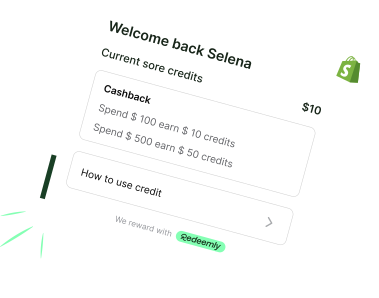
Ready to replace confusing points and margin-killing discounts with a powerful, native store credit solution? See how Redeemly helps top Shopify brands increase LTV and AOV with automated, incentive-driven store credit workflows. Transform your retention strategy today with Redeemly.


Join 7000+ brands using our apps